
“We have to walk and chew gum at the same time”:
Affordable housing expert Sadie McKeown says for multifamily buildings in New York, affordability and energy efficiency go hand-in-hand
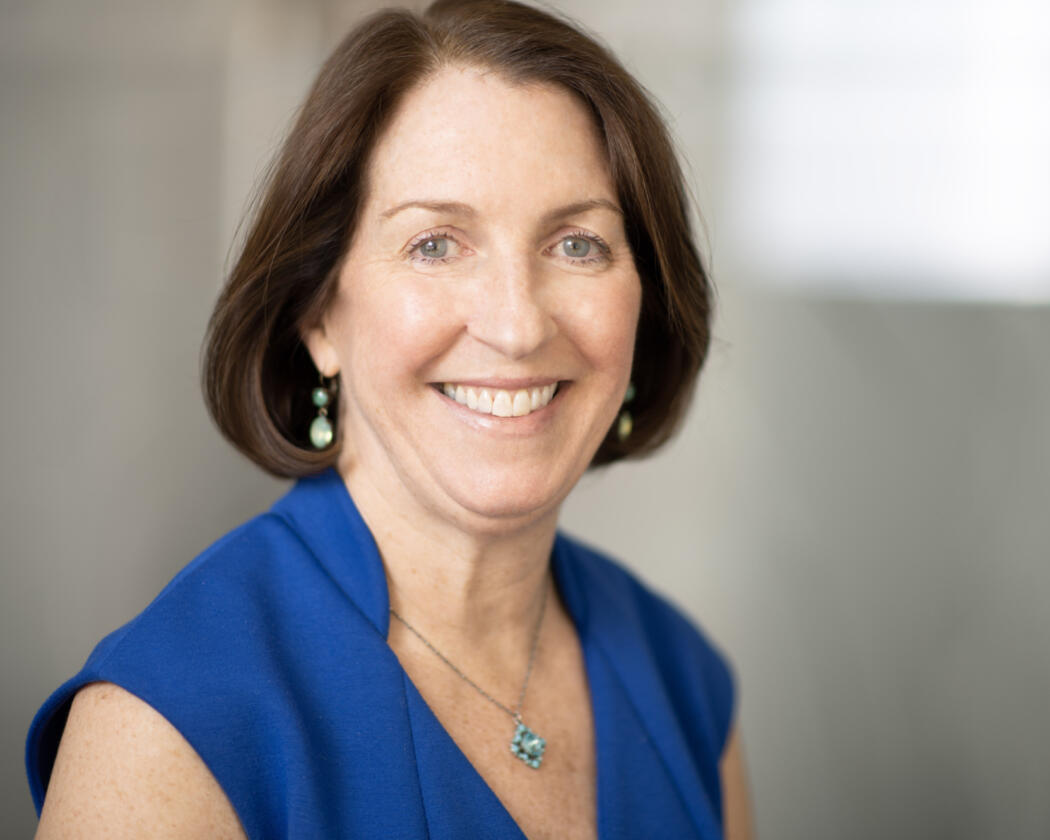
Sadie McKeown. Photo courtesy of the subject.
Despite its reputation for luxury skyscrapers and ever-rising rents, New York City also has a strong legacy of offering affordable housing. With various models from the New York City Housing Authority to Mitchell-Lama co-ops, and new affordable housing developments, generations of New Yorkers have worked to ensure that people of all income levels can make a home in the city. And now, affordable housing is undoubtedly a part of the clean energy transition of the city’s buildings.
No one knows this better than Sadie McKeown. As the Head of Innovation (and former president) of the Community Preservation Corporation (CPC), a nonprofit lender dedicated to creating affordable multifamily housing, McKeown has been a champion not only of affordability, but environmental sustainability and decarbonization, since before it was trendy.
“To me, there was just a really natural integration of the two concepts,” McKeown said. “Affordable housing is an industry that’s always been at the head of the class as it relates to sustainable buildings.”
In her more than 30 years at CPC, McKeown has been a part of driving over $2.5 billion of investment in energy-efficient, affordable and workforce multifamily housing. As of 2025, CPC has financed approximately 18,000 energy-efficient and high-performance homes.
In a wide-ranging conversation with Skylight editor Camille Squires, McKeown lays out her philosophy that affordability and sustainability not only can, but must, go hand in hand. The work involves actors at every level, from the federal government all the way down to individuals. And despite any changing political winds, McKeown says, the energy transition is still possible.
“I am incredibly optimistic,” she said. “There’s so much promise, and I believe that the pendulum will swing back.”
This interview has been edited and condensed for clarity.
Camille Squires: Tell me a bit about your background at CPC and affordable housing development. How did you get into this work and what led you to your current role in leadership?
Sadie McKeown: I started at The Community Preservation Corporation (CPC) as an intern back in 1991. But I grew up in a small white suburb in New Jersey and ended up going to Fordham in the Bronx for undergrad in 1982.
Part of what I learned outside the classroom at Fordham was what another part of the rest of the world looked like. It’s an exciting and vibrant place, and it was completely different from where I grew up but I also saw a lot of poverty and a lot of need. After graduation, I started volunteering in a homeless shelter in a church basement in the West Village. I’d sleep overnight in the church, go home, go to work, and I felt like I was doing something. But at the same time, I was a businessperson, so I went back to [graduate] school [after Fordham] to explore my interest in helping people from a business perspective.
I went to Cornell, and I got my degree in human service administration and [in] my first summer, I interned at HUD [U.S. Department of Housing and Urban Development], where I did a study on organizations that were doing community development, particularly in response to the [1977 federal] Community Reinvestment Act. I had a whole list of organizations that were lenders or investment companies, and CPC was on that list. The next summer, I was going to get a PhD, and then I thought, “I’m not an academic, either. I’m a doer.” So my second summer, I got an internship at CPC, [then] I got a job at CPC right out of graduate school. I started as a loan officer, [where] I really learned the business and understood the needs in neighborhoods from a capital perspective.
I love the work because working at CPC has always been, for me, very much like a private sector job but with a focus and a mission that you wouldn’t get if you went to work at a bank.
CS: In terms of the clean energy transition as it relates to affordable housing, I imagine some may think that “clean energy changes” and “affordability” are an oxymoronic combination, given how expensive these updates can get. But is that your experience? Is it possible for people who aren’t already deeply resourced to access energy efficiency and clean energy upgrades in their homes?
SM: Affordable housing is an industry that’s always been at the head of the class as it relates to sustainable buildings. In 2008, there was the great recession. Energy costs were really high and [the recession] was putting huge pressure on affordability.
At that moment, sustainability was becoming a thing, and I have always cared about the environment, So to me, it was just really a natural integration of the two concepts. We have to walk and chew gum at the same time: We have to be able to address affordability in housing and address sustainability, decarbonization all at the same time.
One of the big challenges is: “How do we pay for this?” To me, if we had started with focusing on getting first mortgage lenders to address this problem [of environmental sustainability], we would have made a lot more progress.
If there’s asbestos, if there’s lead paint, or there’s an underground storage tank, it’s the first mortgage lender that says to the owner [during the Phase One site assessment,] “You have to remediate those things or I won’t close your loan.” I always thought of carbon as a pollutant that needed to be remediated at the time of the first mortgage. So, if the lenders had said, “And you need a plan for decarbonization” — whether that was transitioning to all-electric heating and cooling, or just making buildings much more energy efficient — we would have been much further along in the transition with respect to innovation around energy, with respect to prices coming down.
[Back then, there was a] cultural divide that really created an uphill battle for anybody interested in building decarbonization writ large. We had a lot of energy geeks that were very focused on building performance and energy efficiency who didn’t necessarily mix with the financial jocks [who had to finance the work].
There are a lot of people that would dismiss that [cultural aspect], but I’ve been trying to do this for almost 20 years now, and I can promise you, they don’t talk about energy efficiency at the [Mortgage Bankers Association,] and they don’t talk about finance at the Northeast Sustainible Energy Association and they really should just be more integrated.
CS: If those two worlds had been more integrated decades ago, where would that have left us today?
SM: When the opportunity came from [President] Biden’s administration putting billions of dollars on the table for decarbonization and transitioning to clean energy, CPC ran at that opportunity and — along with Calvert Impact and Self-Help Credit Union under the umbrella of Climate United — we won $7 billion to help really try to start this transition. (Editor’s note: The Climate United coalition was awarded money from the National Clean Investment Fund, one of three programs under the $27 billion Greenhouse Gas Reduction Fund (GGRF), a Biden administration policy.)
[A portion of] our $2.4 billion dollars was going to be used so that we could educate the first mortgage markets, create the tools necessary for them to underwrite the savings with performance data, and create other resource centers where they could go and figure out which energy consultant could help them with a decarbonization plan and identify contractors to do the work.
We were doing the work, but the money was frozen. But if we were [able to continue] the work, AI would [now] be fueling all of that work. So that we would be building all these incredibly efficient tools built on data, and we would really be accelerating. But instead, we’re in a place where we are idling. CPC is still doing the work. We’re raising capital, really trying to continue to do decarbonization in buildings and focus on high performance and resilience and health outcomes.
CS: Where do the private and nonprofit sectors come in? Are there (many) lenders out there like CPC who are looking to help people shoulder the cost of the energy transition?
SM: CPC gets [most] of its money from the private sector, and then we lend it out in the neighborhoods [that need affordable housing]. So [it’s] this sort of Robin Hood concept of: Where are the resources, and how do we bring them to the people that need them? We occupy two worlds; the world of finance and the world of social service. There aren’t that many of us that are trying to sit in between both worlds, and that was the team that I built to do the Greenhouse Gas Reduction Fund (GGRF) work.
So I’ve always been very comfortable in both worlds. For me, it’s about people. The problem that I see is that politics stopped being about all people, and it’s just become about my people. There is no such thing as my people and your people. For me, there’s only our people. And the more we lose focus on people, the less we’re ever going to be able to solve big problems.
I’ve been working a lot recently in innovation, and I went to an innovation conference, and what was fascinating about that conference was, I was now out of my echo chamber; I was in a room with the nation’s biggest home builders. All of the innovation is happening with this constituency of single-family home builders, and large companies like Zillow and Home.com, because that’s where capitalism is focused. That’s where innovation is running, because that’s where they’re going to be able to make money, so they can pay all of those venture capital people that funded them, right? So you realize, they’re really smart — they’re focusing on the problems up here [at the top of the market], but those [challenges] are similar to the problems we have down here in affordable housing. So how do I get those innovators to come down here and plug into our world? And so some of that’s around affordability and the way we build housing, but some of that is also around sustainability and energy and resilience.
CS: As someone trying to bridge both worlds, could you walk me through how you think about financing an affordable housing project? How does sustainability work into the process, and what does a successful financing project look like from your perspective?
SM: A metric we’ve used at CPC is: educate, advocate, innovate, and invest. So, from my perspective, a successful outcome is that we are educating our borrowers about different options relative to the performance of their building, design, and standards. We are advocating for better outcomes [and] for them to transition and use different systems. We are innovating in that we are creating products and tools to support that transition, and then we’re investing and we’re closing those loans. And then all of the investment work that you do, you take the data from that and you use it to further educate, advocate, innovate, and invest. That’s success.
CS: Are there good rules of thumb for your borrowers to make their buildings as efficient as possible? Is it something as straightforward as only supporting buildings where there are heat pumps, or is it maybe a little more bespoke or nuanced than that?
SM: It is a little bit more nuanced. The reality is that, today, it is so hard to develop housing — that the majority of what we do is subsidized with either [NYC Housing Preservation and Development] or [NYS Department of Homes and Community Renewal]. So our advocacy is less important because [efficiency is] a requirement [for those developments.] Affordability is our primary goal [while] our other goals are sustainability, and then closing the racial wealth gap. So, if we are doing a deal with a BIPOC developer that is thinly capitalized, and we want him to do high performance [but] the numbers just don’t work, we might subordinate some of our priorities around building performance so that he can get his first deal done. We’re subordinating it because we have other priorities as well.
Still, we’ve educated that developer. We’ve given them the tools to look at the next deal. And part of what we were building with GGRF was a whole slew of contractors that did this work, so that you weren’t beholden to the one contractor who knew how to do this. We were trying to create more of an infrastructure for people to be able to do [sustainable development] because, frankly, now it’s getting so much [more difficult] — it’s really hard to find contractors because it’s so much easier for a plumber or an electrician to build a data center.
CS: Are there ways that people can approach this on an individual level in a way that isn’t overwhelming in terms of cost and experience?
SM: You’re never going to get everybody, but the majority [will get] in agreement enough to get us to a tipping point where the market just says, “All-electric systems are so much more efficient,” and for that reason make more sense.
I think we’re learning, and the reason that we’re learning is because we’re doing the work. The only way to evolve and figure out what energy transition actually means is to do the work. CPC was awarded a $150 million grant from New York State [through the Climate Friendly Homes Fund] to electrify 6,600 apartments through heat pump installation, and we’re learning. It’s a laboratory for how to transition. I’m constantly meeting with my team and asking, “What did we learn? What are we going to do differently? How are we going to talk differently about this?” And you need to remember that you’re not just [installing] heat pumps; you’re transitioning the economy to clean energy. What does that mean? How can we do it more efficiently? How can we do it [with] less cost? So it’s really just being intentional and not rinsing and repeating.
CS: On the lender side of things, when you’re talking about private sector capital coming in, are you having to convince people that this is a workable model or are you working with people who are already more aligned with affordability and sustainability in housing development?
SM: The majority of people that we’re working with [were] already aligned, and that was [growing] significantly under the Biden administration. And, unfortunately, this has become political. So now, anybody that was considering [electric heating and cooling] may just say, “No, I’m just doing a gas system.”
But there are still the true believers, and we do know that the pendulum will come back, and so we continue to do the work because when the pendulum swings back, we want to be ready.
CS: What is your outlook for the future of sustainable real estate and the clean energy transition especially as it applies to affordable housing?
SM: I am incredibly optimistic because technology is evolving so quickly, and there’s so much promise, and I believe that the pendulum will swing back. I don’t think [the U.S.] can remain the lone wolf in the world, pretending that coal is an acceptable form of energy. So, we’re idling at the moment. That’s okay. It’s also giving us time to think and redefine things like transition […] and to be thoughtful about the impacts that this is having on residents, on tenants, on owners, on agencies, and on policymakers. We should be thoughtful about what we need to do differently when we are given the opportunity and the privilege to do this work again.