
This battery offers New York City apartments a cleaner way to stay cool
Every Electric’s new power bank helps defray the peak demand on the city’s energy grid through efficient energy storage
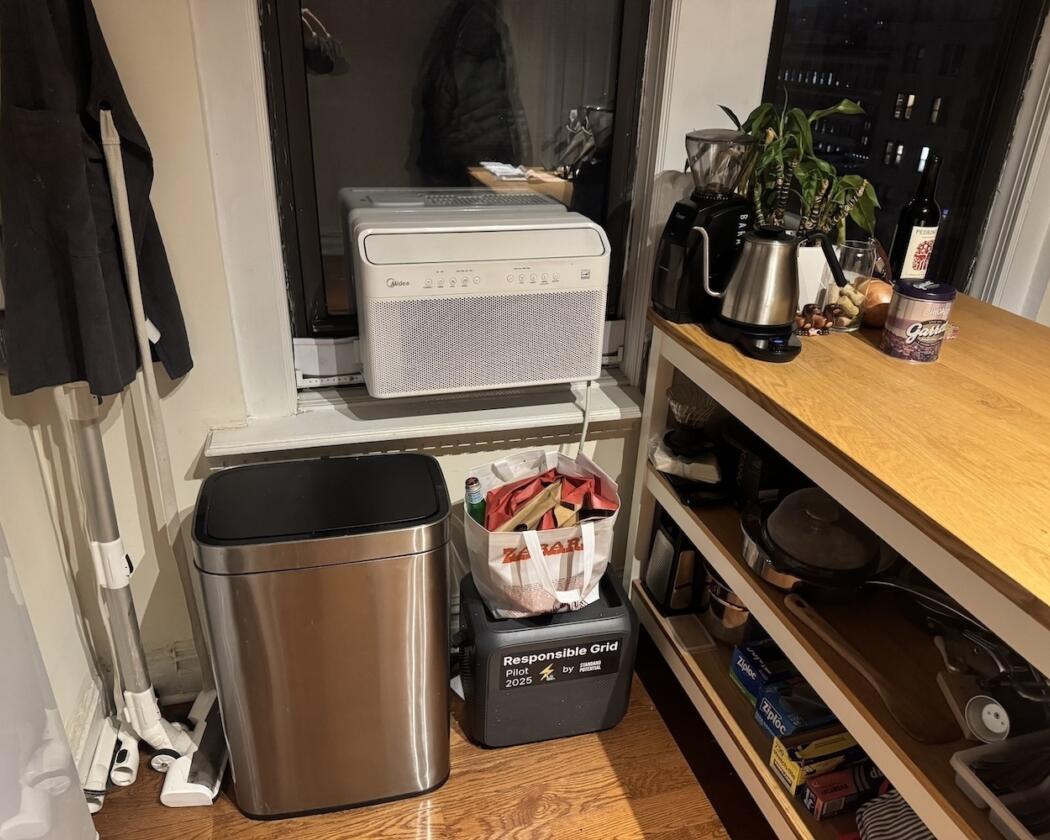
The Every Electric power bank sits below Matthew Schwartz's air conditioner, powering it at times of peak demand. Photo: Matthew Schwartz
As chemistry postdoctorates at Columbia University working on battery technology, Every Electric co-founders Andrew Wang and Richard May were increasingly aware of concerns about rising electricity rates — so much so that Wang stayed in campus housing longer just for free air conditioning, rather than purchase his own unit.
Also aware of how A/C usage in a city of 8.5 million strains the electricity grid every summer, raising electricity costs and emissions, Wang and May found an answer to both of these issues in a battery. According to May, the pair aimed to develop a battery storage solution that was small and portable — important for New York City renters in tiny apartments — but that still offered benefits to the electrical grid similar to large industrial-scale battery energy storage systems.
The duo came up with the idea of outfitting homes in New York City with a power bank: essentially, a boxy battery around the size of a boombox that connects directly to window-unit air conditioners. The battery charges up when overall electricity demand is lower, and stores the energy. It then dispatches it later, powering the A/C unit when the grid is most stressed — like during the hottest hours of a summer day — easing strain on the grid.
In a pilot program last summer, the company gave free power banks to 65 households, as part of Con Edison’s Smart Usage Partner Program, which also allowed users to save money on their utility bills via a direct cash payout.
Every Electric controls the batteries remotely, charging them during off-peak hours when electricity costs less, and switching them on to power air conditioning with stored energy during peak usage hours. A single power bank can charge one 120-volt air conditioner, the voltage of a typical window unit, for up to six hours during the day when the demand is at an all-time high.
The power bank is a solution to a complex problem: New York City’s power grid is dirty. While much of the power supplying upstate New York comes from renewable sources, the majority of the city’s electricity supply comes from fossil fuels. Further, the city’s power grid is backed up by “peaker” plants, fueled by oil and natural gas, which kick on at times of highest electricity use and come with high carbon emissions.
By taking participants’ air conditioners off the grid during the hottest hours of the day, Every Electric’s power banks help alleviate the overall strain that causes these peaker plants to power on in the first place, May said. “Energy storage charges when things are cheap and clean, and discharges when they are expensive and dirty,” said Mohit Chhabra, a senior analyst specializing in renewable energy with the Natural Resources Defence Council.
Using these batteries to reduce peak demand “can [help] keep the grid reliable,” said Britt Reichborn-Kjennerud, the director of distribution planning at Con Edison. “We are pleased to work with program partners like Every Electric that are developing technologies with measurable outcomes that deliver real value for our customers.”
Despite the benefits that energy storage like the Every Electric power banks can offer residents, New York City apartment dwellers have been slow to adopt the technology outside of the pilot. News of large-scale fires at battery storage plants and of e‑bike batteries combusting could make anyone apprehensive about having battery units in their home. But, May told Skylight, the battery technology that Every Electric uses is UL-certified, generally considered the highest safety standard for batteries. “While no consumer electronic device is entirely without fire risk,” May said, “our units are certified for safe indoor use and are designed to be safely plugged in 24⁄7.”
The batteries don’t directly impact the pilot program participants’ electricity bills, but they still offer a financial benefit. Because the power banks help lessen the load on the power grid, users are compensated directly via Every Electric as a Con Edison’s Smart Usage partner. In this role, Every Electric operates as an “aggregator” that receives a financial incentive from the electric company for dispatching the battery power banks and taking ACs off the grid. Every Electric then passes the revenue on to its customers.
It’s worthwhile for ConEd to pay users for reducing their consumption because, as May explained, “When demand is at a peak, every marginal generation source that ConEd runs [like peaker plants], is expensive.”
According to Every Electric’s terms, consumers can earn a maximum of $150 annually per connected device. This includes monthly performance bonuses for staying connected during the summer months when New Yorkers tend to run their A/Cs the most (June, July, August), plus a final payment equivalent to customers’ highest monthly electricity bill between May and September 2026 — or $80, whichever is higher. According to Every Electric, the 65 households in the pilot program earned $10,000 cumulatively in 2025.
One of those participants, Matthew Schwartz, has already grown accustomed to using a battery to power his A/C. He hardly notices the small box sitting snugly beneath the windowsill of his Lincoln Square apartment. “It’s something that you get and forget about,” he said. The backup battery also offers him peace of mind that he can use it to charge his phone and laptop for a short time in the case of a power outage.
This summer, Every Electric plans to dispatch 2,000 more power banks throughout the city. In the future, they also want to use the batteries as backup power for heat pumps. Storing energy at home with power banks is a rare opportunity for residents to “do something green and support the grid,” said Schwartz — while also making some money to offset costly energy bills at the same time.