
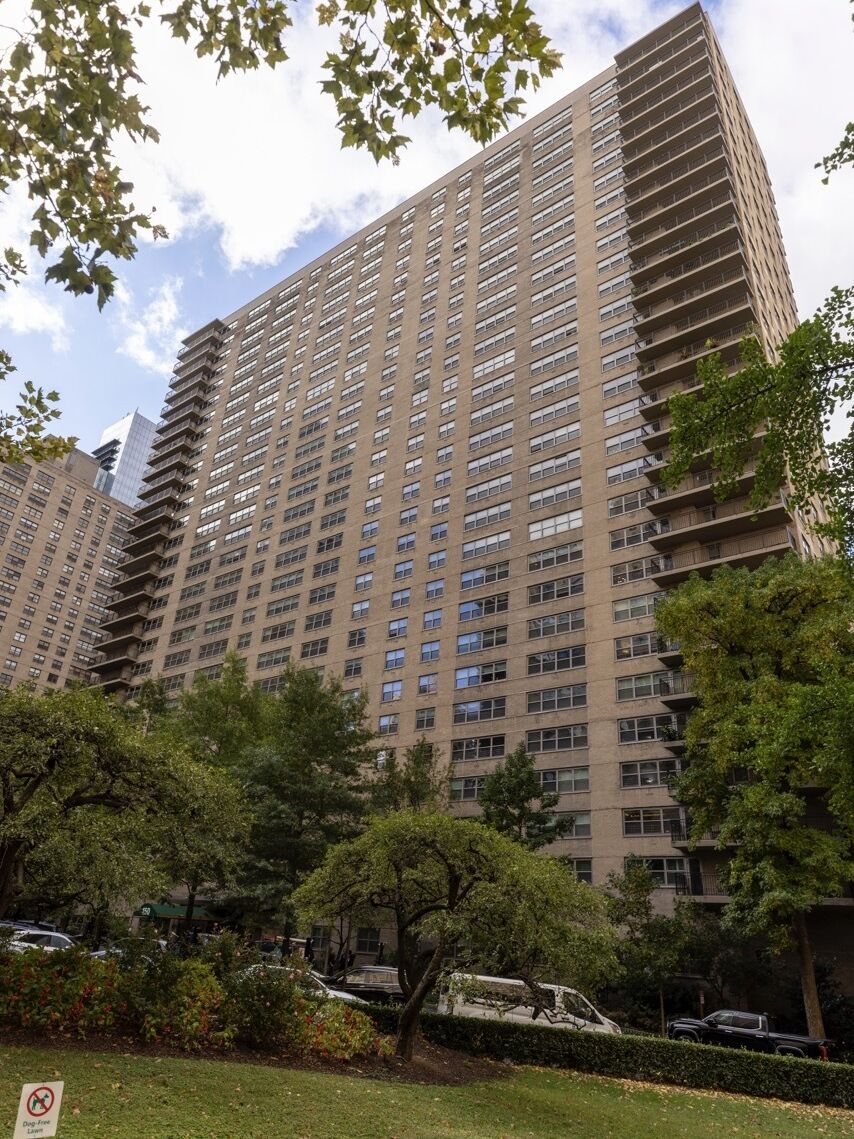
The exterior of 150 West End Avenue, an Upper West Side co-op. Photo: Courtesy of AeroSeal
‘One50’ West End Avenue, a 29-story residential building on the Upper West Side, is cutting its energy use by finding out where exhaust air is being wasted.
To comply with Local Law 97 (LL97), One50 West End Avenue had limited options. The Upper West Side co-op was constructed in 1963 with 454 units across 29 stories as part of a larger development meant to serve middle class New Yorkers. But when starting to look at improvements several years ago, the building, which now describes itself as an “upper-middle-class residential haven,” lacked the upfront capital dollars for a full overhaul.
And perhaps, space was an issue, too: “We found out that this building would’ve required more than a football field of solar panels to meet our rising costs,” said resident Daniel Mori. “That wasn’t going to happen here.”
Mori lived at One50 for years before relocating to the West Coast. When he moved back to New York in 2022, he returned to the building — this time eager to get involved. So, he joined its board in 2024, which had been weighing a project which fit his background in engineering and data. It involved leaks.
Luckily, the water systems were just fine, but an earlier audit had found that the building’s ventilation — the system that removes stale indoor air and brings in fresh air — was eating up about a fifth of One50’s carbon footprint, nearly twice as much as expected for a properly functioning system of that size.
A pre-project assessment found One50 was moving far more exhaust air than intended: roughly 150,000 cubic feet of airflow per minute (CFM), compared with a design target of about 78,500 CFM. That’d be like if a garden hose was spraying out water, and suddenly it upgraded to an industrial fire hydrant. The difference in flow is massive.
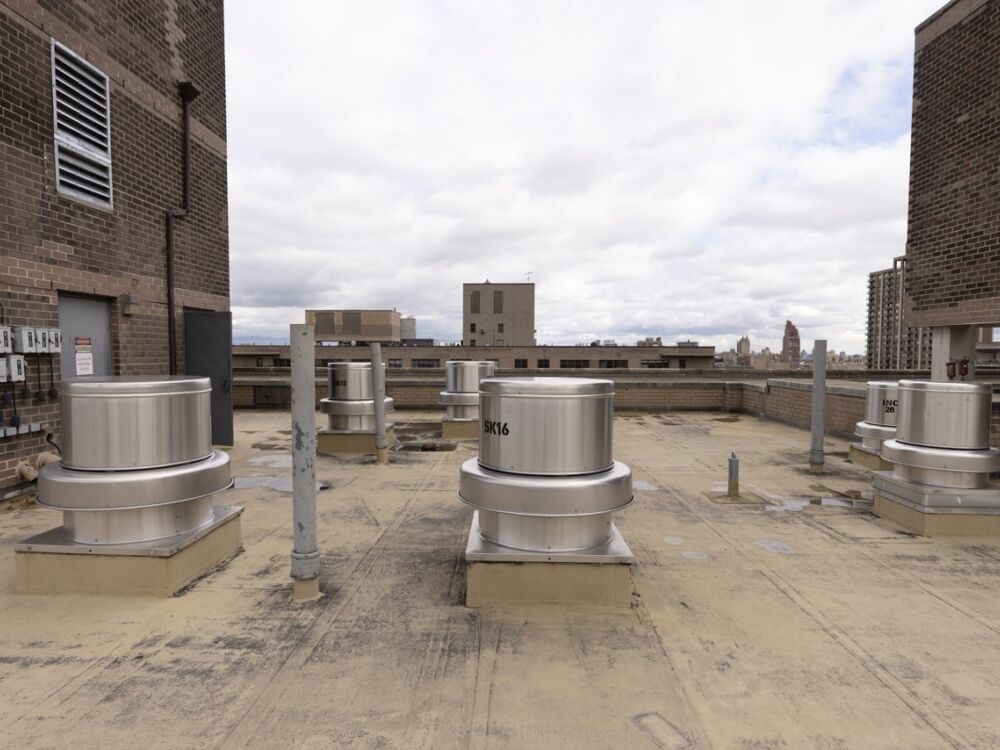
Much of the excess airflow at One50 came from leaks in the building’s vertical riser shafts that worked to pull exhaust air out of the building. Photo: courtesy of AeroSeal
At One50, much of that excess airflow came from leaks in the building’s vertical riser shafts that worked to pull exhaust air out of the building. So, in the summer, when the building’s electric-powered central cooling system ran, the ventilation system pulled this cooled air out of the building; in winter, it was doing the same with air heated by district steam. Each extra CFM of conditioned air exhausted from the building cost nearly $2 per year. Pre-project testing found about 71,000 CFM of leakage. In other words: wasted energy — and dollars.
After conducting market research, the board in 2025 approved an optimization project with AeroSeal, a company that has for over 20 years sealed ductwork using a sprayable aerosol sealant. The $1 million price tag for the project was nearly halved through subsidies from ConEd’s Affordable Multifamily Energy Efficiency Program, in partnership with NYSERDA. The building covered the rest with a loan.
But the estimated annual savings of more than $200,000 in utility bills, which put them on a pathway to comply with future LL97 requirements, made the pitch appealing. “The public-private partnership allowed us to test this out,” said Mori.
Now, with several months of post-project data, the project has something to show to One50 — and maybe many other buildings elsewhere.
Riddled with holes
It’s tough to spot air leaks, in large part because they’re invisible. Outside of causing a higher energy bill, which could have multiple culprits these days, the signs are subtle. One leak on its own may not be noticeable, but at One50, they added up over time. And for a building this old, outdated envelopes coupled with older insulation can compound the issue.
All together, they began to have a small but notable impact on everyday life in a building.
Excessive exhaust at One50 created a persistent low-pressure environment inside the building. That made the lobby doors difficult to open due to the difference between the indoor and outdoor pressure. It was common to hear apartment doors slam. If a window was open inside, the air was just trying to close the gap. Elevators would hiss. Smells would freely waft between units, and a backdraft that came out of the trash chutes certainly didn’t help. “You would always feel a small draft wherever you were,” said Mori.
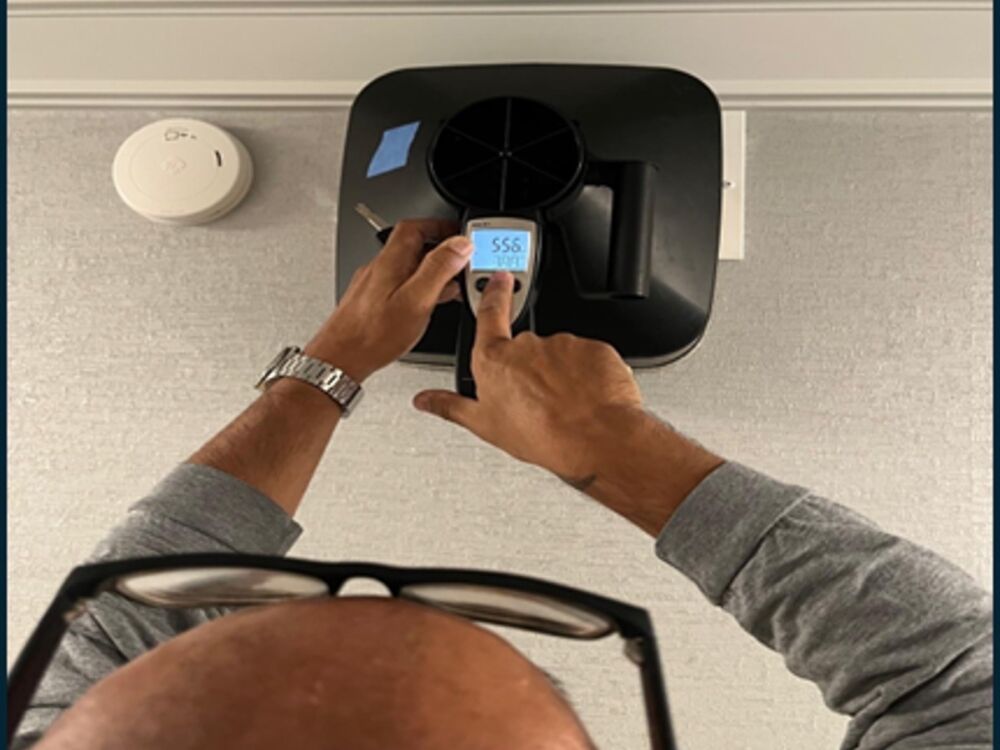
Specialists from AeroSeal went into each apartment to measure airflow. Before the project, not a single one passed the company’s field testing. Photo: Courtesy of AeroSeal
The building staff tried to adjust fans and cover up individual vents, but to no avail. If anything, it inadvertently made things worse: airflow was now unevenly distributed, leaving some apartments with better air quality than others. The under-ventilization even landed several units with mold and air quality concerns.
When AeroSeal measured apartments for airflow, not a single one passed the company’s field testing. The average airflow in a kitchen at One50 was about three to five times the usual airflow, and the bathroom, two to four times. And the building was paying the price: highly inefficient ventilation meant that in winters, without any intervention, the building was set to spend anywhere between $100,000 and $170,000 each month on heating bills.
“It was costing us a fortune,” said Mori. “And for the last three years, it has only been getting worse.”
Plugging it up
On a recent warm and sunny Friday afternoon, Hector, a maintenance worker at One50, escorted us to the rooftop. “The view is beautiful up here,” he remarked. Our focus wasn’t the horizon, but the building’s fans — 24 large metal cylinders that dotted the roof. Each one connects down vertically to a set of apartments through vents and shafts.
The optimization work that Aeroseal did sealed the exhaust system from the rooftop curbs, added new airflow controls, and recalibrated the rooftop fans. Importantly, it also sealed up the apartments themselves — all 454 units.
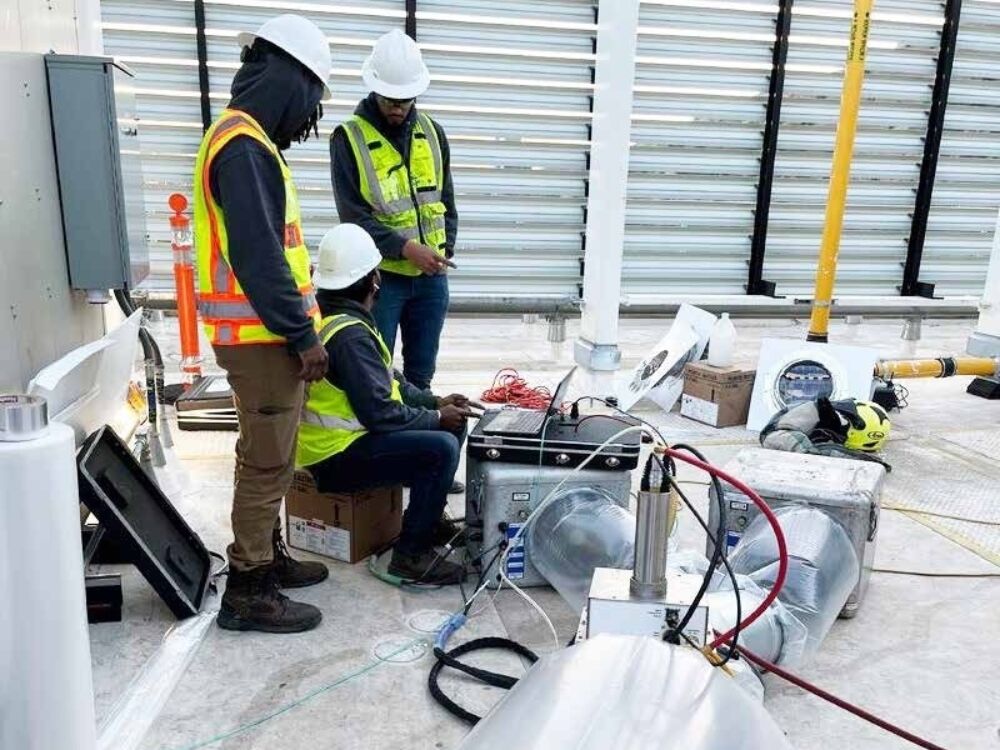
Technicians blow in aerosol sealant into the ductwork at One50, plugging up air leaks. Photo: Courtesy of AeroSeal
Here’s how the process generally works: First, vents are closed to trap the air inside the ductwork. Then the company hooks up a special machine that pumps air in to test and measure leakage, which is recorded by a computer. Once the gaps are revealed, the aerosol sealant is applied; water-based polymer mist — using chemicals found in most hair sprays — is blown inside, with adhesive particles that “stick” to the escaping air, sealing up the ducts as it goes.
Each week, the AeroSeal team worked through about two exhaust shafts and several dozen apartments. After the leaks were sealed, new vent controls were installed at the kitchen and bathroom exhaust connections, and the rooftop fans were recalibrated to run at lower, more efficient airflow levels.
In total, the effort took about three months from its start in the summer of 2025, with extra time budgeted for any setbacks. They had to move very methodically: “We do these buildings riser by riser, exhaust shaft by exhaust shaft,” said Christian Weeks, a vice president at AeroSeal. “And if there’s one unit on a line that we can’t get into, we can’t do the whole line.”
Thus, communication is essential. At One50, Mori and the other board members acted as primary liaisons between AeroSeal and residents, letting people know when they’d have to offer unit access so the company could get to work sealing gaps. They ended up receiving only a handful of complaints, some from residents with larger maintenance issues and others with genuine concern. “One person commented about a haze that the aerosol sealing left behind in the hallway for a day or two,” Mori said. “But it was nothing we couldn’t handle or respond to.” Board members were able to point residents to AeroSeal’s information indicating that their sealant is non-toxic.
Thankfully, the board had been briefed beforehand. With any project, Weeks said, the company meets with stakeholders — like co-op boards and tenant associations — to review both the product and process. “We answer all of their questions about our technology, how it works, how we’re going to fix the problems in their building, but also, how we’re going to impact the residents when we mobilize to perform the work,” Weeks explained. “That upfront engagement is critical.”
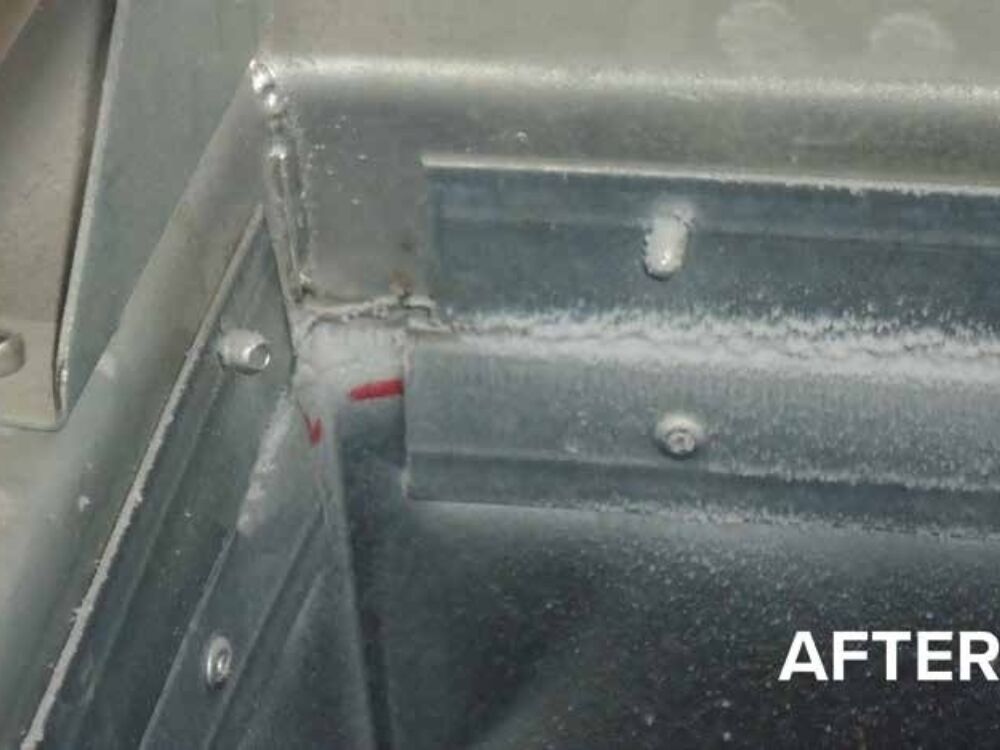
A closeup of an air duct at One50 after the new sealant was applied. Photo: Courtesy of Aeroseal
It’s airtight
As fate would have it, the new setup faced a formidable challenge shortly after installation: one of the worst winters in the city’s recent history. Within a few weeks of completion, New York was battered by one of its harshest winters in decades, marked by blizzards, polar vortex-driven cold, and subzero windchills. This placed a particular strain on heating systems as residents sought to stay warm. At One50, it also made for good data.
AeroSeal’s project team compared One50’s actual heating bills with what the building was expected to spend without the retrofit, using more than two years of past bills and outdoor temperature data. The test period included major winter weather, including an 11-inch January snow storm and a 19-inch February blizzard.
From Dec. 22 to Jan. 20, the building’s actual heating bill was $75,000, compared with a predicted $129,000, a savings of 42 percent. From Jan. 21 to Feb. 19, the actual bill was $122,000, compared with a predicted $167,000, a savings of 27 percent.
Across the first four post-retrofit billing cycles, One50 saved $155,000 on district steam heat.
The 94 percent reduction in leakages recorded by AeroSeal contributed to a 75 percent reduction in total exhaust volume — the cubic feet per minute of air mentioned earlier. In other words, the system was now functioning far closer to what it was actually designed to do. Now the fans on the rooftop operate at much lower speeds, which reduces electricity costs as well. Anecdotally, Mori reports that many of the previous issues reported by residents have subsided as well.
The pocketbook savings applied to the footprint, too: by cutting significant amounts of steam, it is estimated that 208 tons of CO₂ were avoided in the first four months after installation. The building already complied with the initial emissions limits in 2025, but this project puts One50 on track to curb steep fines when stricter limits go into effect in 2030.
Now, the AeroSeal team is busy monitoring the summer season. But based on how a record winter went, they’re expecting a solid return. The impressive stats, Weeks said, will be useful in making the case to other buildings who are looking to affordably and strategically meet LL97 targets.
“When the board [at One50] looked at the parts of their budget they controlled, it became clear that the energy component was one of the largest that they could actually do something about. And with utility costs increasing so significantly year after year, that was the focus,” said Weeks. “That’s a universal issue; I don’t think that’s unique to this building. In New York City and elsewhere, these rates are a stress, and this can help alleviate that.”
At One50, the promising implementation has excited the board about the potential of other cost-cutting endeavors. The team — encouraged by Mori’s enthusiasm for a data-driven approach — is exploring ideas like predictive analytics, where smart meters and energy modeling can preset ventilation for real-time changes, and digitizing asset management, so the building can prevent maintenance issues before they emerge.
“The results here went beyond our expectations,” Mori said, while overlooking the Hudson River. “We’ll keep monitoring how it goes. But now we’re wondering: ‘Where else can we optimize? What other wasted energy can we find?’”