
“If you have a pulse on what’s going on, you don’t lose a building”
A Q&A with property manager Desi Ndreu on the value of communication, and how property management is responding to the need to decarbonize
For property manager Desi Ndreu, constant communication is the name of the game. A typical day for her consists of fielding hundreds of emails from the many people she oversees across her 18-building portfolio. Her work spans everything from handling individual resident complaints to overseeing multimillion-dollar mechanical overhauls, and, in the past few years, steering her portfolio toward compliance with Local Law 97 (LL97). It’s a job that demands both adaptability and empathy, along with a depth of knowledge of how buildings work and what keeps the people inside them happy.
Over 34 years in the business, Ndreu has seen the field of property management evolve. But what hasn’t changed, she says, is the importance of staying in touch. Her philosophy is simple: “If you have a pulse on what’s going on, you don’t lose a building.” Over a video call with Skylight, Ndreu shared how she keeps her finger on that pulse.
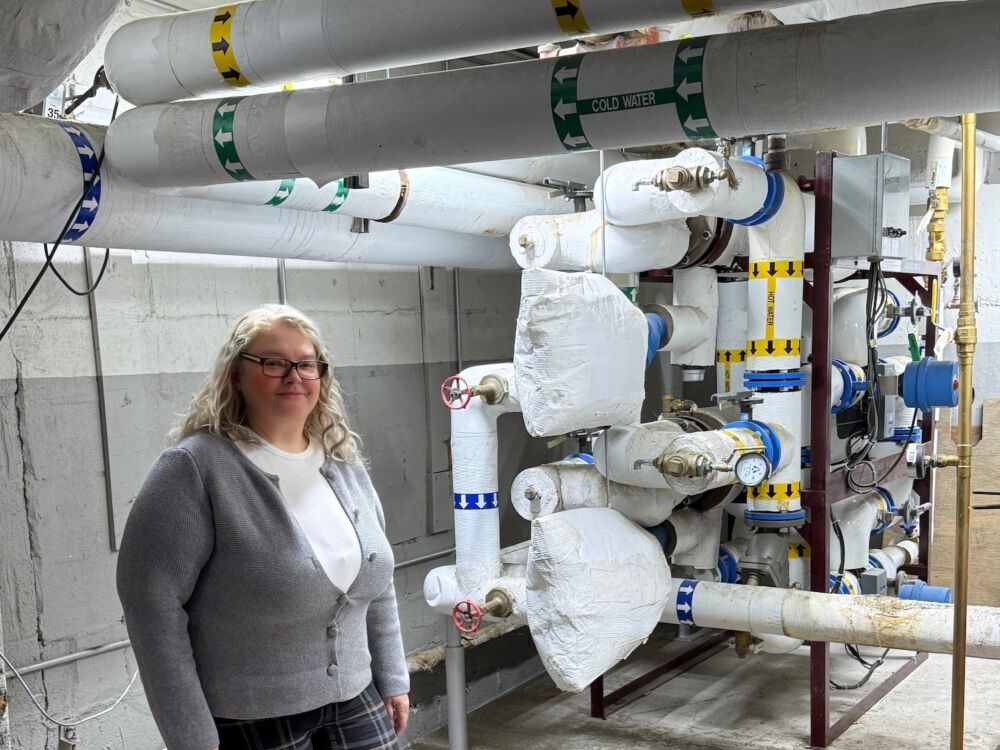
Ndreu stands in the basement of one of her buildings. Photo: Provided/Desi Ndreu
Skylight: Can you tell me a little bit about the buildings you manage?
Desi Ndreu: I currently manage 18 buildings. 16 are in Manhattan, two are in Westchester. My largest is about a 500-unit building. My smallest is 70 units.
Most of them are co-ops; some — two or three — are condos. They are all currently embarked on LL97. Some are in the beginning stage, some are knee-deep, and some have worked towards getting to the goal lines of no fines in 2030.
So, how many people do you oversee?
We have three different statuses of employees: The majority of my buildings are [SEIU] 32BJ, superintendent/resident managers, handymen, porters, doormen. A couple of them are non-union in Manhattan, and there’s different non-unions.
The average building is about seven [employees], so I would say that we would probably have about 100 staff members all in. I try to remember all their names; I go to the buildings every week, I see the supers, the doormen that are on staff. The only doormen that I probably don’t really have a great relationship with are the ones that work overnight, because I don’t see them as much.
How would you define good management in the context of building performance?
Managing a building is a team effort. It starts with management and the [residential] board. The board gives us the guidelines, and management enforces it; we work with our employees to kind of coax them to understand how to enforce it.
[Nowadays,] it’s an understanding that we’re in 2025, and things are different. A 2025 property manager is not the same as a 1980s property manager. The world has changed and evolved. You’ve got to be able to pivot as an agent — you have to create a custom management package. What works on 73rd Street in Manhattan, management style, will not work on 14th Street in Manhattan, because they’re different areas of New York that have a different culture. So we have to adapt to the culture of the building.
My building on 73rd Street, which is 70 units — because it’s such a small building, when we have something such as arrears, instead of me drafting a letter and sending it to all the residents, I call them up, because it makes a difference. Whereas [in my 500-unit building] on 14th Street, we draft a letter. Then, if we don’t hear from them, we call them up.
We had children [in one building] on the East side that were running around, so I called the parents and I said, “You know, this is causing hardship on my doorman. They’re trying to do their job but now you’re adding extra to the job description, which is not fair to them.”
And they understood. Same thing with a resident who was getting so many packages but not picking them up. I said, “You’re getting all these packages and my doorman has to constantly pick them up. They’re heavy. You’re not around.” You know.
It’s understanding your client, understanding your client’s needs, being on top of your client’s needs, and ensuring that your staff is educated and trained to pick up those same needs. Everyone being on the same page is really important.
At the WISE event where we met, you mentioned something that floored me, which was that you communicate with every one of your buildings every day. Is that right?
Yeah. 300 emails a day.
Talk to me about why you do that, and what difference it makes.
I started this business not because I wanted to be in this business — I was actually supposed to go to law school. But my dad was a superintendent, and he asked if I wanted to be his assistant on site and I said sure, because I wasn’t doing anything, and I fell in love with this line of work.
I realized early on that communication is really key. I have a pulse on what’s going on. When you lose a building, it’s because you don’t have a pulse. And in the 34 years that I’ve been doing this, I’ve never lost a building, because I have a pulse.
Of course, I’ve made mistakes. But then, you know what? You try not to make the same mistake over. You apologize, you jump on the horse, you fix it, and you move on. And [residents] respect that. They respect the fact that you work hard. They respect the fact that you are attentive and that makes a world of difference.
It’s like the old saying: “You never know what’s behind that person.” When you walk past someone in New York City, everybody in New York looks mean, but we don’t know the story they have. So if you smile, you set the tone. And I think communication’s the same way — if you communicate, you set the tone. If people know what’s going to happen, they don’t like it, but they can accept it, right?
One of my buildings, 7 E. 14th St., we’re rebuilding it mechanically in the basement. We’re also going into everyone’s apartment, cleaning their duct work. We are also opening up a chase well, and replacing four pipes in the chase well; the elevators are being modernized.
Now, on Monday of this week, they had no water because a pipe burst. They woke up to no water at all on a Monday, and then on Tuesday, they woke up to no hot water. They had the right to complain; waking up Monday with no water is pretty crappy. They were at their limit. So I drafted a memo. I said, “Totally understand you are at your limit, rightfully so.” I said, “‘I appreciate you’ is too small of a word for what you are allowing us to do.” And I said, “You know, we’ll be done in November. Then we’re going to be giving you the holidays off, free of vendors, and we’ll start up again in January.”
I didn’t get any complaints from a 500-unit building.
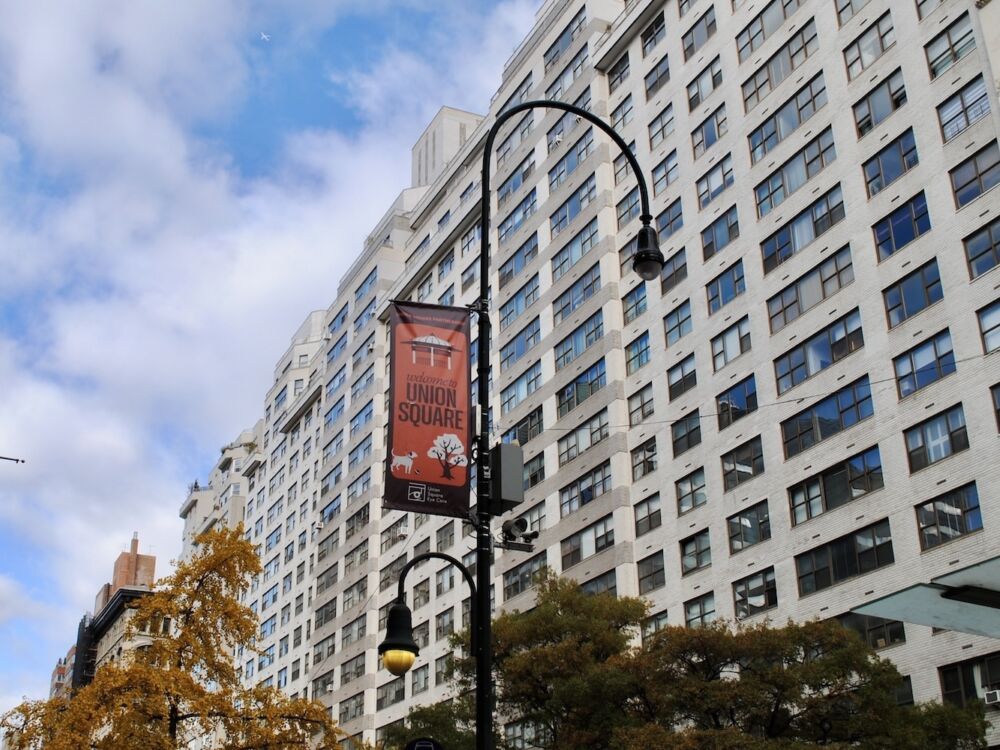
Among other buildings, Desi manages the Victoria at 7 E. 14th St. by Union Square, which encompasses nearly 500 units and takes up most of a city block. Photo: Hannah Berman
Switching tacks now, you mentioned LL97 at the top. I’m wondering how your approach to managing buildings has changed since the law came into effect, and what your attitude toward decarbonization as a property manager is — whether you think of it as just part of the job description, or whether it’s something you care about personally.
I learned about LL97 through Allen Hobbs of NYC Accelerator. I believe in 2015 or 2016, we started the conversation, and the more I spoke to him, honestly, the dumber I felt. It was just so complicated, because you have [only] one chance to get it done right. It’s a lot of money, and there are shareholders that have to pay for this. So the more I got educated, the more that I needed to ask more questions and reeducate myself.
Any type of repair that I’ve made, going from 2016 to present, is to make sure that [the building is] in line with LL97. I’m not just going to repair it in kind. If it means paying a couple more dollars to upgrade to make sure that you lower your carbon emissions, that’s what you have to do. We started off early enough on these bigger buildings to make sure that we get to where we need to before everyone jumps on the bandwagon [with incentive applications].
The bigger capital expenses might not be able to bring you over the top where you’re in compliance in 2030, but they’ll bring you close enough; for now, [I tell residents,] let’s look at the low-hanging fruit to create the bigger picture.
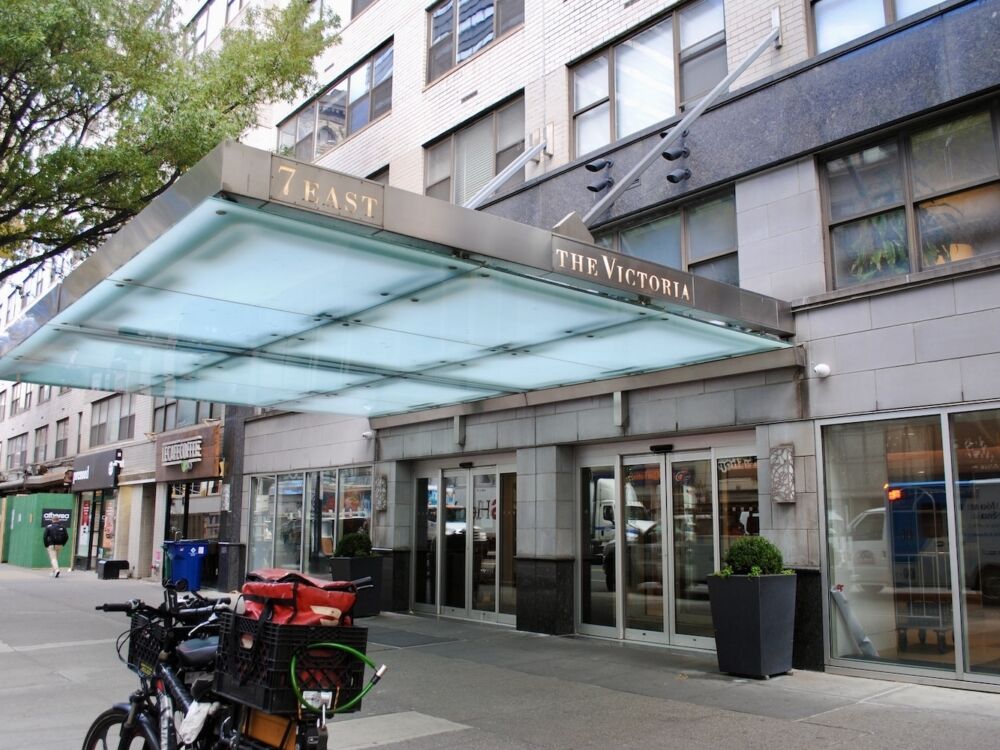
The Victoria has not fully electrified, partly because of Ndreu’s worries about becoming too reliant on the grid. Photo: Hannah Berman
I definitely think it’s the right thing to do. If we don’t take the measures today, [there] won’t be a tomorrow. When we had those [forest] fires and the winds were blowing from Canada and we couldn’t breathe, that’s what we’re going to get. So we are obligated as human beings to do [something].
[However,] I do think that when the city rolled out LL97, they should’ve rolled it out with help, because not all buildings have the cash funds to do so.
And then they did come out with a PACE loan, but that was like six percent, when the loans were 2.8 percent. It’s great that the city rolled it out, but there should’ve been help in getting us to where we need to be. A tax credit for the buildings, for the shareholders, for the owners, for the landlord — something along those lines.
But I’m all for it, and I think it’s the right thing to do.
When you see the need for decarbonization upgrades in your buildings, how do you convince the shareholders or the owners to get on board with those changes?
It’s a lot of education. I tell the board members that their job is to be a board member. Their job is not to manage the building; that’s my job.
My job is to get them all the information they need. I like to get the opinion of two or three or four different engineers and then I bring in four separate engineers [with different perspectives], and then we interview them and we spend a lot of time with each of them.
We ask them to kind of give us a footprint of what they think is best for the building, with an estimated budget of what it would cost. And then we then take the four and narrow it down to two, and then we spend more time with those two, and then we go with the one we choose to move forward with.
So it’s a lot of research, a lot of different opinions, a lot of reaching out to buildings [to see] what they’ve done and [asking] are they happy. A lot of reading articles, and going back to those buildings, and then having the board be able to make a decision because they’ve done their homework.
I want to end by looking forward. What do you think the next few years are going to look like for property management in New York City?
For those that fell asleep at the wheel, I think there’s going to be a lot of work that needs to be done. Building [shareholders and residents] are going to probably make changes because they’re going to realize that they weren’t educated enough by their property manager to get them to where they need to be.
I think for a lot of these buildings, with something such as LL97, [the next benchmark is] 2030. It sounds like a long time, but take elevator modifications, for example — an elevator mod takes about 14 to 18 weeks of engineering. Then you pick up a contractor, and then that takes another probably 20 weeks before you’re ready to go. So you’re already looking at December of next year, if you haven’t started yet.
There will be a huge transition of management firms, and the supply and demand in New York City is going to go crazy. The demand will be high, but supply will be low. So with this inflation, I think buildings are really going to get hit on the head by a lot of these contractors. It’s not going to be a pretty thing, for people who are behind. And if you haven’t started any of these projects as of today, you are way behind.