
Steam heat systems learning new tricks
A legacy boiler company is pioneering boiler replacement with a steam-generating heat pump powerful enough to heat New York’s biggest apartment buildings
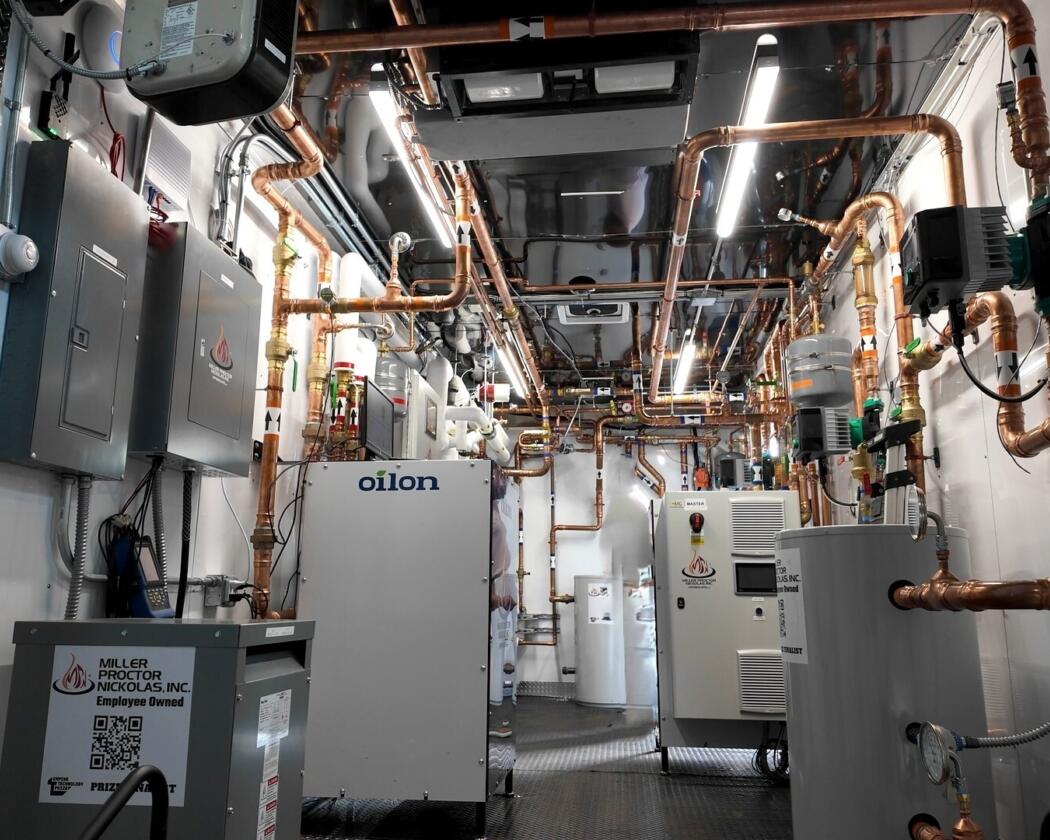
Miller Proctor Nickolas built a full demonstration model of their new heat pump system in a mobile trailer. Photo: Provided by MPN Boilers
As New York City moves deeper into its clean energy transition, it’s not only the city’s buildings who are figuring out how to adapt to this new era of decarbonization — the multitude of contractors that have been built up to support them also need to learn and innovate to face the challenge.
Take boiler companies, for example. For more than 60 years, Miller Proctor Nickolas, Inc., or, MPN Boilers, has built its business on installing, maintaining, and providing services for the fossil-fuel-based steam boiler systems that are the backbone of New York’s historic building stock.
But the introduction of Local Law 97 (LL97) several years ago posed a fundamental question for MPN: How does a legacy boiler company adapt to this transition and also position itself as a leader?
“The introduction of LL97 was really an eye opener for us,” said Ian Rowburrey, Chief Commercial Officer at MPN Boilers, “that there was a tremendous need for action to reduce fossil fuel consumption in New York City.”
They knew that in order to keep serving their customers, and to gain new ones, any solution they devised would have to involve installing electric-powered boilers and moving away from those powered by fossil fuels. But there was one central question that remained: How could they integrate electricity into the boiler mechanics they knew so well?
Inspiration from abroad
Finding and adopting innovative solutions beyond the conventional boiler systems MPN was known for wasn’t straightforward. For Jaime Tetrault, who became the company’s CEO in 2020, leading the company through this new transition would require a sophisticated and effective solution.
Tetrault first came across the technology he was looking for in 2022, at the international Air-Conditioning, Heating and Refrigeration (AHR) Expo in Las Vegas. It was a heat pump made by Oilon, an energy technology company out of Finland known for its heating solutions, heat pumps, and low-emission burner systems. Having worked in Europe for years, Tetrault was already familiar with the water-source heat pump technology Oilon’s products employed.
Finland is like other Nordic countries in that its cities tend to use district heating to warm most buildings. The system uses a giant central power plant to heat up water, and then pumps that hot water through a network of insulated pipes that run under the streets and connect to buildings. “So if you want to heat your building, you tap into that line and heat your building with your hydronics,” Tetrault said. This means buildings don’t need their own local heating systems like oil or gas boilers.
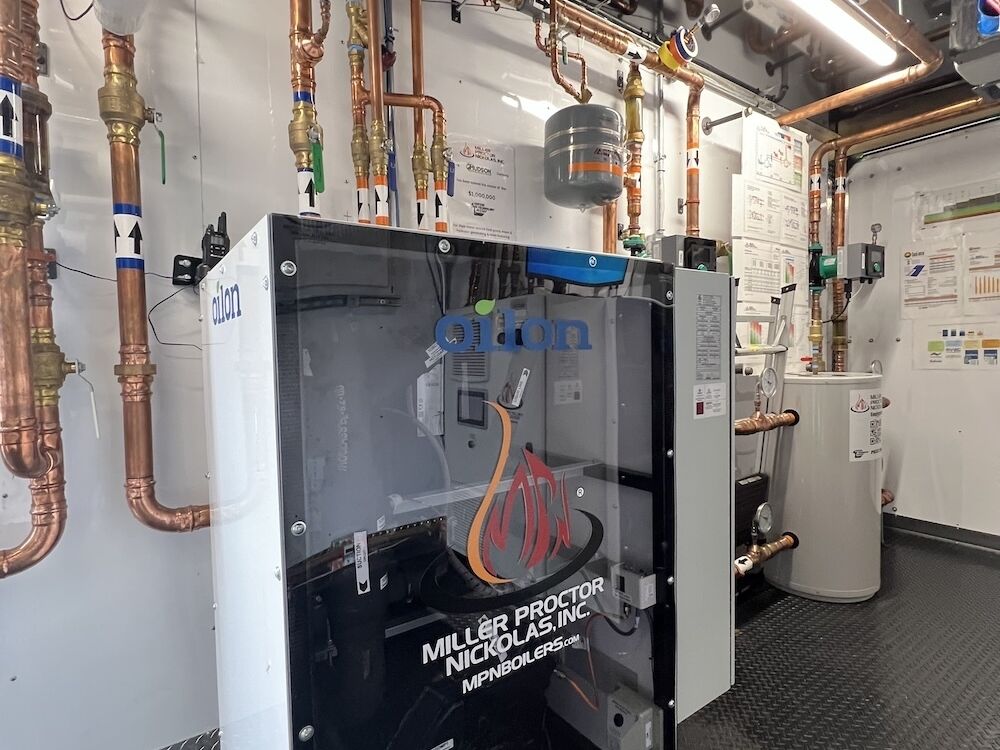
MPN makes use of a water-source heat pump developed by Oilon, a Finnish company, to create a new steam-heat solution for New York buildings. Photo: Saugat Bolakhe
What Oilon’s engineers realized is that by adding a water-source heat pump to individual buildings connected to this larger district heat system, a building can pull even more usable heat out of the hot water coming from the city network before it returns. The technology is energy efficient, using the city’s hydronic loop more effectively and reducing overall energy demand.
Tetrault saw an opportunity to bring this technology to New York. “I thought maybe this could be something we could bring in,” he said. “I wanted to be a differentiated player, and not be playing against all the air source heat pumps that are already out there.”
Heat pump challenges in New York City
But New York is not Helsinki, and adapting an efficient clean energy technology for the largest urban hub in the U.S. poses some site-specific infrastructural challenges.
For one thing, New York City, and the borough of Manhattan especially, has many tall, century old buildings with localized heating and cooling; that is, an on-site boiler powering stories upon stories of residential units. Changing out these heating systems for air-source heat pumps in thousands of buildings would require lots of disruptive construction. It’s “not just an engineering problem — it’s a people problem,” said Ian Motley, programs manager at the company. “With 70,000 buildings in New York, you can’t just move people out of their homes.”
This is where the water-source heat pump comes in. It changes very little of the existing infrastructure of a boiler-powered heating system, including leaving in place the same pipes and radiators that bring heat up into individual apartments, but can supplement or replace the boiler with a heat pump at the source.
Traditional boilers rely on fossil fuels including natural gas or oil to create fast-burning and very hot flames that heat water and distribute it through the building’s heating system. “There’s a tremendous amount of power in fossil fuel,” Rowburrey said.
Instead, a water-source heat pump uses electricity to “move” heat around — capturing heat from the water and transferring it inside to warm the buildings. What makes these heat pumps different is how they tap into existing sources of heat. The Oilon heat pumps make use of potable city water that New York City buildings already receive, which arrives at around 50 – 60°F. They can also capture heat from wastewater that many buildings produce through refrigeration systems or ground-floor retail.
The circulating water flows through a heat exchanger inside the heat pump, which contains a fluid called refrigerant. When the two meet across the metal heat exchanger, the refrigerant absorbs heat from the water and evaporates into a gas. Then comes the compressor, which squeezes the gas, rapidly increasing its temperature up to around 150°F. That heat then warms up the water in a different loop that becomes low-pressure steam rising through pipes to the radiators throughout the building.
The quick, minimal, and efficient replacement of the existing heating system is what makes the technology so appealing to NYC building owners. “We can pull the old boiler out. We don’t have to change radiators or piping. We plug right into the system from the bottom and — bam — we’re in business,” said Julia Cyr, the head of sustainable business development at MPN.
A big opportunity to test the new solution
MPN knew they wanted to partner with Oilon to adapt the heat pump for New York City, but before they could bring it to market, they needed to do a lot of testing. To do this, they entered into the Empire Technology Prize. The competition, put on by New York State Energy Research and Development Authority (NYSERDA) and non-profit clean energy accelerator The Clean Fight, was designed to spur innovation for technologies specifically to decarbonize tall buildings.
As they made their way forward in the competition, MPN was awarded $965,000 in funding to test their Oilon heat pumps at three demonstration sites, including one high-rise residential tower. The site they found was a 35-story, 300-unit building on the Upper West Side that is subject to LL97 and was looking for a way to get off of fossil fuel-based heating. In addition to this residential testing site, MPN tried their new heat pumps in a mixed-use building, a designated historical building, and even built a mobile heat pump trailer to show people first-hand how this technology could create steam free of fossil fuels.
“By bringing the mobile demonstration trailer directly to the building that is implementing the system, building owners and decision makers are able to see the scalability and customization that is possible,” explained Cyr. “With the trailer, you can see how all the components come together to create a tailored efficient plan for your retrofit working live in front of you.”
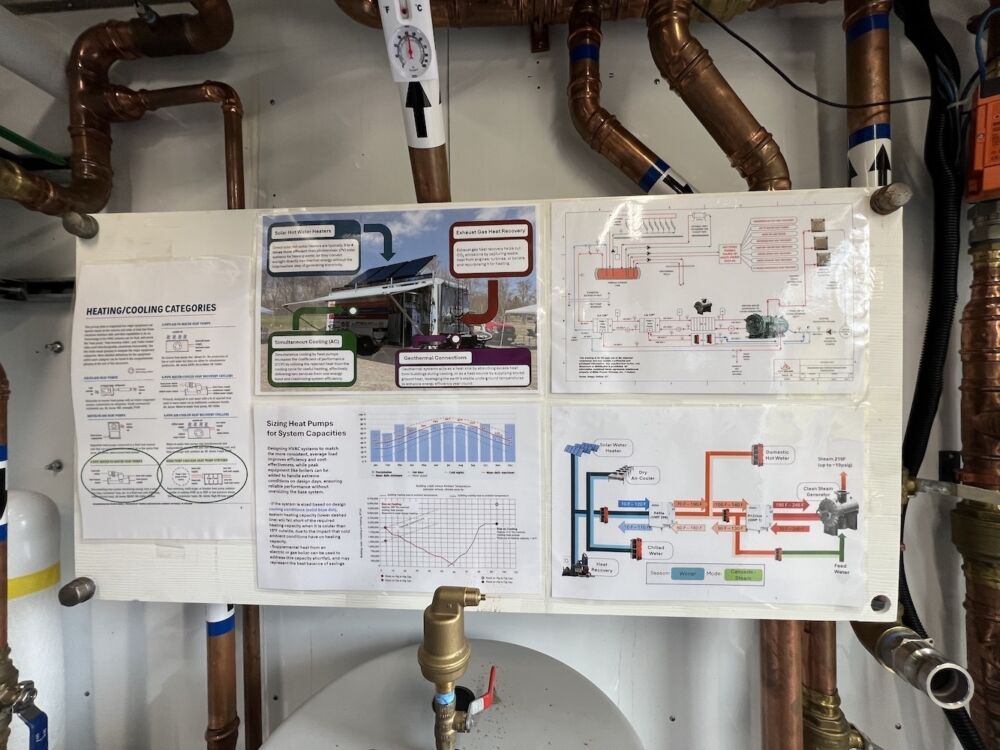
A series of charts and images explain how MPN Boiler’s mobile heat pump trailer operates. Photo: Saugat Bolakhe
These demonstrations were deemed a success — so much so that they earned the company the $1 million first place prize.
“I think MPN has done a very good job of demonstrating how you can make the existing building owners comfortable with new technology by allowing them to interact directly with the technology,” said Julia Park, the program director of buildings at Clean Fight.
Changing infrastructure means changing culture
All the buzz around the strong potential MPN has seen with these new steam-generating heat pumps has earned them quite a bit of interest. According to Cyr, they have roughly a dozen other projects that they’re currently designing with the new Oilon heat pumps, and are fielding inquiries from more than 60 other buildings.
Even so, Ian Rowburrey sees getting a majority of building owners and operators onboard with clean energy as a major challenge.
“We feel that there are many businesses and building owners who are maintaining a thought that, ‘Hey, if my heating system works, I don’t want to mess with it. Why bother fixing it, if it’s not broken?” Rowburrey said. What the owners don’t realize, he said, is that “they’re relying on a piece of equipment that could be up to 50 years old and could just drop out.”
His team is actively trying to work with those building owners that have reached out to them, and have the foresight to recognize what’s coming. “Bringing in LL97 — it should have been done 20 years ago,” Rowburrey said. But even with LL97 and other laws now in place, the key thing has to be getting the word out, from technicians to local residents. Most engineers in New York, Tetrault noted, have never worked with water-source heat pumps before. Creating broad awareness of the technology is essential for the team.
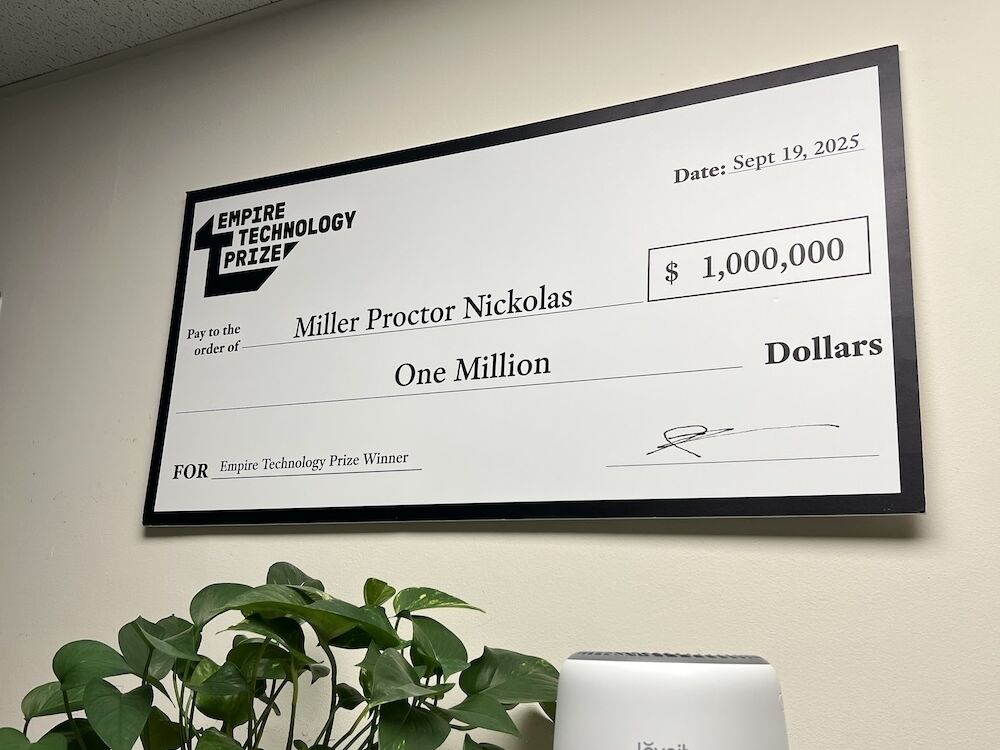
MPN’s project innovating steam and high temperature hot water heat pumps won them the $1 million top award from the Empire Technology Prize. Photo: Saugat Bolakhe
Only with broad public awareness, Rowburrey said, will people start to understand just how much emissions are being released into the atmosphere. “And maybe then they can ask their building owners to replace such old heating systems with options that cost lower.”
Park hopes that in an ideal world, New York’s clean energy transition is able to not only reduce emissions for the city but also provide additional comfort and improved qualities of living for the city’s residents. “Even in my pre-war apartment, we’re overheated a few weeks of the year, and we’re way too cold in other times of the year,” she said. “Things definitely can be optimized further with the technology that we have today. So I’m hoping that LL97 becomes a trigger point for building improvements as a whole.”