
Optimizing your steam heat boiler
How to upgrade steam boiler heating systems to meet Local Law 97 emission standards
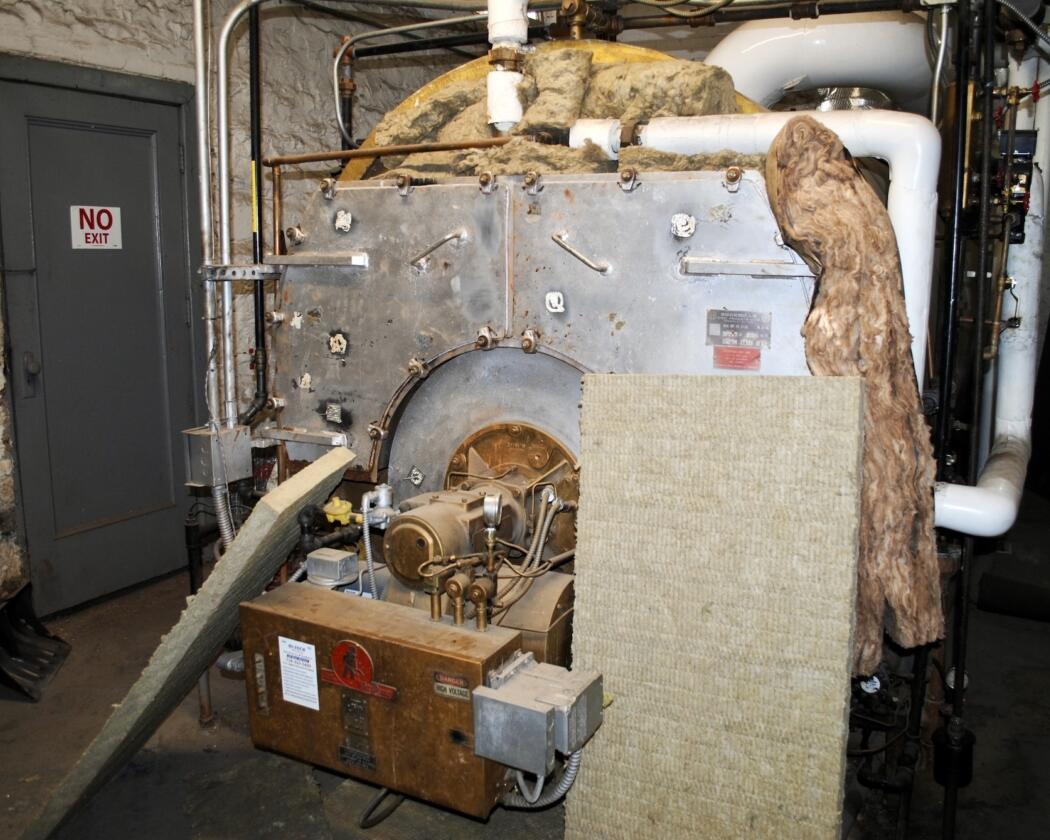
Sun Garden Homes’ boiler — “Basically a big teapot, boiling water,” according to cooperator Mike Weiss. Photo: Hannah Berman
Steam heat boilers have been a part of the fabric of New York City for generations as a proven technology for heating large multifamily buildings. But now, with Local Law 97 (LL97) setting strict limits on the carbon emissions that a building may produce — and tightening those standards gradually over time — many building owners are giving their oil- and gas-powered boilers a closer look, to see what improvements can be made to reduce emissions and costs.
Some buildings with older heating systems may decide to do away with them entirely, opting for electricity-powered heat pumps instead. Still others are choosing a more hybrid system that combines heat pumps with existing boilers.
But there are energy efficiency gains to be made — and carbon emissions to be saved — by simply improving the operation of an existing boiler and distribution system. Small tweaks can be made to make a boiler work smarter, before (or instead of) engaging in a complete retrofit. Below we’ll look at some of the system upgrades that are available, and how much they can improve the efficiency of a steam boiler.
Do I have to replace my boiler?
One important factor to consider is whether upgrading an existing steam heating system will be economical in the long run, or if a full system replacement might be required to comply with LL97 requirements. For example, buildings with boilers powered by No. 4 fuel oil (of which there are about 1,000 throughout the city) are required to phase out this type of oil by July 2027. These buildings may find electrification of heating and hot water systems to be the most cost-effective solution over the long term. For buildings that use boilers powered by No. 2 fuel oil or natural gas, the retrofits and improvements that can increase efficiency can be a worthwhile way to save money on fuel consumption and improve resident comfort in the process.
How to make steam boiler heating systems more efficient
1. Regularly clean and tune up boiler tank
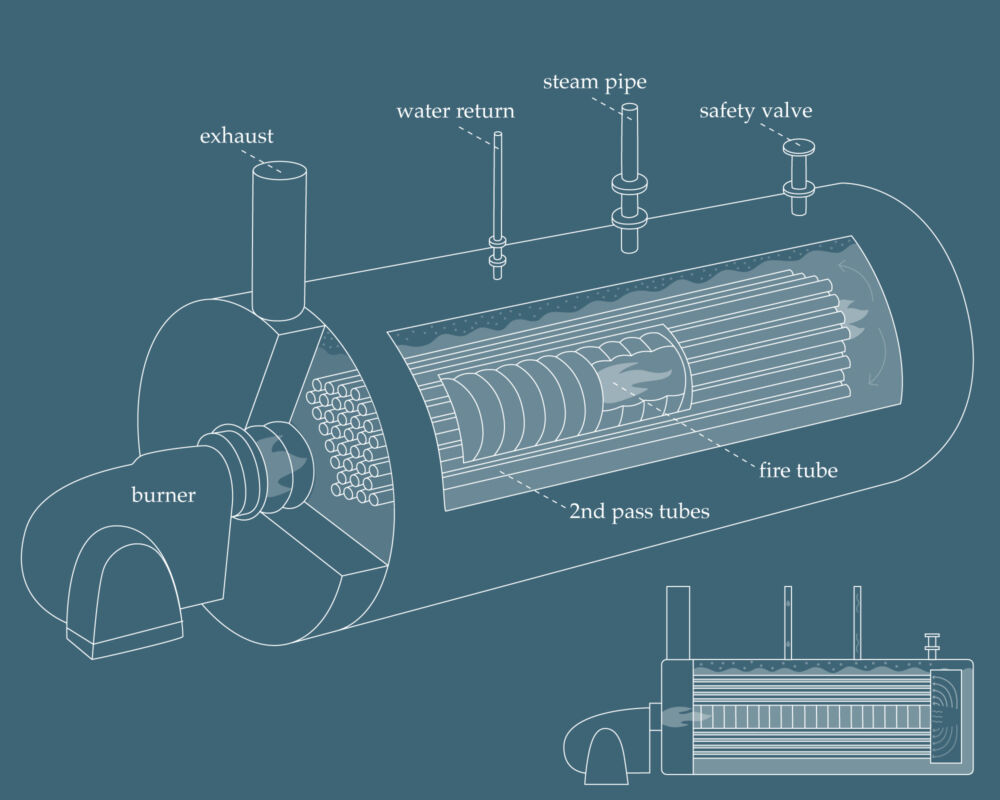
Detail of the combustion chamber and heat exchanger of a boiler. Illustration by Diana Steelman
Steam boilers are designed to reuse as much water as possible within the system, sending steam to heat residential units and then recollecting cooled water, also known as condensate, through the same distribution system to be heated again. However, some residual condensate is always lost to leaks in the return piping. This requires water to be occasionally added to the system as replacement.
Yet all added water contains dissolved oxygen, which attacks the boiler metal, and minerals that can coat the boiler’s internal heat transfer surfaces, which can block some of the heat energy transfer from burners to water and reduce efficiency over time.
This is why regular boiler service is essential. (A good rule of thumb is to do this at least once per year.) Cleaning the entire system includes flushing the boiler tank completely of water, clearing out sediment, and also cleaning soot from the fireside of the boiler. Once cleaning is complete, the boiler tank can be refilled to the level set by the automatic water feeder, typically measured by an internal probe or float.
Boilers in most residential buildings in New York City — that is, any building housing six families or more — are required to be inspected annually by licensed professionals, who may offer cleaning services during their inspection. It’s usually worth taking them up on their offer, since a clean boiler can improve efficiency by up to six percent.
2. Add pipe insulation
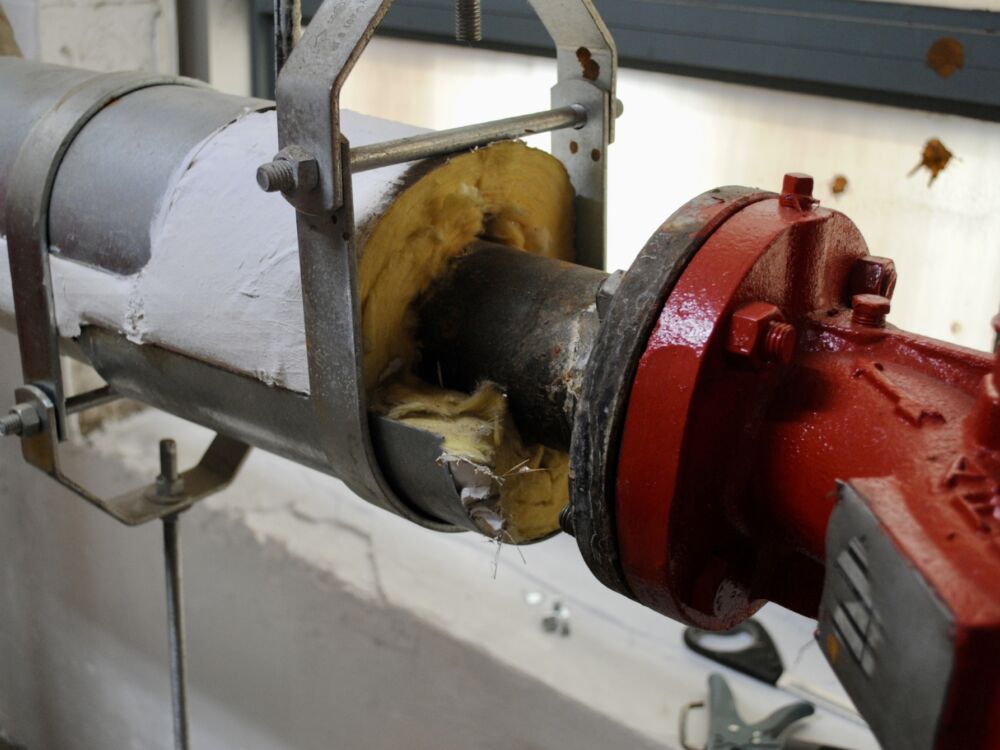
At facilities manager Martin Robertson’s building, all pipes are covered in insulation — except for this small gap, which he uses to check the temperature. Photo: Hannah Berman
Adding insulation to the pipes used to distribute steam throughout the building is one of the most cost-effective ways of reducing heat loss and improving boiler efficiency. Uninsulated pipes allow significant amounts of heat to be lost to the surrounding air, typically right within the basement of the building, before it’s travelled very far. This allows the steam to return to liquid water, or “condense,” before reaching any radiators, forcing the boiler to burn more fuel to send more steam into the distribution system — essentially, working harder to send sufficient steam throughout the system.
Modern steam pipe insulation is typically made from fiberglass or foam sleeves that are wrapped around the pipes and sealed at the joints to prevent heat loss and moisture intrusion. The insulation usually comes in pre-formed, rigid sections sized to fit common pipe diameters, with an outer vapor-barrier jacket made of foil or plastic to keep condensation out.
To install, sections are cut to length, fitted snugly around the pipe, and secured with tape, wire, or plastic bands. Elbows and valves can be covered using flexible fiberglass wrap or custom-molded covers to maintain continuous insulation along the entire pipe. (While you’re at it, you should insulate your domestic hot water pipes as well.)
3. Check on the steam traps
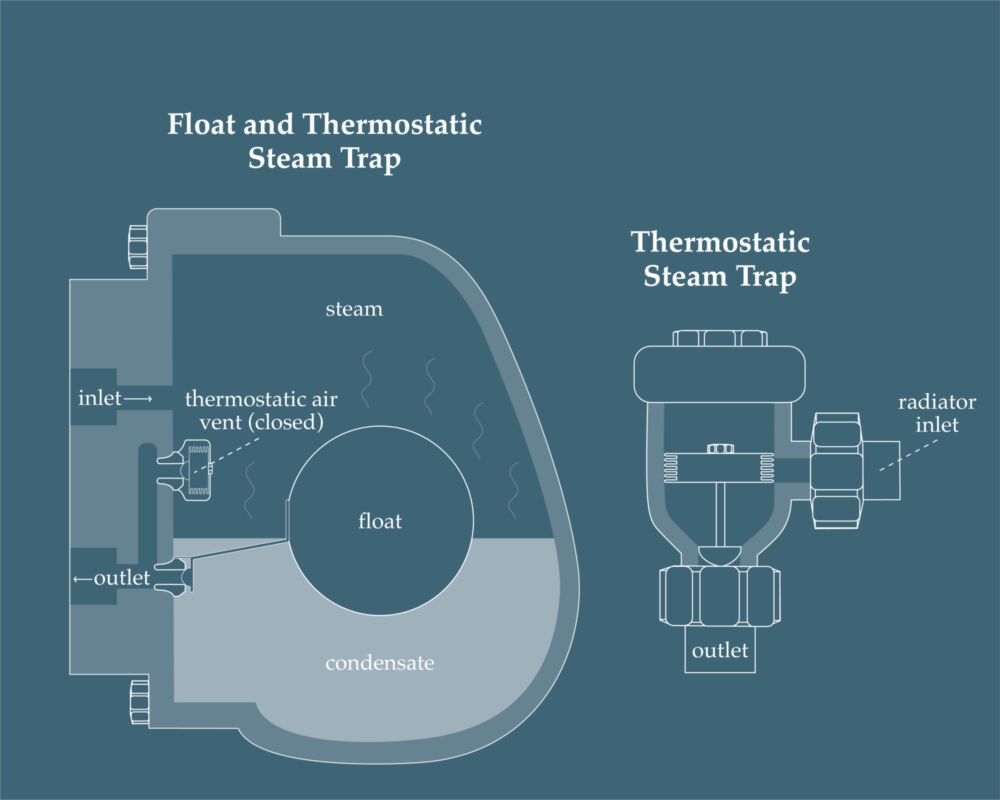
Float and thermostatic steam traps (left) connect to the steam mains, while thermostatic steam traps (right) connect to radiators. Both types of traps prevent steam from escaping the system, therefore making it work more efficiently. Illustration by Diana Steelman
Steam traps are essentially valves that automatically prevent steam from making its way back to the boiler before it has condensed into water. They allow air and condensate to pass through, but close off when hit by steam.
There’s also a particular type of steam trap designed especially for radiators, called a thermostatic radiator trap. This works to keep steam inside the radiator until it gives up all its heat and condenses back into liquid. Steam traps are generally absent from one-pipe steam systems, but are found on both steam mains and radiators in two-pipe steam systems.
Without routine maintenance, these traps can malfunction, allowing steam to be unintentionally vented from the system. Vented steam needs to be replaced with additional water, which removes heat energy from the system, so preventing steam trap malfunctions can go a long way in increasing system efficiency.
Just like cleaning the boiler, maintenance of steam traps located on a boiler’s primary piping system usually needs to be done while the system is not in use — usually during the summer — and it should be performed by a licensed professional.
4. Tune up the burner
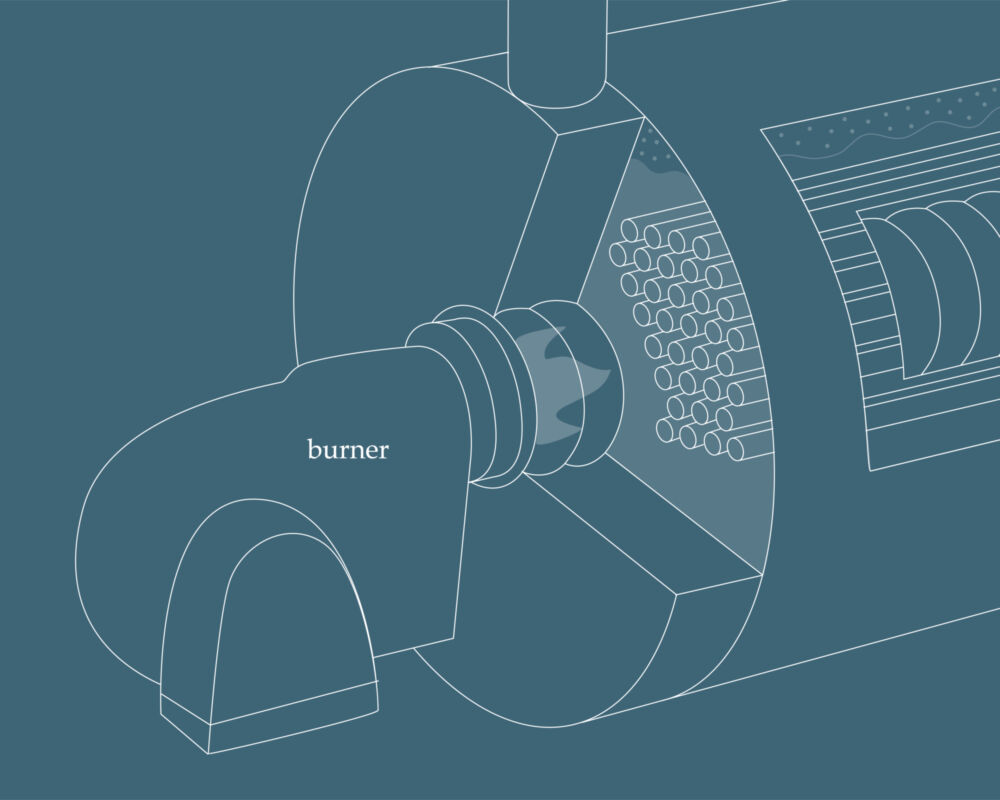
Close-up on the burner of a steam heat boiler. Illustration by Diana Steelman
Burners kick off the steam heat process. Having the correct flame strength is essential for creating the initial amount of heat needed to convert water into steam at the required volume based on inputs like outdoor temperature and apartment temperature. Because of this, it’s important that burners have the appropriate mix of air and fuel for combustion to maintain a consistent temperature, instead of swinging from too hot when fuel is being fired, to too cold when the burner is off.
To ensure the burner is working as it should, it should be regularly tuned up. This involves cleaning the various air- and fuel-handling parts, and then adjusting the air-to-fuel ratio for clean and efficient combustion.
On a modulating burner that has more than one firing rate, the air-to-fuel ratio should be checked, and adjusted if necessary, at multiple firing rates. Since burners operate with high volumes of combustible fuel, they should always be serviced by a licensed professional.
5. Improve heat balance
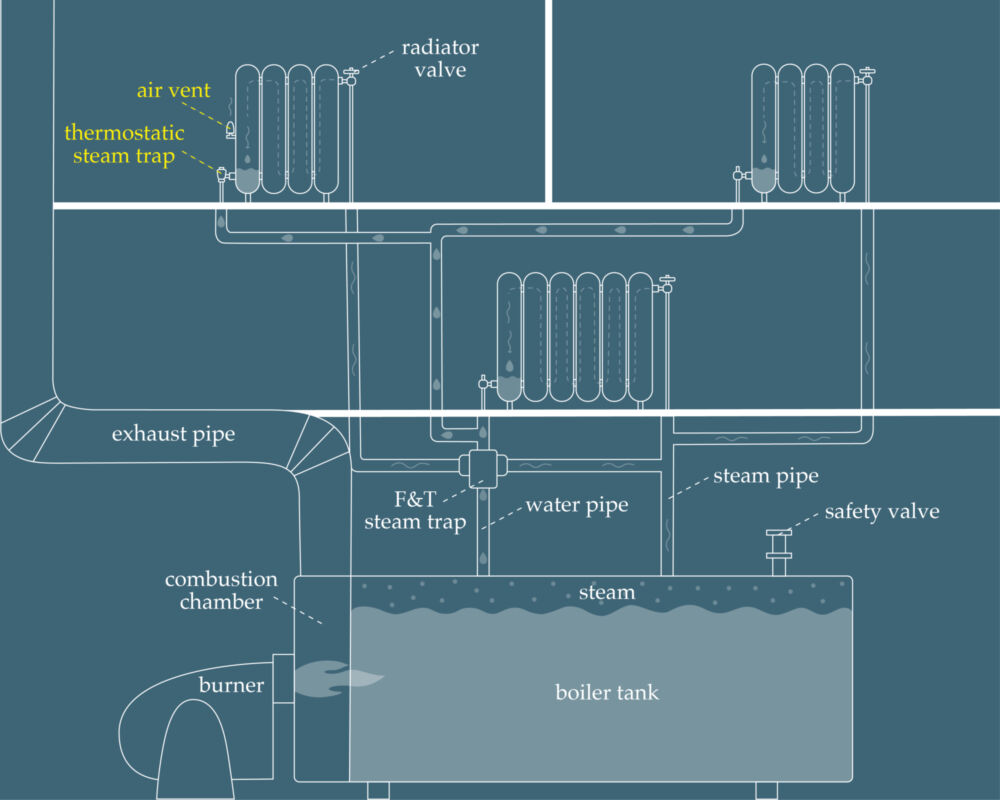
Overview of a steam heat system with air vent and thermostatic steam trap on a radiator. Illustration by Diana Steelman
Uneven heating in different units of a building is caused by a variety of factors, including the position of the sun during the day, the direction of prevailing wind, variability in the air sealing of a building, etc.
But one culprit for uneven heating can be the air vents. In one-pipe systems, these vents allow air to escape the radiator as it fills with hot steam. But sometimes, steam can be prevented from reaching some radiators because the air inside the pipes is not pushed out by the steam fast enough, or at all. This is usually the result of failed radiator vents and/or inadequate air venting at the ends of steam distribution mains and the tops of steam risers.
Replacing failed radiator vents and adding new vents to the ends of mains (primary pipes connecting to boiler) and the tops of risers (vertical pipes to cary steam) will help air escape the system more quickly, which can reduce heat imbalance, leading to efficiency improvements of between 5 and 10 percent. Replacing failed air vents attached to radiators can be easily handled by most building supers; installation of main and riser vents may require the services of a plumber or other professional.
6. Install thermostatic radiator valves
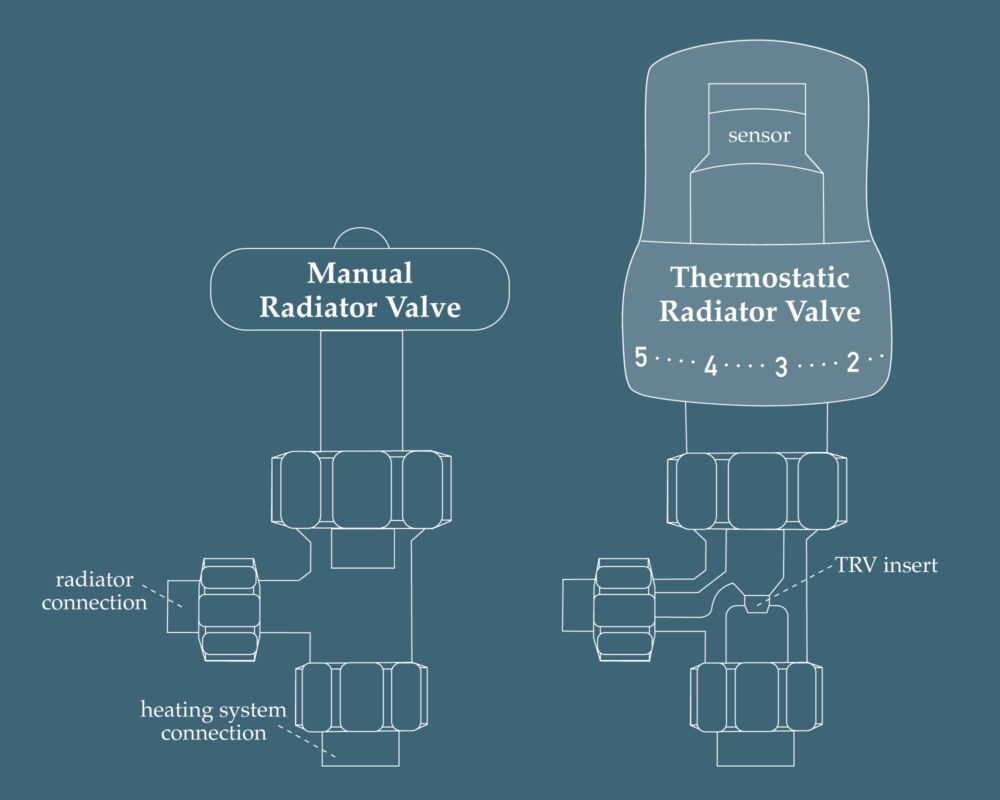
Radiators come standard with a manual radiator valve (right), but they can be replaced with a thermostatic radiator valve (left) for greater local temperature control. Illustration by Diana Steelman.
Thermostatic Radiator Valves (TRVs) control the amount of steam supplied to individual radiators, allowing residents to adjust the temperature of their space. This increases resident comfort and reduces fuel consumption, because boilers are not always supplying the maximum amount of steam to all radiators within the system.
Adding TRVs can involve replacing parts of the distribution system that connect to the radiator, and in most cases should be done by a professional plumber. If installed improperly, these retrofits can lead to steam and water leaks, and should be performed by licensed professionals.
7. Improve temperature controls with a building management system
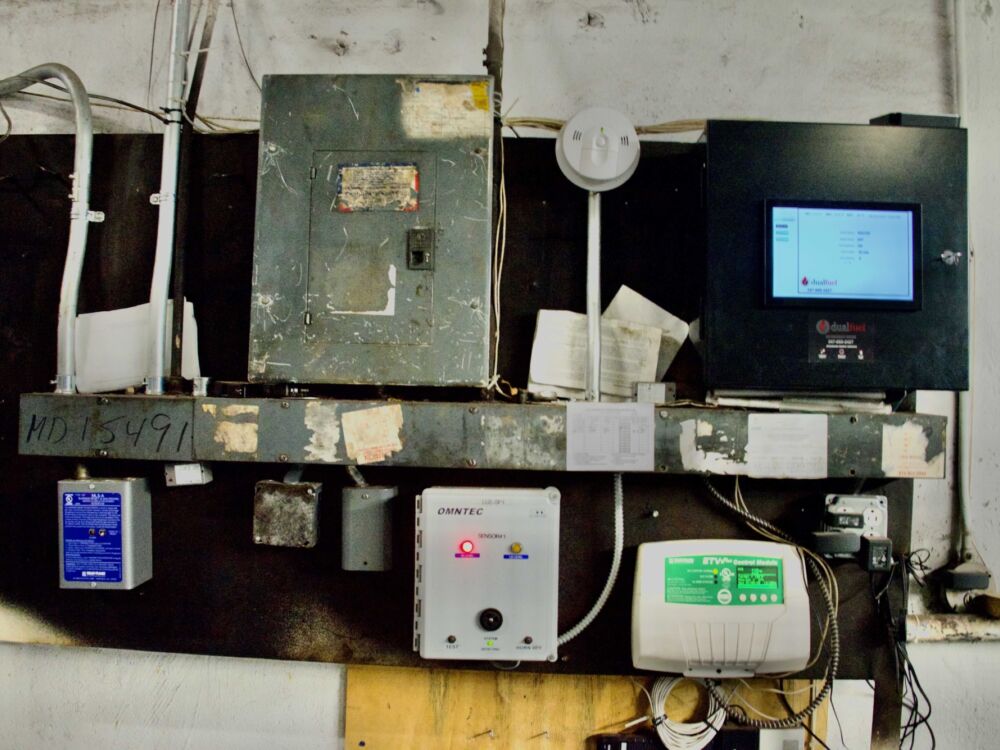
Sherman Terrace’s boiler contractor, Dual Fuel, installed a RTEM system called Axxon (pictured in upper left) to gain better insights on the boiler operation. Photo: Demi Guo
At its most basic, a boiler functions in a binary on/off way — either the system is on, and heating water to a specific high temperature (typically 180°F or above), or it’s off. But this can be a very inefficient way to run.
A step up from this, which many boilers in multifamily residential buildings already use, is an outdoor reset control (ORC). This system modulates the boiler’s run cycle and water temperature in accordance with the outdoor temperature. So for example, when it’s very cold outside, say 20°F, the ORC tells the boiler to run at full capacity, heating water to a very high temperature. But if it’s a warmer 40°F outside, it may not heat the water as high, or run as long. Some controls will turn the boiler off completely once the outside air reaches a certain temperature.
For many years, ORCs, plus the addition of TRVs, were the best tools a building had to improve a boiler’s efficiency. But new digital technology has emerged in recent years to offer even more precise controls. These include Building Management Systems (BMS), which use sensors to control boiler operation based on indoor temperature, not just outdoor.
Take for example the Real Time Energy Management system, a proprietary BMS created by Duel Fuel and installed at the Sherman Terrace co-op in the Bronx. This system allows building management to set the desired temperature for the entire building, and uses wireless sensors and a modem to communicate temperature data between individual apartments and the boiler in the basement. It also records all this data and sends alerts when energy use is out of the ordinary. BMS systems can be pricey to install, so they represent a significant capital investment for many buildings. But they can also pay for themselves in energy savings.
What should I do first to make my boiler run more efficiently?
Not sure where to start? Here’s a quick checklist to help identify visible or audible warning signs that your building’s steam heating system could benefit from one of the upgrades described above:
Visual cues
- Rust around the boiler, pipes, or radiators may indicate leaks, worn insulation seals, or condensate trapped within insulation that merit professional inspection.
- Pooling water or visible water vapor are clear signs of leaks that require immediate attention.
- Uninsulated pipes in the basement or mechanical room are a clear sign of wasted heat.
- Discolored water during flushing can suggest sediment buildup, meaning the boiler may need cleaning.
Physical cues
- Uneven heat between apartments or radiators often points to air venting issues.
- Overheated or underheated rooms within the same unit may suggest the system would benefit from more temperature control from a thermostatic radiator valve..
Other potential Issues
- If the boiler runs constantly without maintaining steady indoor heat, that may indicate poor venting, water quality issues, or an outdated burner.
- If the annual inspection sticker is missing or out of date, it may be time to schedule your law-required yearly inspection by a licensed boiler technician.
Efficiency now, clean energy later?
Ultimately, each building will need to weigh the costs and benefits of retrofitting an existing boiler against replacing it with a different, electricity-powered system. No matter what they choose, investing in efficiency now will reduce fuel costs and ensure compliance with New York City’s tightening emissions rules. By planning ahead, owners can turn what might feel like a regulatory burden into smarter, cleaner, and more resilient building operations — and a cleaner, more comfortable city for generations to come.
Reporting contributed by Camille Squires.