
“Something they can talk about with their board”: Reflections on Skylight in print
The Skylight team offers lessons on the rewarding experience of distributing our debut tabloid to residential buildings throughout the city.
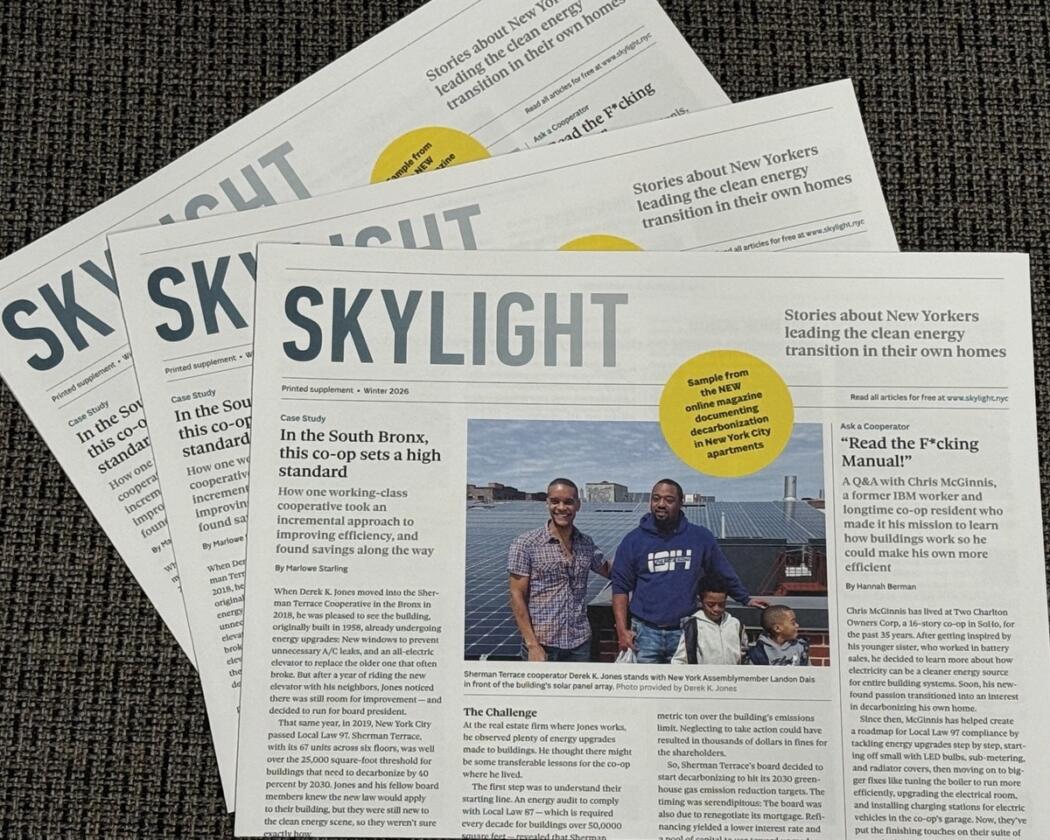
Skylight's first printed tabloid, Winter 2026. Photo: Hannah Berman
At the start of this year, faced with the challenge of meeting readers where they are doing the work of decarbonization — in their own homes — the Skylight team decided to pound the pavement.
In February, the team printed and distributed copies of its debut tabloid — a four-page spread of existing Skylight stories, arranged in a traditional newspaper layout to offer readers a comprehensive overview not only of Skylight’s reporting, but the New York City building energy transition in progress.
Skylight staff and friends then spent the next few months distributing the tabloid to buildings all across New York City. Ever since, Skylight Publisher Eric Lee has had many “startling” encounters with New Yorkers who recognized Skylight from the print they received in their building’s mail room.
In one encounter, Lee was handing out tabloid copies at a Jackson Heights farmers market over the summer when he met a woman who already recognized Skylight; she’d received a copy of the tabloid in her building.
“We printed 2,500 copies, so in a city of eight and a half million people, you wouldn’t necessarily imagine bumping into somebody who got the print edition. But that has happened several times,” Lee recalled. “It’s been pretty gratifying.”
The idea for the tabloid was initially conceived out of a need to increase awareness of Skylight as a publication in its infancy. But unlike other new media, Skylight’s specific mission covering New York City means it can’t just rely on an online viral moment to gain readership.
Stefanie Lew and Joseph Cho are principals at Binocular Design, which designed the Skylight website. They initially proposed the idea of a printed tabloid to Lee and former program director Hannah Berman as a tangible “sampler of articles from various editions” Skylight has published online, Lew said.
“We tried to imagine what Skylight would be like if this were the pre-website days, much like you would have a small newspaper or a tabloid on the news on the subway,” Cho added.
The Skylight team worked with Lew and Cho to design a print that not only “showcased the best of Skylight” but was also “easily accessible from the outsider’s perspective,” Berman said. When choosing the tabloid’s content, the team reread all of Skylight’s articles from the perspective of someone unfamiliar with the difficult work of building decarbonization.
Berman, who shepherded the project, said she found the task of making Skylight “legible as an entity to people who don’t understand what we are,” to be a “really interesting and cool intellectual challenge.”
After undergoing many iterations, Skylight finally put the tabloid to print and first mailed a portion of its 2,500 copies to several allied nonprofit organizations, city council members, and friends working in industries concerned with building decarbonization, according to Lee.
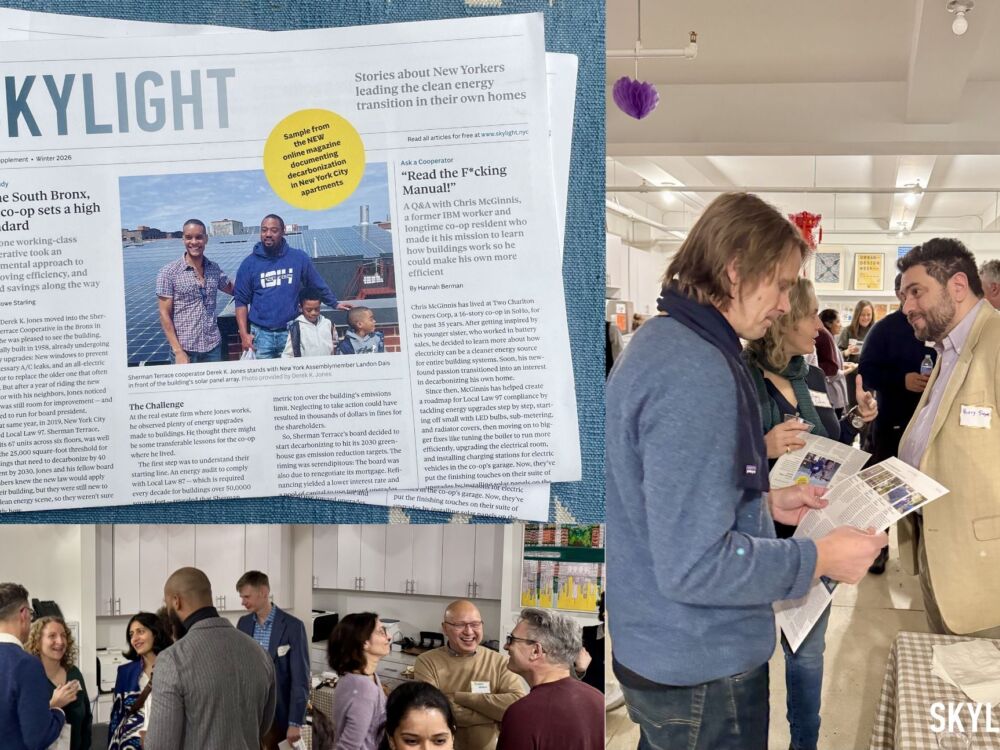
Readers peruse the Skylight tabloid at an launch event in February 2026. Photos: Hannah Berman
Next came the biggest distribution effort; going door-to-door handing out copies in person to relevant apartment buildings across New York City. For this project, Berman worked with Skylight consultant Jaime Stock to download and analyze public data of co-op and condo locations across the city. Equipped with this data, the Skylight team chose to visit co-ops in densely populated neighborhoods.
“The task was to go off into the world with a whole stack of printed editions, and knock on doors…and leave about five printed editions at every building you go to, in the hopes that co-op board members…would be able to grab a copy and engage with the content,” Berman said.
At times the door-to-door distribution was challenging. “Getting these flyers to the right people requires you to go through gatekeepers or to gain access to a physical building,” Stock said. “Not everybody wants to take stuff (and) not everybody wants to put stuff out. But most people were pretty excited about it and open to it at the minimum.”
These in-person distribution challenges mirror the ones faced by New Yorkers seeking to renovate their buildings, Stock added: It’s difficult for buildings looking to undergo energy upgrades to find the right people to assist with the project. And even if you are the qualified person, it’s hard to connect with everyone else you need to work with to “make stuff happen.”
Still, the Skylight team found the distribution a mainly rewarding experience.
Stock found going door-to-door on the Upper West Side “really fun” because she encountered “really nice, lovely doormen who were excited to chat and happy to tell me they would find the head of the co-op board and make sure they saw it.”
For Lee, the “most striking” part of his distribution experience was in the East Bronx, where he saw “a wide range of kinds of apartments in one neighborhood.”
“There are a lot of stereotypes about the clean energy transition and who’s interested in them,” Lee said. But when conversing with New Yorkers from all “kinds of different circumstances,” across the city, Lee found that they responded to Skylight with a common “openness” to solutions in the buildings of fellow New Yorkers.
Ultimately, Skylight’s team members found the debut tabloid project so successful, that they plan to release future printed editions, Lee says.
Those who received the tabloid also largely found it to be a useful tool.
“I love the maps showing where projects are and the succinct ways of capturing other stories — emphasizing its people that do this work,” Judith Boroschek, a climate organizer with Mothers Out Front, who received one of the tabloids by mail, wrote in an email to Skylight. “Overall [Skylight] really show[s] how decarbonizing is do-able.”
Two core tenets of Skylight’s mission are making the work to lower building carbon emissions visible, and providing an informational roadmap for New Yorkers to follow the example of their neighbors, Lee explained. He says the in-person distribution project “substantially advanced” these goals.
“The problem is visibility, and so you don’t just want to make it visible [digitally] — you want to make it visible in an embodied sense.” Lee said. “You want to meet people, show them that you’re doing the work, as are other people who are represented in a publication.You want to show them you’re present where they live.”
“Skylight is founded with the theory that people need to feel less alone in this struggle,” Berman said. “From talking to a lot of different people in this situation, a lot of them feel really alone, and so part of (the reason why we are) going in person and giving them something that they can talk about with their board…is we want to build this community of people who believe in the mission of decarbonizing New York City.”