
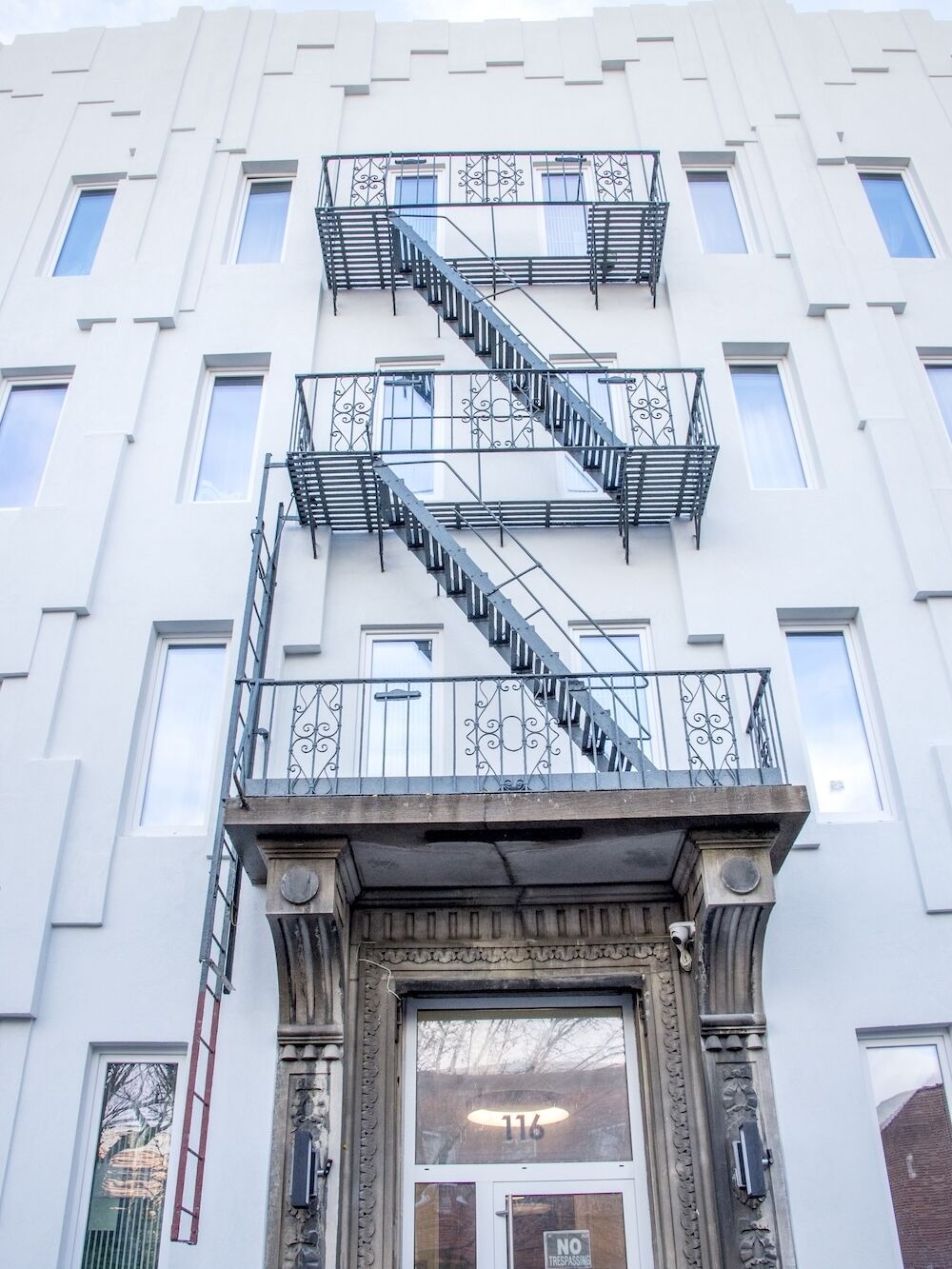
Exterior entry to one of the buildings in the Casa Pasiva development. Photo: Provided/Casa Pasiva
The passive house movement is alive and well in New York City, proving that even old buildings can achieve extreme efficiency
In 2018, RiseBoro Community Partnership, a nonprofit affordable housing developer and social service community organization, had a choice about how to approach the renovation of 143 units across nine multi-family buildings it owned in Bushwick, due for refinancing and upgrades. The organization decided that updating the 90-year-old development to reduce energy consumption was a no-brainer; RiseBoro was already a frontrunner in terms of greening buildings in New York after building the state’s first 100% affordable passive house, nearby in Bushwick.
Even though retrofitting existing buildings can pose a very different challenge than imagining a new structure from the ground up, RiseBoro decided to take a similar approach for the renovation — installing a hyper-insulated building exterior; tearing out old heating systems and replacing them with split unit heat pumps; and adding energy recovery ventilators (ERVs) to the exterior— all in the service of minimizing the amount of energy needed for heating and cooling. These strategies come from the passive house movement, which was formalized as a voluntary building certification program in the 1970s during a global energy crisis.
“We’re going to have these buildings in perpetuity,” said Josh Shaffer, capital planning and sustainability manager at RiseBoro. “So it really makes sense to build to a passive house standard, because your operating costs get lowered so substantially, and it just makes it easier to operate the building and provide a safe and comfortable space for our tenants.”
They eventually dubbed the nine buildings “Casa Pasiva,” which is “passive house” in Spanish, a nod to the building’s mostly Spanish-speaking residents. Not only did the retrofit result in a 40 to 50 percent building-wide reduction in energy use, but RiseBoro managed to execute the improvements without displacing tenants.
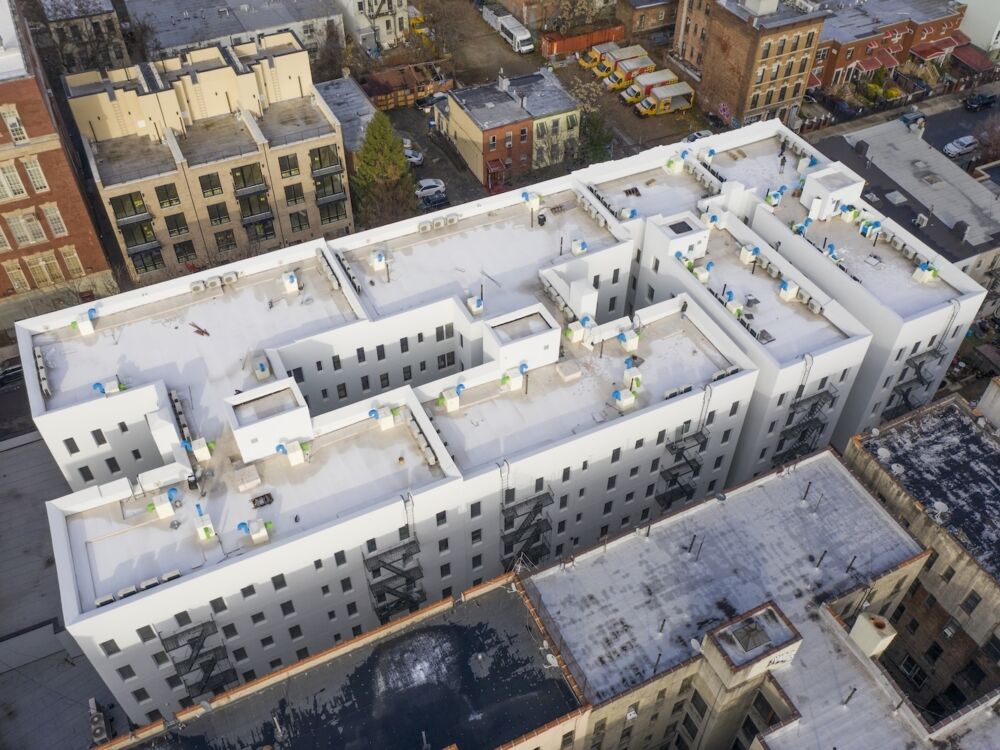
A bird's eye view of Casa Pasiva, with newly insulated roofs. Photo: Provided/Casa Pasiva
As New York City’s building sector has been driven by policy in recent years to steer away from leaky buildings and oil furnaces toward a cleaner and less carbon-intensive future, owners, developers, and contractors have been experimenting with a myriad of innovations to make buildings operate more efficiently.
In the passive house standard, builders are finding a proven approach to making buildings more energy efficient that can support these efforts. The basic philosophy of the design framework is this: When buildings are constructed to self-regulate temperature — staying warm in the winter and cool in the summer — they require less energy to artificially manipulate indoor temperature.
“The interesting thing about passive house, which changes the game completely in New York, is if you do it well enough, you almost don’t need heat,” said Michael Ingui, president of New York firm Ingui Architecture and the founder of Passive House Accelerator, a platform for spreading knowledge and information about passive house projects.
Since passive house’s early days in Europe in the 70s, it has fully taken root in New York City. The city now boasts a number of innovative passive house projects, including The House at CornellTech, a 26-story residential tower that was at one time the largest passive house building in the world; Engine 16, a former firehouse turned church turned multifamily passive house; and now, Sendero Verde, the East Harlem development that offers more than 700 units of affordable housing built to passive house standards.
Typically, passive house standards have been applied to new construction and single family homes. But New York City is proving that these concepts can be also applied to existing buildings through retrofits — even on historic buildings, or co-ops and condos that have exterior aesthetic requirements. What’s more, these changes don’t have to be prohibitively expensive; most buildings can justify passive house applications based on a simple ROI calculation, even without subsidies.
“High-performance, low-carbon buildings are not just possible, but scalable and essential to the future of our communities,” said Shaffer.
Passive house 101: What makes a passive house?
Passive house is premised on five central concepts: A well-insulated envelope, an airtight envelope, reducing thermal bridges, high performance windows and doors, and balanced heat recovery. These principles can be applied to new construction and to existing buildings alike. Here is a breakdown:
- Insulated building envelope: A building should have a continuous layer of insulation to retain consistent temperature, which helps keep the building warm in the winter and cool in the summer.
- Airtight envelope: In addition to insulation, the whole building envelope — that is, the exterior walls, roof, and basement — should include another layer that acts like a windbreaker and stops air from penetrating to the inside. Air barriers can be built with sheet membranes, fluid-applied membranes, tapes, and sealants that transition between components of the building envelope.
- High-performance windows and doors: Windows and doors are points of entry for cold and hot air. Having high-performance doors and triple-pane windows reduces that leakage.
- Balanced heat recovery: Filtered fresh air helps make passive house buildings healthy living spaces for residents, which is especially important because the buildings are designed to be airtight. HRVs (heat recovery ventilators) and ERVs (energy recovery ventilators) are two types of “balanced ventilation” components: In the winter, they allow heat energy in the outgoing air to passively transfer to and warm the incoming air, without the two airstreams ever mixing. In the summer, it’s the reverse.
- Reducing thermal bridges: A thermal bridge is any building element that allows heat or cold to bypass a building’s thermal barrier — for example, a concrete floor that continues from inside to outside, or a beam that penetrates an exterior wall. Thermal bridges can be minimized or eliminated by introducing gaps or insulation to interrupt the transfer of heat or cold.
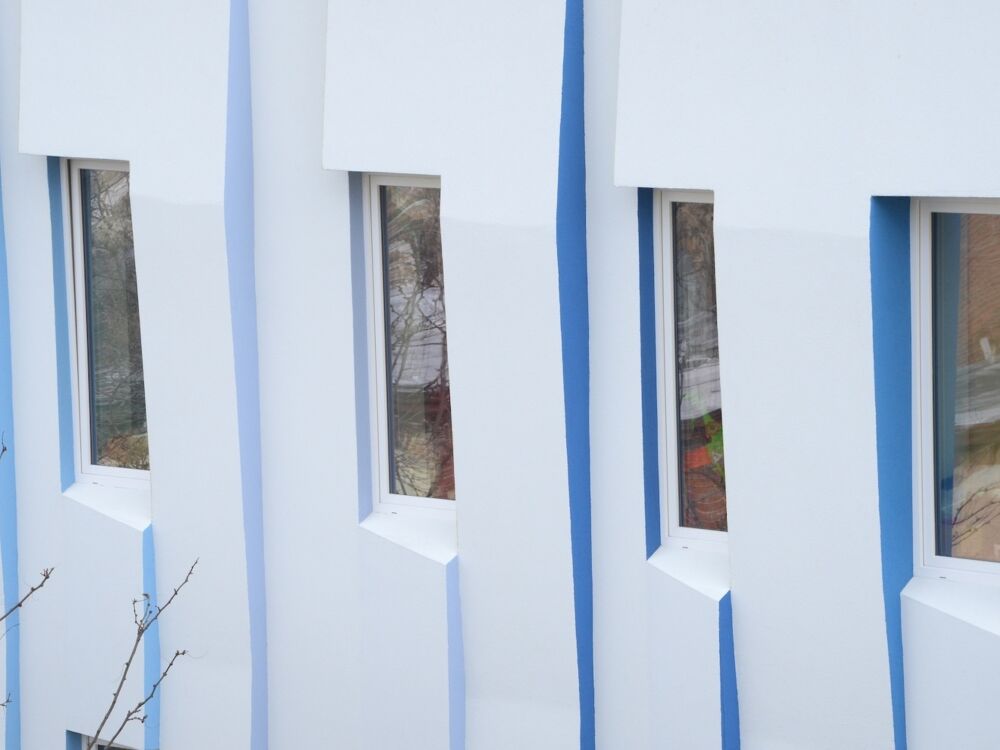
Casa Pasiva's high-performance windows and airtight envelope. Photo: Provided/Casa Pasiva
The passive house movement in New York City
Interest in passive houses has been growing in New York City in recent years. Carmel Pratt, the executive director of New York Passive House, which is the leading nonprofit organization that supports the movement in New York City and New York State, told Skylight that an encouraging policy climate has led to an uptick in project certifications in New York City.
There are currently two pathways to certification. One is the international standard through the Passivhaus Institute (PHI). The other is the North American Standard through Passive House Institute U.S. (PHIUS). Collectively, the two organizations have certified millions of building square footage in the United States.
“When [passive houses] first came out, it was seen as this premium, more expensive thing… and that’s kind of flipped in the opposite end in a really great way,” said Pratt. “We’re now seeing the scale tip that actually many more really large scale multifamily affordable housing projects are pursuing the certification standard.”
Ingui concurs: “Because of the scale, whether it’s affordable housing or it’s market-rate housing, [doing a passive house retrofit] winds up becoming cost neutral at a minimum for large development projects.”
One catalyst for the increase in projects has been incentives from state and local authorities to reduce the cost of adopting passive house in New York. New York state’s Clean Energy Initiative, in partnership with housing agency Homes and Community Renewal (HCR), offers low interest loans for affordable new construction and rehabilitation projects that pursue passive house standards. This funding is designed to help projects meet sustainability guidelines required by HCR.
Incentives also exist at the city level; the city’s Housing and Preservation Department (HPD), in partnership with the New York State Energy and Research Development Authority (NYSERDA), provides additional funding through the Future Housing Initiative to new construction projects pursuing passive house certification.
“Now it’s our work to get market rate and luxury to see the benefits,” Pratt added. “There’s still a great ROI financial incentive to pursue passive house for a long term operational costs benefit, not just [for] a potential subsidy.”
Retrofits in action
Bed-Stuy Passive House
When Ruth Mandl, co-founder and principal of design and build practice CO Adaptive, bought a brownstone with her partner in Bedford-Stuyvesant in Brooklyn in 2016, she knew from the start she wanted to do a passive house renovation.
“If you’re going to do anything close to a gut renovation, renovating to passive house standards is only a five to 10 percent increase on a standard construction” based on costs at the time, said Mandl. “And that pays off in the lack of energy bills over seven to 10 years.” Her building is now totally electric, and since the energy consumption is so low, the load is entirely covered by a rooftop solar system, which also powers an electric vehicle.
She pointed out that the passive house design is also about comfort for the people who live there. “You can sit by a window in the cold of winter in your underwear and you’re not cold,” she said. “And the fact that that sort of package…is also good for our planet? I mean, it’s a no brainer.”
The retrofit involved the application of substantial blown-in cellulose along with mineral wool batts on the interior of the building, in order to provide insulation while preserving the historic exterior. Additionally, roughly a dozen tilt-and-turn, triple-pane windows were installed, with operable exterior shades to mitigate solar heat gain in the summer. In order to minimize penetrations in the house’s air-tight membrane, new plumbing, electrical, and ventilation systems were located within an interior central spine from which they branched out to service each floor. The project is now in the final stages of approval for certification with PHI.
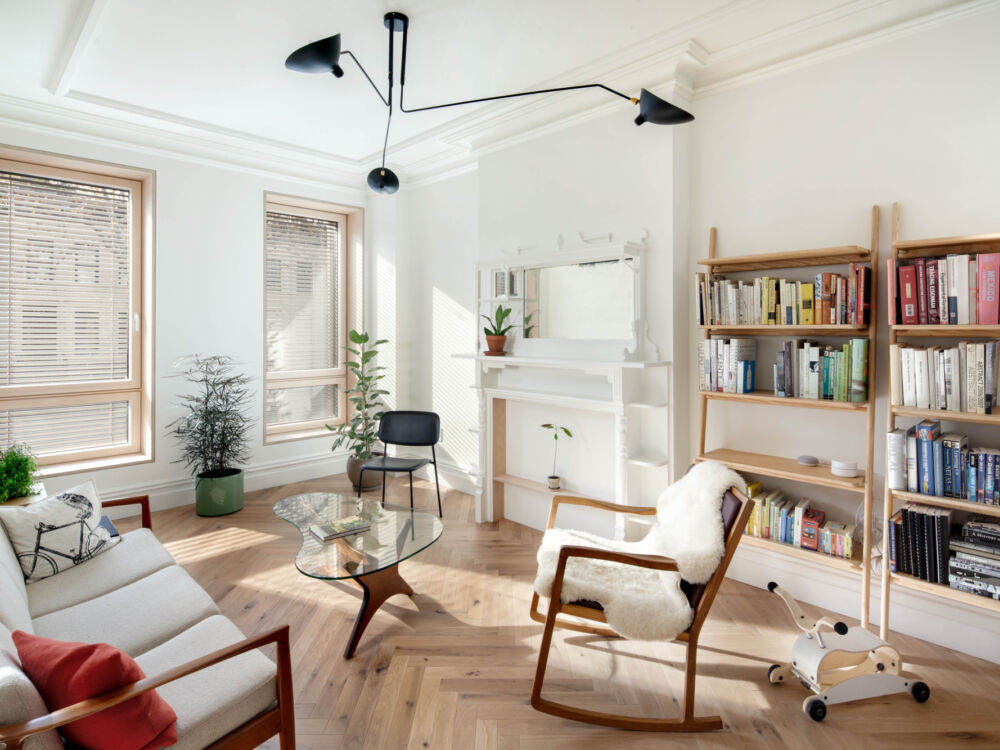
Now completed, the Bed-Stuy passive house is a low-energy single family home. Photo: Peter Dressel/Provided by CO Adaptive
“Once you experience [a passive house], it’s sort of a no-brainer that this is the future of building,” said Mandl. “While construction prices are climbing and energy prices are climbing, [with a passive house,] you’re at a stable point, right? And that, I think, is what’s special. So while it was definitely more than anybody would have invested in our neighborhood at that time, we knew we were going to live in that house. And it wasn’t about resale value, it was about a home for us. I am beyond happy now.”
Mandl and her family did not live in the home during most of this renovation, but she recognizes that in order to update the city’s existing housing stock, many retrofits will have to happen with people inside their homes.
RiseBoro similarly minimized the amount of work needed to be done on the Casa Pasiva units by putting new cladding on the building exterior. In this way, they were able to keep tenants in place during the renovation. But for some homes, that is not a possibility.
“There’s a lot of old housing stock in New York, including old tenement buildings, where it’s really hard to get the building to an entirely empty state to do a passive house renovation,” said Mandl.
Three Arts
Three Arts, a 62-unit high rise apartment building in Manhattan, was built in 1926 as the first residence in the United States intended for young women in the arts. Almost 100 years later, it is undergoing a massive rehabilitation to continue to support a different specialized population, this time providing deeply-affordable housing for seniors.
“We’re actually providing homes for people who need it,” said Sean Flynn, of Curtis + Ginsberg Architects. “And we’re also making a building that conforms to the best possible standards for energy use and the standards necessary to cherish its history and be respectful of its importance.”
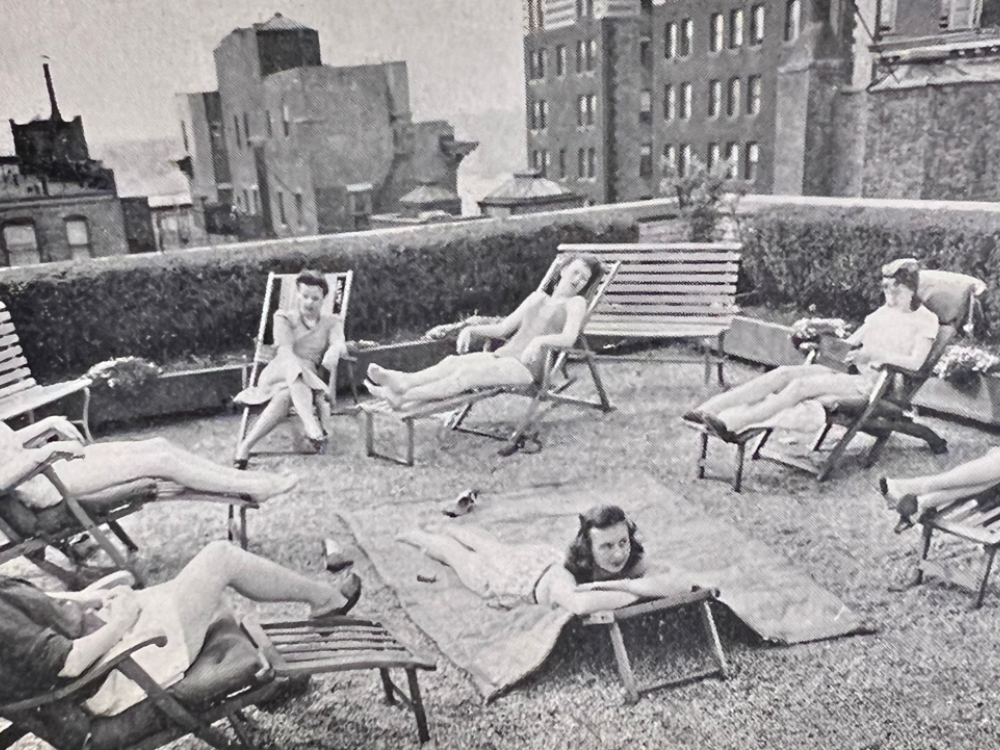
Residents lounge on the roof of the Three Arts building back when it was a home for single women in New York City. Photo: Provided/WSFSSH
Curtis + Ginsberg Architects have a habit of recommending passive design to clients. Flynn said that the Three Arts owner, West Side Federation for Senior and Supportive Housing, was fully supportive of the vision.
The combination of Department of Interior standards for historic places as well as New York Landmark District rules presented various obstacles to designing the building to passive house standards. A newly insulated exterior was off the table, and the interior walls could not be built in more than three inches. Though Curtis + Ginsberg Architects would have preferred to install more insulation, they installed only 2.5 inches (plus half an inch of gypsum board) from the inside. But even so, the modifications are expected to be effective — the building is still on track for a passive house certification from PHI.
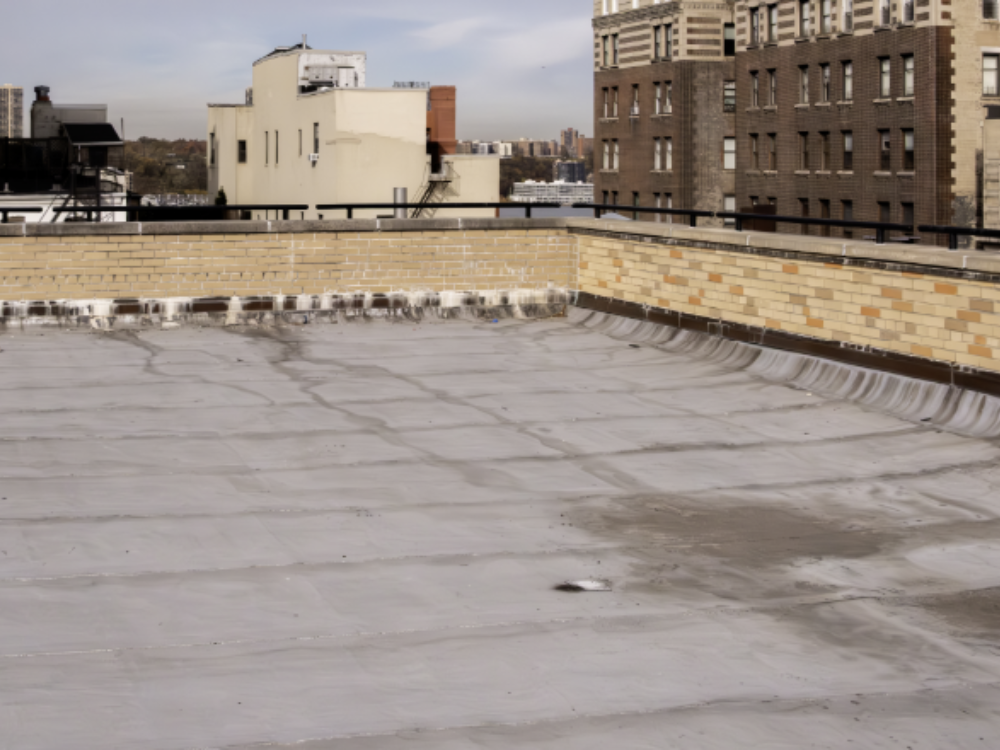
The roof at the Three Arts building as it is today, before renovations are completed. Photo: Vishnu Rao/ Provided by Curtis + Ginsberg Architects
The retrofit also includes triple-pane windows, packaged terminal heat pumps for space conditioning, air-source heat pumps for domestic hot water, and centralized energy recovery ventilation. The renovation is expected to be completed by the end of 2027, and the project has already received a $1 million award from NYSERDA through its Buildings of Excellence program.
Flynn noted that in addition to reducing operating costs, passive house design brings non-monetary benefits to its residents.
“Particularly for senior housing, draft-free, evenly heated spaces are extremely beneficial. The filtered air that’s brought in through energy recovery ventilation systems is also extremely beneficial.”
RiseBoro looks to the future
While RiseBoro puts the finishing touches on the Casa Pasiva rehabilitation, they look to the future for more opportunities to build and rehabilitate to passive house standards. They recently began rehabilitating a 24-building scattered site with 3 – 6 unit buildings also in Bushwick, where they will continue to pursue passive house retrofits when feasible.
“These projects represent a shift in how affordable housing can lead on climate, health, and long-term resilience,” Shaffer said. “We do what we can within the given budgets and on-site circumstances, but our target is always to build to a passive house standard.”
Reporting contributed by Camille Squires.