
Submetering for savings at Queensview
Behind the metering strategy that shifts the onus for electricity use onto the individual — making users more aware of their own waste
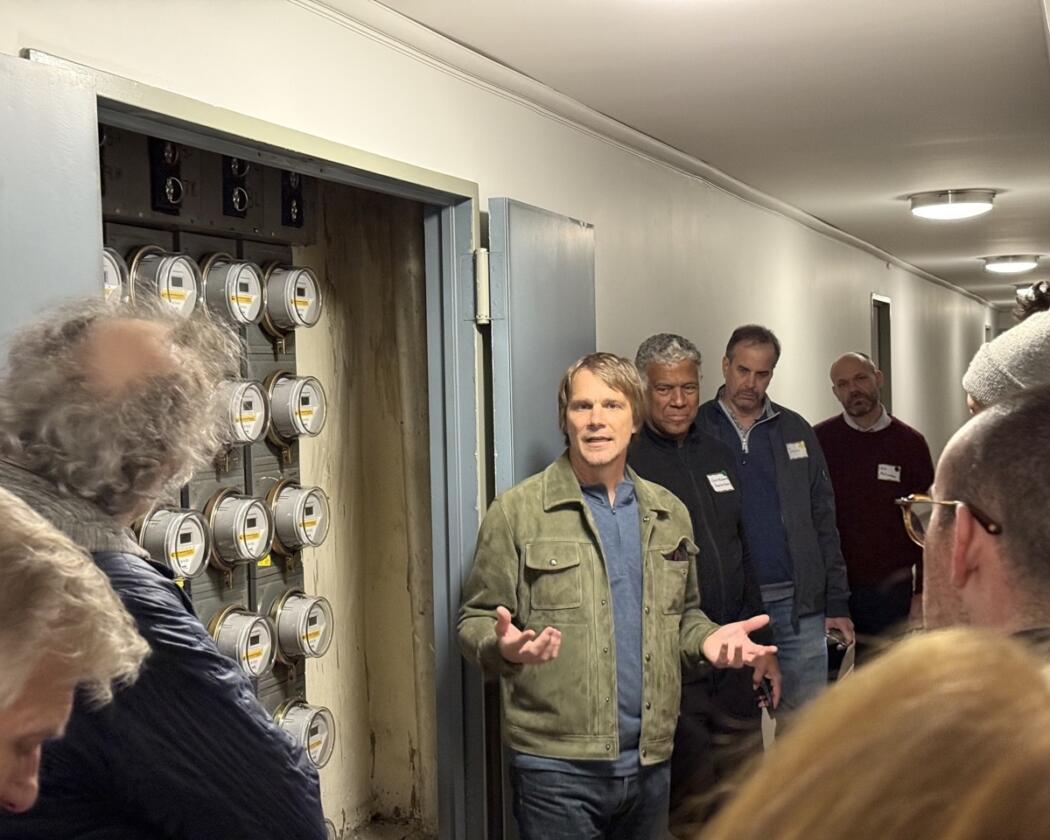
McGowan Southworth, co-founder and president at DaisyChain Energy, explains submetering outside of a meter closet at Two Charlton Owners Corp. Photo: Jaime Stock
Before 2025, thinking about electricity costs at the 726-unit Queensview co-op was a burden that board president Victor Roggia bore practically alone. When electricity was billed to the complex as a whole and divided equally among residents as a building expense, individual shareholders weren’t conscious of how much they were using.
“We couldn’t afford to pay the electric bills anymore because everybody was walking around here saying, ‘What do we care about electric? It’s free!’” said Roggia.
But as part of an efficiency-first strategy to reduce emissions and avoid Local Law 97 (LL97) fines, Queensview underwent submetering — the installation of additional meters that measure electricity consumption by individual households.
The submeters output hyper-specific usage data for energy consumption, heating, and electricity usage across all the apartments in the complex. To track all of this data, Queensview installed meters produced by InTech21 in every apartment, in addition to the boiler room and common spaces. Each meter connects back to a comprehensive distributed energy resource management systems platform. This allows property managers to view real-time utilities usage for each individual unit, pulled from sensors located in each apartment and stored in cloud storage. While the core features of this building management system are similar to others on the market, it offers an additional feature of measuring in-unit temperatures, which provides building managers with live updates from tenant apartments without having to submeter the boiler.
Once installed, the largest “building system” the submetering impacted wasn’t a system at all, but rather residents’ behavior around energy usage. Households experience more fair billing for monthly maintenance costs as a result of submetering, and Roggia estimates that 65 percent of households at Queensview experienced reduction in maintenance costs, while a smaller proportion of residents experienced a hike in monthly maintenance fees due to consuming more electricity than their neighbors.
Still, even those residents who are high consumers became more conscientious of their energy consumption, said Roggia. “There’s 25 people that use the majority of electricity [here]. Once they figured out their bill — like, mine is $60, $70, $80, it depends; theirs were like $700 [or] $800 — then, all of a sudden, their awareness changed, and they started using less.”
The submetering project only began in March 2025, so there is no comprehensive data available yet on how it has reduced energy consumption since. But Roggia emphasized that the overall reaction from residents has trended in the right direction.
At the same time that submetering aimed to reduce overall electricity usage and carbon emissions, the Queensview board also tried to improve overall affordability in an environment of rising electricity costs. They did this through buying energy in bulk from Constellation Energy Group, a third-party energy supplier that delivers energy to buildings in New York City using Con Edison’s infrastructure. Victor noted that Queensview households save 30 percent more than if they’d had individual ConEd accounts.
“Costs can still go up, because the rates sometimes are offsetting,” said Thomas Morrison, Director of Energy Management at EN-POWER GROUP. “But the ROI [return on investment] is still there because we’re seeing the consumption savings.”