
Taking advantage of tax breaks gave this co-op a bigger budget for energy efficiency work
At the Queensview co-op, the J‑51 tax break secured almost $3 million in abatements over a nine-year period
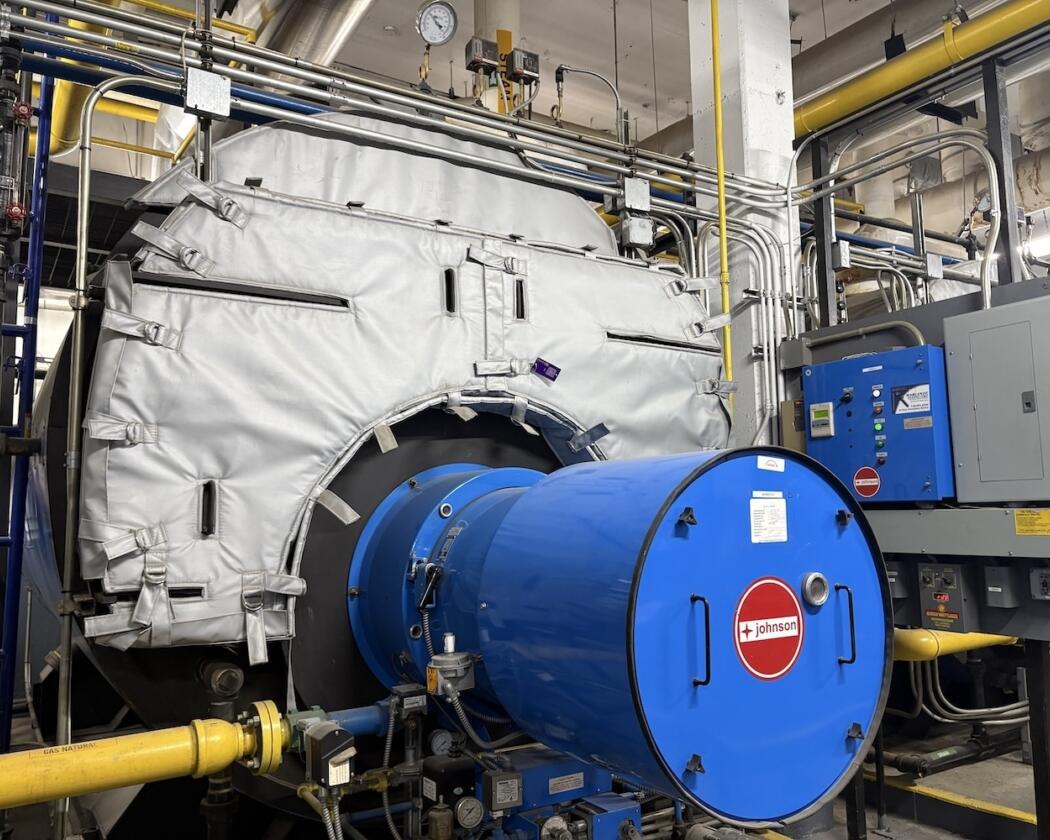
Installing insulating jackets for their steam heat boilers was one of the projects Queensview took on to improve energy efficiency. Photo: Emily Driehaus
The J‑51 tax break has the name of an arcane piece of city policy, but for those in the know, it’s a powerful tool for making building renovations happen.
The tax abatement was first introduced in the 1950s to incentivize certain New York City building owners to make important upgrades to aging buildings, and was just revived at the end of 2024, renamed J‑51 R, with an aim of explicitly helping qualifying homeowners afford energy efficiency renovations that ultimately help reduce carbon emissions.
Queensview, a 726-unit co-op building in Astoria, was able to take advantage of both versions of this tax break for their projects that began in March 2025 — but getting all of their work to qualify was a matter of very precise timing.
Miles Appelman is a J‑51 expeditor and consultant with his own firm based in Long Island. In the course of his 38-year career, he has filed thousands of J‑51 and J‑51 R applications for co-ops and condominiums in the Bronx and Queens, including for Queensview.
According to him, one of the key discrepancies between the old J‑51 program and the revived one lay in the scale of the work that must be performed to qualify for the benefit. “In the past, you could file for a J‑51 for any work that was in their eligibility schedule,” explained Appelman. “Now you have to do work that nets at least $1500 [of benefit] for every apartment in the building. I find J‑51 R has led to larger projects than in the past.” In the case of Queensview, the complex’s size meant that it had to undertake work costing at least $1 million to even qualify for the benefit.
Compared to the previous iteration of J‑51, another key challenge of the current J‑51 R program is the relatively small window of time for eligible projects, which other New York City co-op shareholders have raised concerns about: The tax break only applies to work completed between June 29, 2022 and June 30, 2026. The Queensview’s projects fell within this window, but even so, they only had four months after project completion to file a successful application.
To offset the costs of their energy efficiency projects, which included electrical submetering, roof repairs with added insulation, and the installation of a BMS for more precise energy use controls, Queensview was approved for a significant tax abatement over time. They received a tax break of $353,000 per year for eight years, and $141,000 in the ninth year, for a total savings of nearly $3 million. Having these funds freed up for the capital improvements was an enormous help, says co-op treasurer Alicia Fernandez.
“It is a very detailed and complicated process for a property of our size,” she said. “Miles Appelman did a wonderful job for Queensview, for both the J‑51 and the J‑51 R.”
Given this new truncated application process, Appelman advises other owners considering applying for the program to get started on meeting all of the initial requirements for an application early — especially the pre-notification requirement, a notice that must go out to building residents well in advance of any work that describes what type of renovation project will be happening, and how much it will cost.
“Pre-notify, pre-notify,” Appelman emphasized, “You have to send out a certified letter to every owner in the building, plus all the rental tenants in the co-op… I yell at my clients everyday: I say, ‘Guys, if you remember anything about this phone call, get pre-notified before you start — at least 30 days before.’”