
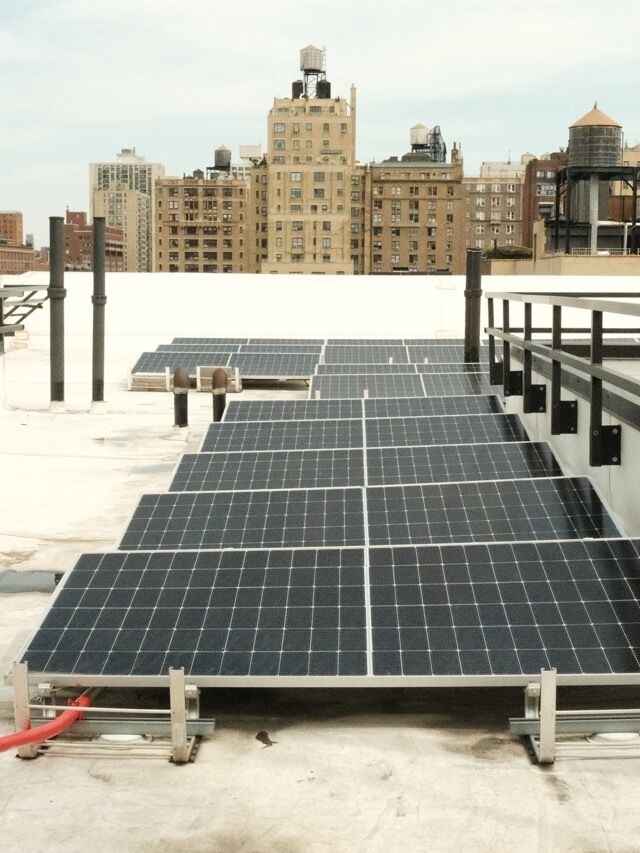
A view from the roof of the Lathrop at 46 W. 83rd St., complete with its new array of 77 solar panels. Photo: Alexander C. Kaufman
The Lathrop co-op made a solar installation work for its budget, and its historic landmark status. Now, it’s keen to choose more projects from a “menu” of energy efficiency upgrades.
Perhaps the building’s destiny was always in the name. Built in 1911 on what’s today a leafy stretch of the Upper West Side next to Central Park, the eight-story co-op at 46 West 83rd Street was dubbed the Lathrop, a name which originates from an Old Norse term for a lush green rural farmstead located on a settlement’s frontier.
It’s unclear who chose the regal-sounding English name for the 60-unit building. But more than a century after its construction, the Lathrop’s co-op board did, indeed, try to remain at the leading edge of “going green”.
Sometime in the early 2010s, the board considered lining the rooftop with rows of energy-harvesting solar panels at the behest of environmentalist members who wanted to do their part to fight climate change. But this was before China’s mass production of photovoltaics sent the cost plummeting, and an initial calculation of the costs for the Lathrop showed that installing the panels in a way that was compliant with the building’s landmark status would be expensive. Plus, charting out the path to claiming and distributing the benefits of nascent state tax incentives was complicated, so the board abandoned the idea.
“We crunched the numbers and we spoke to our accountant, and we said, ‘It doesn’t work,’” Mindy Stern, the long-time resident who heads the board, said on a recent weekday afternoon. “So we said, ‘Not for us.’”
A few years later, the economics started changing. The passage of Local Law 97 (LL97) meant the Lathrop would be staring down potential fines by 2030 from energy efficiency lapses as the statute gradually took effect.
Along came the legislation in April of 2019 and, “like everyone else, we freak[ed] out,” Stern said. The board reconnected with architect Ted Sheridan and McGowan Southworth, the co-founder of DaisyChain Energy, both of whom had engaged in the building’s previous effort to build solar on the roof. This time around, the calculus looked different: lower solar prices, increased state grants for building panels, and the threat of looming fines on the fiscal horizon if they did nothing.
To offset how much natural gas residents used, the Lathrop needed to use more electricity, but the vast majority of the electrons on the New York City grid were now coming from natural gas since the state shut down the Indian Point nuclear station north of the Bronx that once supplied virtually all the clean power in the five boroughs. To guarantee new power that was both clean and cheap, the building needed solar panels.
“This time,” said Stern, a lawyer and Bronx native, “we could make the numbers work.”
By the time the project completed earlier this year, the board at 46 West 83rd Street had carried out a first-of-its-kind renovation that could offer a model for other large, pre-war buildings looking to comply with a statute the city is fully prepared to enforce, albeit with some potential tweaks.
It started on the roof
By the time the board called Sheridan again for a consultation, the Canadian-born architect noticed a shift.
“This board was really serious about it,” he said.
Sheridan, too, had grown more serious about the project. While his firm, Ryall Sheridan Architects, had long specialized in upmarket green renovations, Sheridan himself had gained an insider’s appreciation of the new policy conditions under which the entire industry was working. During the COVID-19 pandemic, when then-Mayor Bill de Blasio’s administration was working out the details on implementing LL97, Sheridan joined about 15 other professionals in an advisory panel that helped shape the carbon accounting rules the city uses to encourage electrification of buildings.
“The members were incredibly varied. There were environmental advocates, but there were also developers. It wasn’t a one-sided discussion,” Sheridan recalled. “It was quite effective actually.”
When the Lathrop board approached him again, Sheridan offered them a list of roughly 20 potential upgrades and renovations the building could undertake to comply with the law.
“They picked a few key things from a big menu,” he said. “And they actually had the money to do it.”
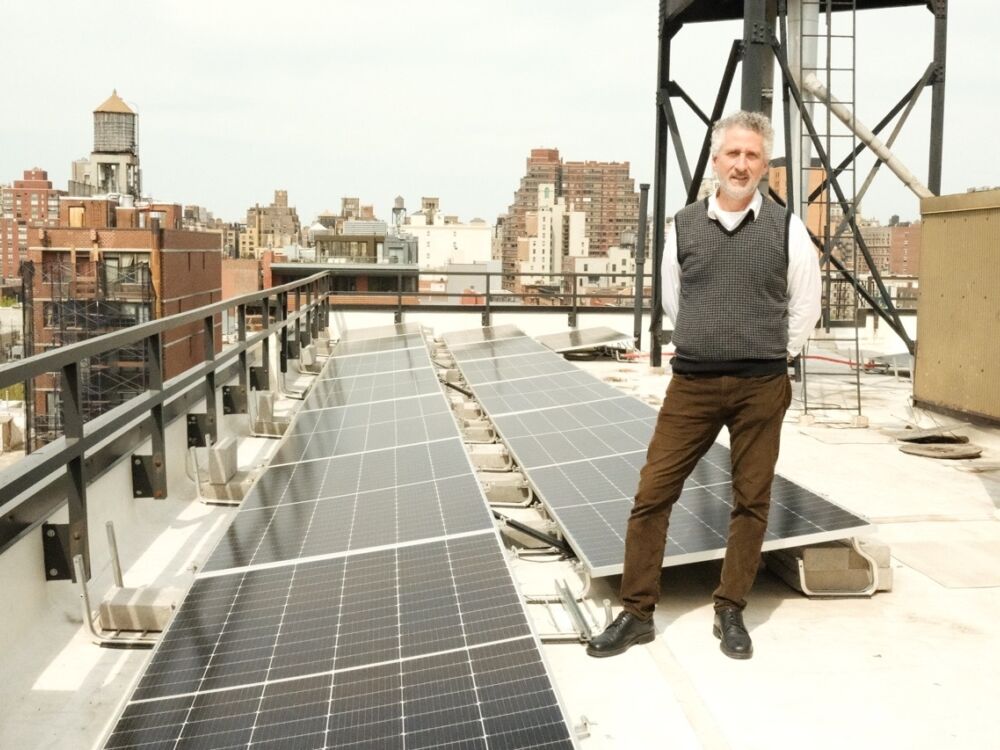
Architect Ted Sheridan stands alongside the new solar array he helped create. When the board approached him for a consultation the second time around, he could tell This board was really serious.". Photo: Alexander C. Kaufman
The roof was the natural starting point. Aside from first the aborted solar idea, the board had for years entertained the idea of greening the sun-soaked roof with some kind of garden or deck, Stern said. Between the cost and the compliance issues with the building’s landmark status, nothing ever came of it. Still, the board resisted selling the roof rights.
“It turned out to be fortuitous that we never did [sell],” Stern said. “It was just this unused amenity that all of a sudden became available to use.”
They ended up using that available space to install an array of 77 solar panels, but ones that looked different than others on rooftops around the city.
On a late morning earlier this year, Sheridan stood atop the roof, squinting as sunlight elbowed through parting clouds, and bounced off the low-slung rows of black glass panels into his eyes.
The reflectiveness was by design. Crouching down to eye level with the narrow gap between the base of the solar panels and the roof itself, one can see that the Lathrop painted its roof white.
All of these features — the low-lying solar array, the white roof — were small but critical details of the project. The color not only gives the building a trendy “cool roof” that avoids absorbing and radiating excess heat like a typical black tar roof, but it also increases the efficiency of the panels, Sheridan said.
The building’s landmark status and broader aesthetic regulations in the neighborhood prevented the Lathrop from elevating its solar panels to an optimal height to convert the most sunlight into electricity. To compensate, the white-painted roof reflects more of that light back to the underside of the panel, giving the photovoltaics a second opportunity to harvest energy from the same beam.
Those panels now connect to circuitry in the building that carries the power down into the basement and to the broader electrical grid. The solar panels are not currently powering anything in the building, but rather all the power generated on the roof of the Lathrop is sold back to the grid.
The board had long wanted to add batteries to the project, allowing the building to store solar power generated during the day and sell it back at night when prices on the grid are higher. But the New York City Fire Department, which has set stringent rules on lithium-ion batteries due to the risk of igniting a blaze, took years to approve the proposal.
The firefighters just greenlit the additions this summer. In recent weeks, the board filed an application for a state grant that would completely pay for the batteries and installations.
“It would pay for everything,” Stern said. “If we got that, it’d be unbelievable.”
Stern, on behalf of the board, declined to comment on how much the building spent on its project, but confirmed that about 60 percent of the costs were covered by a mix of city, state, and federal tax credits
A little power company in the basement
The second big change took place in the bowels of the building. On our tour, Sheridan and I rode down the freight elevator to a neatly kept basement hallway leading to a room filled with gauges. This was among the most essential changes.
Previously, each unit at the Lathrop had its own individual electricity meter with Con Edison, allowing the power company to collect service fees from each household. Aside from the added expense — to boot, individual electricity rates are also typically higher than bulk rates — the separate meters complicated the board’s task of fairly distributing the benefits of electricity generated from the building’s own solar panels.
Now, the building is what’s called master metered. A single electrical meter measures electricity use for the building, and then the co-op does the billing internally with the help of DaisyChain Energy, Southworth’s group.
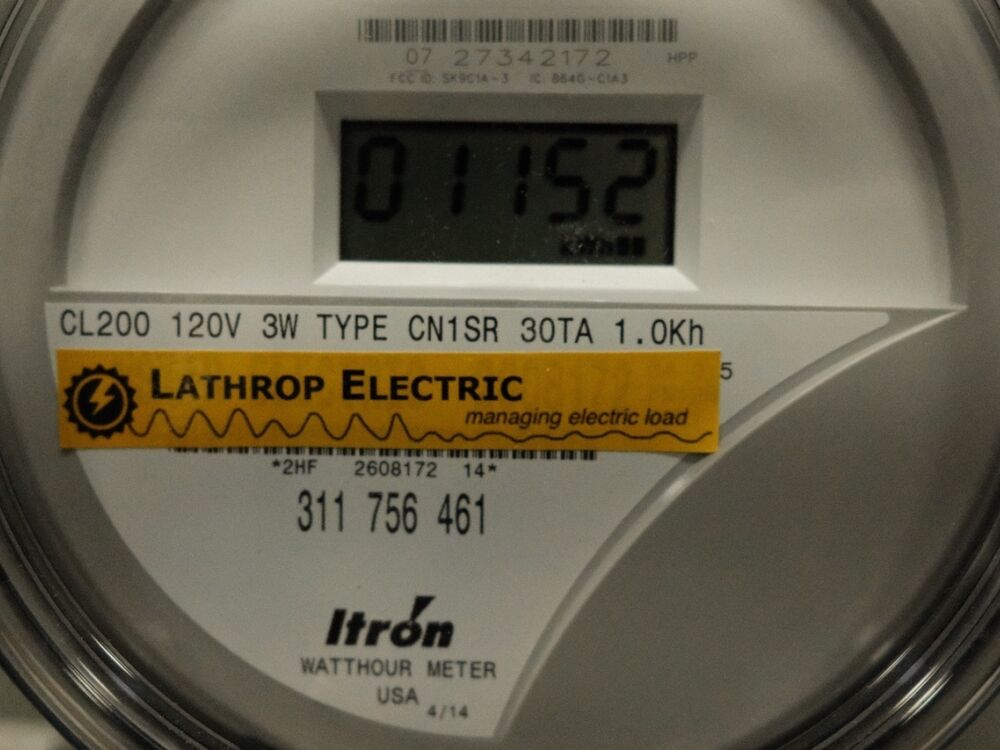
Lathrop Electric is the residential co-op’s new electrical co-op, which buys power from the grid and offsets the cost with solar energy from the roof. Photo: Alexander C. Kaufman
The renovation didn’t require rewiring anyone’s walls, but the end point of the electrical hookups now joined at one master machine in the basement with “sub” meters for each apartment. On each gauge is a sticker for Lathrop Electric — essentially the building co-op’s new electrical co-op, which buys power from the grid at a bulk rate and offsets the cost with generation from its rooftop panels. DaisyChain runs the co-op and structures its bills to make sure each shareholder apartment eventually receives a fair share of the benefits. It’s also helping to apply for the state grant for batteries.
On average, generating solar power is shaving about 20 percent off the building’s total electricity usage, but residents aren’t feeling that just yet.
“Now, because we spent more money than we had planned to, we’re not passing through the savings on the administrative costs to shareholders at the moment,” Stern said, explaining why the solar array isn’t yet showing up on the bills residents receive from Lathrop Electric. “We’re just pocketing it because we have to build back up our reserve.”
Still, savings are showing up in other ways. In total, the renovations avoid about 15 metric tons of carbon dioxide per year, according to a calculation by DaisyChain.
Window shopping
Once the board replenishes its savings, Stern would like to see that money spent on knocking off more items on the menu of energy efficiency upgrades Sheridan initially offered.
“We did meters and the solar first, but that list also contains possible window refurbishing, improved insulation, working on the boiler, improving the temperature control system in the building…” Sheridan said, his pupils trained upward as he ran through a mental checklist.
Without missing a beat, Stern jumped in to add to the list converting more residents to induction stoves: “Bringing electrical risers up so that we can convert more people from gas to electric.”
She sighed. “That was back when we were feeling optimistic — for the building and the country — about the cost associated with all of this,” she said, referring to the period before President Donald Trump returned to office and eliminated many federal policies to support clean energy.
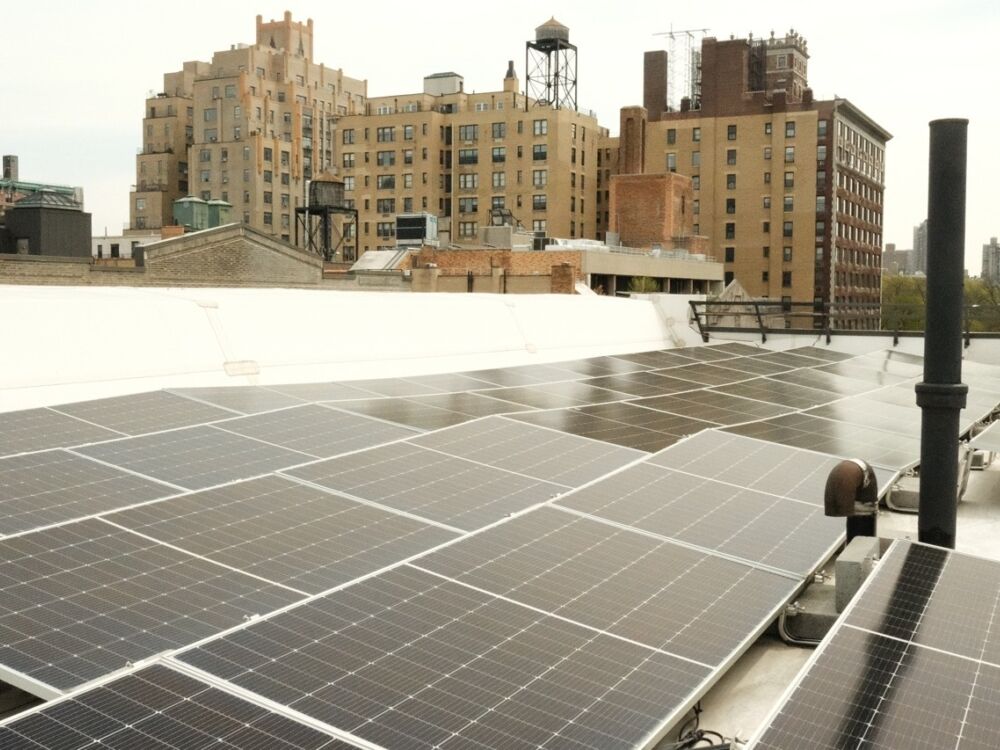
Regulations prevented the Lathrop from elevating its solar panels to optimal height. But the white roof reflects sunlight to the underside of the panels to compensate. Photo: Alexander C. Kaufman
Political realities
The Lathrop, like many buildings planning to make decarbonization upgrades, are staying attuned to changing political winds at all levels of government. Here in the city, the current mayoral administration has not yet formalized any changes to the implementation of LL97, but the lived reality of implementation has not been as straightforward as intended when the law was first passed in 2019. For one thing, the companion climate law at the state level was recently changed by state legislators to ease some of the deadlines, which experts say will affect LL97.
And there’s still the possibility for local changes. During a mayoral candidate forum ahead of the June 2025 primary that vaulted Zohran Mamdani to victory, then-candidate Mamdani said he supported LL97, but also criticized the difficulty of implementation for condo and co-op owners in particular, saying “what I’ve heard from so many is that it’s easier to pay the fine than to get into compliance.”
At that time, Mamdani suggested he supported reforms to make compliance the easier choice. But while the city has revamped its tools to help buildings navigate compliance, this administration is still maintaining the existing rules finalized in December 2024 under former Mayor Eric Adams, and published its latest list of covered buildings in March.
At the federal level, meanwhile, the Trump administration has gutted incentives for funding home upgrades to make structures more energy efficient, and in particular the 30 percent tax credit for residential solar.
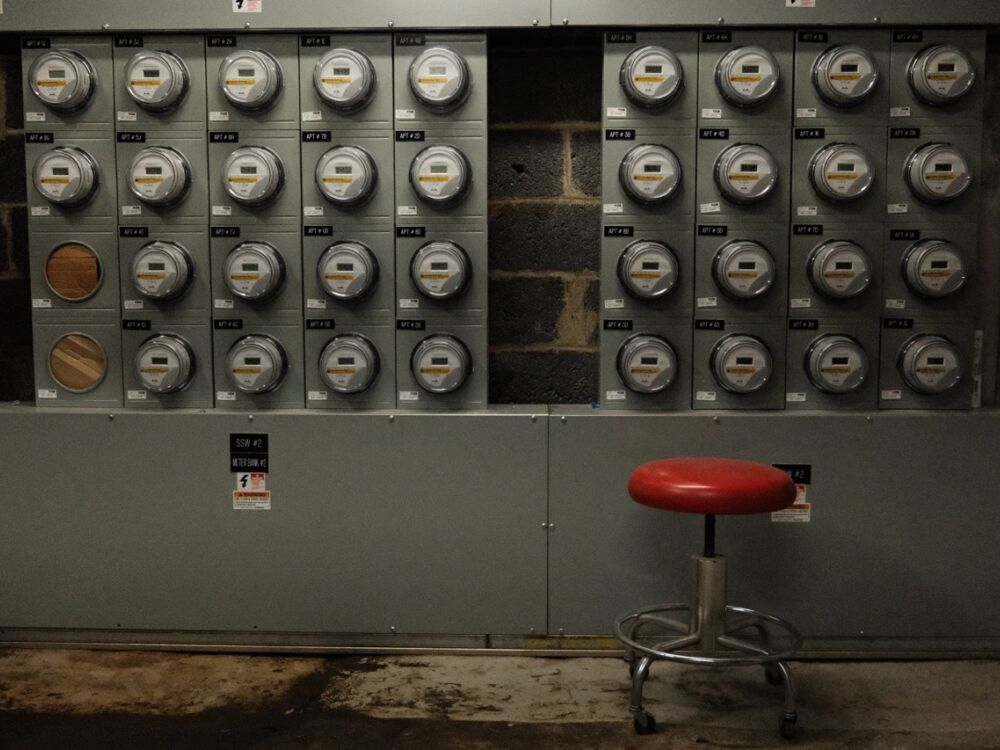
A new array of electrical meters line the wall of the basement at the Lathrop, part of its master metering project. Photo: Alexander C. Kaufman
Still, the Lathrop board is glad it acted early and in fact may be a canary in the coal mine as more buildings take on retrofit projects to be able to stay in compliance with ever-tightening emissions limits.
“A lot of these co-op buildings have boards with, like, eight people, sometimes 10. In this building, about half the board were interested in energy efficiency for philosophical reasons, just wanting to try to do their part for greenhouse gas reductions,” Sheridan recalled of his early conversations with the Lathrop board.
“Two of them were keen because they wanted to avoid fines from Local Law 97, and they wanted an A rating to stick on the door. They didn’t want an embarrassing B, C, or D on display for everyone to see.”
Today the building boasts a B grade for its energy efficiency rating. In response to emailed questions, the board said the rating is “on the cusp of an A” and suspected it would “hit A this year,” noting that a high B is still “very good for a pre-war apartment building.” Without any further changes, Sheridan said the building would be LL97 compliant through 2035.
Ultimately, Stern said, the pragmatism of the latter messaging won the day.
“We didn’t get into those philosophical discussions with the shareholders. What we focused on was, if we do nothing, we’re going to be fined, so we have to do something,” she said. “It’s going to be more cost-effective in the long run to do this, and it has the added benefit of doing the right thing for the universe.”
Therein lies what Stern called the “conundrum” underpinning New York’s efforts to decarbonize its buildings, the largest source of greenhouse gas pollution. Unlike power plants or cars on the road, which fall more directly under City Hall’s authority, the work of decarbonizing residential buildings is a shared responsibility.
“On the one hand, it’s very important to reduce the carbon footprint,” she said. “On the other hand, it has become so expensive to live in New York and maintain property here that those two things are really in major conflict with one another.”
Local Law 97 works, Stern said, because “it’s going to affect us in the pocketbooks.” But the renovations also only made financial sense because the project managed to wrap up before Trump’s tax law changes took effect and phased out key credits for solar installations.
“We certainly are relieved that we did it when we did it before the federal tax credits went away,” she said, then shrugged her shoulders. “But whether it is cost effective for buildings now has to be carefully evaluated.”