
Battery systems store lots of potential for New York City. Here’s how they work.
An explainer on residential building energy storage systems (BESS) and what they can offer to NYC buildings.
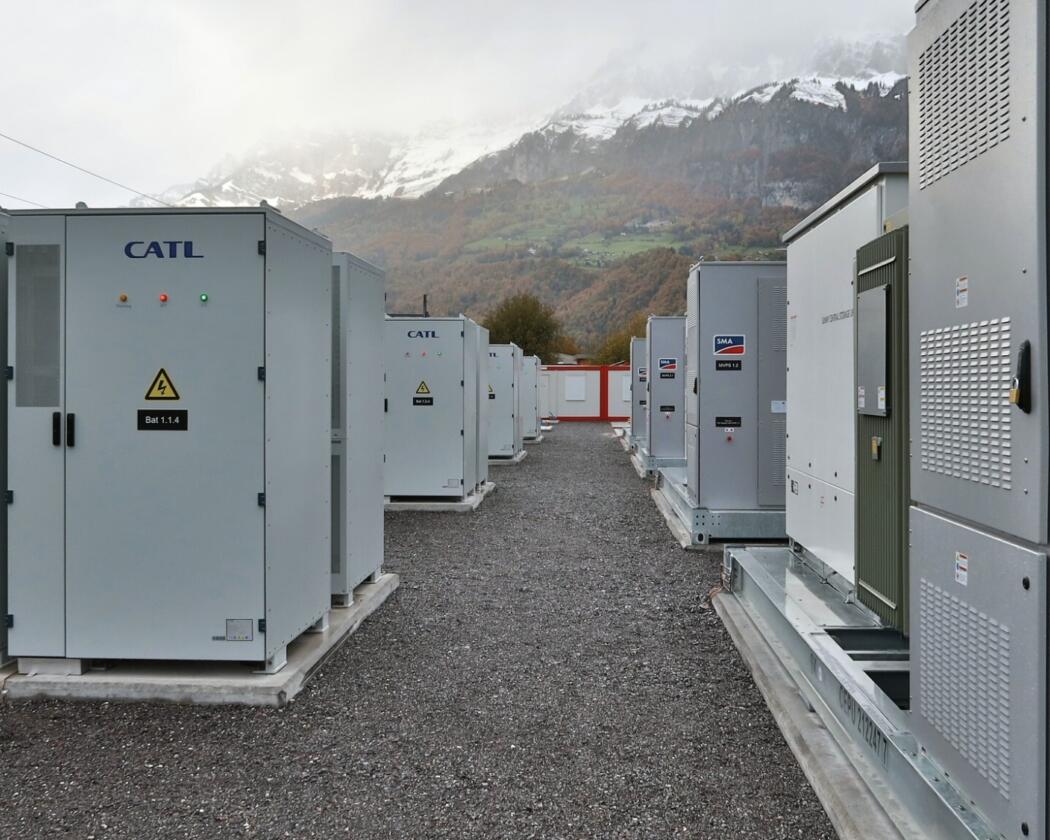
A large battery storage farm in Walenstadt, Switzerland adds 13 KW of power to the local community. Photo: Kecko/Flickr
In Chinatown, a six-story townhouse quietly made history last year when it became the first multi-dwelling residential building in New York City to install a battery energy storage system (BESS) for its own use.
Installed by Brooklyn SolarWorks, the rooftop battery can charge off the solar array looming above it, reducing the amount of power the building draws (and pays for) from Con Edison’s grid. It’s big enough to power lights, appliances, and other essential equipment for a few hours in the event of a blackout, Brooklyn SolarWorks founder and CEO T.R. Ludwig told Habitat magazine.
That’s the good news. The bad news is that it took nearly eight years for the city to permit the battery following a marathon effort by Brooklyn SolarWorks and Briggs & Stratton, the system’s manufacturer. It’s still the only residential-scale energy storage system approved by the FDNY, according to Briggs & Stratton. And it’s quite small: About a quarter the size of the mobility battery used in a Tesla Model 3 sedan.
“The FDNY has made it next to impossible for the [New York City Department of Buildings] to approve anything, because they have limited what products can even be used,” Dean Santa, executive officer of Brooklyn-based solar installer Solanta, told Skylight in an email.
Energy storage has the potential to play a large role in new infrastructure as part of New York’s clean energy future. Properly-managed batteries can soak up cheap, low-emissions power and then discharge power when demand for electricity spikes, replacing aging, expensive “peaker” plants that run on oil or natural gas.
But large-scale adoption is far from a foregone conclusion. Municipal red tape is one of several impediments to building out the decentralized energy storage networks in New York, which experts say will be necessary to meet city and state decarbonization goals.
Adding to tensions are the social, structural, and economic hurdles to overcome: Viral videos of scooters and e‑bikes bursting into flames fuel pushback from building residents and neighbors; older buildings may need costly retrofits to meet ventilation and fire suppression codes for indoor systems or support rooftop systems’ weight; and Con Edison says parts of its electric grid are already under too much stress to handle larger battery installations without significant, and expensive, upgrades.
Despite these hurdles, energy storage advocates say grid-tied batteries have too many benefits to ignore. They’re cautiously optimistic that New York will soon see more batteries in basements, rooftops, and lots around the city.
What is battery energy storage?
Today, most stationary energy storage batteries consist of lithium-ion. It’s the same basic chemistry found in the smaller cells powering your laptop, phone, or e‑bike.
In buildings, batteries can be “standalone” or connected to a rooftop solar array in a “hybrid” configuration. Standalone batteries must draw power from the electric grid, while hybrid batteries can charge directly off panels when the sun is shining. They’re typically placed in building basements, garages, or on roofs.
Residential batteries store power until it’s needed, then discharge it back into the broader electrical grid, or for use locally within the building itself. Most installations can discharge at full power for one to four hours before needing to charge again. Batteries used primarily for backup power may be configured to discharge at slower speeds.
Depending on the make and model, the energy storage capacity of a stationary battery can range from a few kilowatt-hours (kWh) — a handful of e‑bike batteries, give or take — to well over a megawatt-hour (MWh). Large-scale installations in rural or industrial areas can knit together dozens of individual batteries to reach hundreds of megawatt-hours at a single site.
Brooklyn SolarWorks’s Chinatown installation is petite by comparison at 19.6 kWh, the smallest FDNY-approved stationary battery. But larger New York residential buildings could in theory host megawatt-scale projects. Larger battery installations are sprouting up at apartment communities in other major metro areas of the United States, like these two near Dallas which will serve a combined 531 housing units.
Potential benefits for buildings, the grid, and the environment
What benefits do on-site battery energy storage systems offer to building owners and residents?
Resilience, for one. With proper sizing and management, batteries can provide hours to days of backup power for lighting, kitchen appliances, and more. New York’s power grid is among the country’s most reliable, but outages still occur and they often coincide with dangerously hot or cold weather conditions.
Another potential benefit: When paired with solar panels, or programmed to charge when the electric grid is awash in carbon-free electrons from renewable or nuclear power, batteries can help reduce host buildings’ carbon intensity. (Batteries aren’t inherently climate-friendly, however. Charging when the local power mix is dirtier may indirectly increase carbon emissions or even overload parts of the power grid.)
“If they all charge and discharge at the same time, that’s a challenge [for the grid]. It’s no more helpful than anything else would be,” Alliance for Clean Energy New York’s executive director Marguerite Wells told Skylight. “Running in series, when the grid actually needs it — that is the job that we all believe batteries should be doing.”
Buildings metered on a Con Edison time-of-use rate, meanwhile, can directly reduce net peak power consumption — and thus total energy costs — by charging batteries during cheaper off-peak periods and discharging when peak rates are in effect.
Other customers stand to benefit, too. Powering enough energy-intensive appliances with batteries at peak demand lowers the risk of disruptive brownouts and blackouts, and reduces the need for high-emissions peaker plants. Some New Yorkers have already started to see these benefits: Last summer, the tech startup Every Electric partnered with Con Edison to trial in-home battery packs to power air conditioners in 65 households. The results were promising, where the batteries helped reduce strain on the grid, and users earned money just for using them.
Barriers to battery energy storage in NYC buildings
Many “community-scale” battery energy storage facilities already operate across the five boroughs and projects totaling at least 50 megawatts — enough to power tens of thousands of homes — are under development, according to Cleanview, which tracks energy development across the U.S.
Community-scale energy storage is typically sized between a few hundred kilowatts and a few megawatts per site. The batteries often sit at ground level in nonresidential areas, where fire is less likely to spread to surrounding buildings. They’re also housed in sophisticated containers that meet FDNY’s rigorous safety standards, said Paul Rogers, a retired FDNY lieutenant who helped develop the department’s energy storage safety codes. Advocates say higher adoption is the result of a thoughtful city-led planning process.
“For a time, New York City was one of the hardest places in the country to get energy storage systems permitted,” said Wells of Alliance for Clean Energy New York. “Then, about half a dozen years ago, we got really good codes and a good [permitting] process. All of the sudden, it became pretty much the easiest place in the country…as long as you know what you’re doing.”
Barriers remain, however. Last fall, Con Edison proposed a new interconnection framework for larger battery systems that would require project developers to pay for any grid upgrades it deemed necessary to avoid overloading its infrastructure. Developers and their allies said the framework could cost tens of millions per project and render many uneconomic. In March, the New York Battery and Energy Storage Technology Consortium said developers had already canceled 25 projects and more than 90 others were at risk.
In a statement provided to Skylight, a Con Edison spokesperson said the utility “has been a champion of battery storage” and touted its work with FDNY on the city’s safety codes. Batteries installed in the right locations and “operated during the right charging and dispatch windows” can reduce stress on the grid, they said.
But “because grid constraints vary across our system — from neighborhood‑level distribution lines to major transmission corridors — the location of a battery ultimately determines how much benefit it can deliver to the grid and to customers,” they added.
Though small-scale residential energy storage systems may have an easier time connecting to Con Edison’s grid, code compliance can be costly, said Rogers, who now co-owns Energy Safety Response Group, a consulting firm that works with battery developers, local officials, and property owners to site and support energy storage facilities.
To get a FDNY Certificate of Approval for an energy storage system, the manufacturer needs to supply a detailed hazard mitigation analysis, emergency response plan, and results from “destructive testing” by a nationally recognized lab, Rogers said. If a system is proposed to be placed in a basement or on a rooftop, Rogers said FDNY may add requirements beyond what’s in the energy storage section of the city fire code, such as reinforcing slabs for roof-mounted systems or extra sprinkler capacity in rooms housing batteries.
It’s an expensive, painstaking process that’s nevertheless worth it for the large-scale battery systems used by commercial energy developers around the city. But the benefit isn’t as clear for manufacturers of the smaller batteries more likely to be used in residential buildings, Rogers said.
This may account for how few residential systems have been deployed to date. Though New York City has more inhabitants than most states, its residential energy storage market may not be big enough to justify the additional work, Rogers said.
“It’s not that FDNY is preventing them. It’s just that there are not a lot of products that have gone through the process,” he said, adding that he can’t speak to individual manufacturers’ thinking.
Though Rogers is an adept navigator of municipal energy storage permitting — in an email, one commercial developer called him “sort of the Jedi Master on [battery energy storage] issues” — he said it’s not always practical to retrofit older residential buildings for indoor battery systems. A few years ago, concerns about whether a nearly 100-year-old host building could support the added weight derailed a Brooklyn project that would have been the first residential rooftop battery system in the U.S. Adding new ventilation shafts, sprinkler lines and drainage can be prohibitively expensive, too, Rogers said.
Property owners can recoup some energy storage installation costs through New York City’s generous Solar and Electric Storage System Property Tax Abatement, which offsets 30 percent of system installation costs up to $250,000. The city expanded the scheme in 2024 to allow owners who’d previously claimed the abatement on solar systems to receive a separate credit for newly installed energy storage systems.
A separate state program offers a $250/kWh incentive for eligible residential energy storage systems in Con Edison’s territory, which covers the five boroughs. That’s nearly $5,000 for a system the size of the one in Chinatown.
Challenges notwithstanding, clean energy developers see opportunities ahead for residential energy storage in the city. Solanta’s Dean Santa said he’s getting homes ready for energy storage tomorrow despite a dearth of city-approved options today.
“We are circling the issue from a different direction by preparing homes with all of the hardware to add a battery later during their solar installation,” he said.