
State climate law has changed. How will that affect New York City buildings?
New York State has one of the most ambitious climate laws in the country — but will recent changes at the state level move New York City away from its goals?
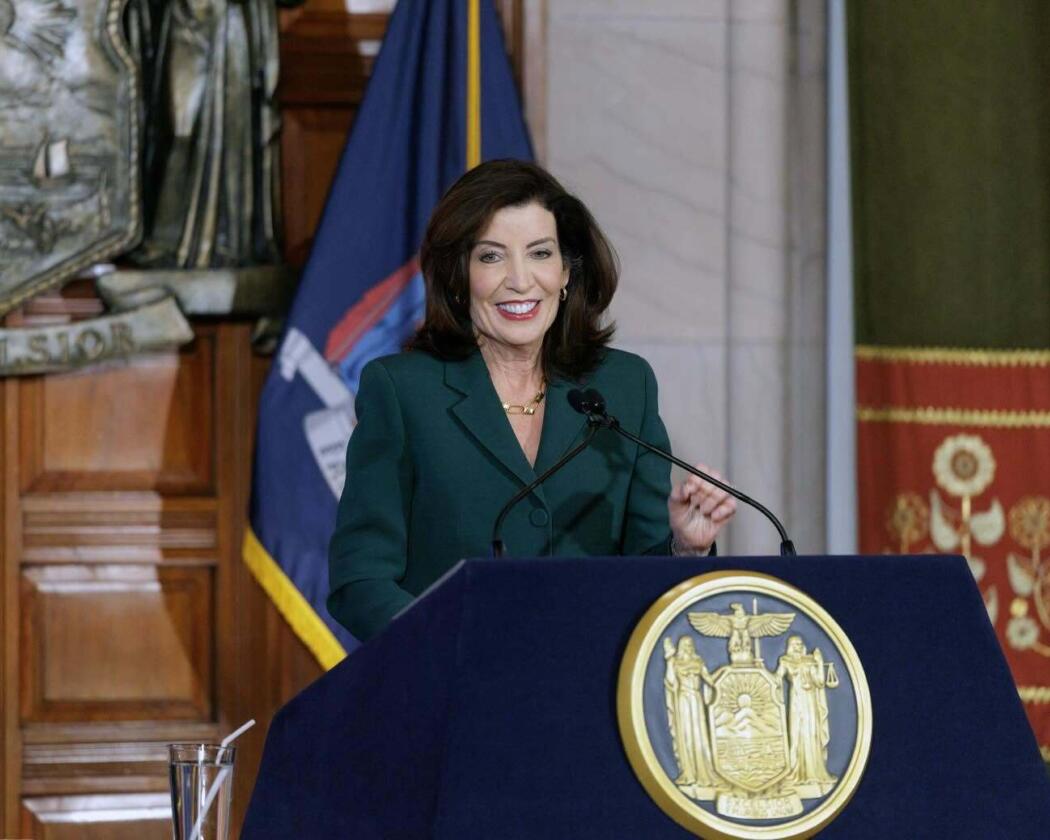
Governor Kathy Hochul presents the executive budget for FY 2027 on January 20. Photo: Facebook/ Governor Kathy Hochul
When it was passed in 2019, New York state’s climate law was considered the most ambitious in the country. The Climate Leadership and Community Protection Act (CLCPA) set landmark carbon emission targets for the state’s electrical grid, with a goal of net zero by 2040.
Heavy air pollution was to be cut down to 85 percent of 1990 levels by 2050, and at least a third of all funding for these changes had to go to underserved communities, defined by a criteria of demographics and past investments, or lack thereof. The first deadline was 2024, by which point the state had to issue regulations — or a road map — to get there.
But that deadline came and went. And so when a state supreme court judge ordered Governor Kathy Hochul’s office to either comply or pursue a change in the law, her administration did the latter. Lawmakers followed suit: for the first time since the CLCPA’s passage, lawmakers in Albany made significant rollbacks to the measure in May as part of state budget negotiations.
Hochul, who had been lobbying for a change to the law since earlier in the legislative session, insisted that it came down to a question of costs. “For us to meet the goals on the time frame that was set by the legislature, there’s going to be enormous costs to families. Enormous,” she said to reporters in March. “I just need a reality check.”
The changes made in this year’s budget pushed CLCPA’s deadlines further out. Now, the administration has until the end of 2028 to come up with a plan. The net-zero goal for 2050 has stayed the same, but the 2030 interim target has been pushed to 2040, and with a lighter mandate of a 60 percent decrease in emissions. And even that comes with caveats.
Ken Lovett, Hochul’s senior communications advisor on energy and environment said in a statement to Skylight: “Governor Hochul has made clear her top priority is keeping the lights on and costs down for all New Yorkers.” He emphasized that the changes in this year’s budget “protect New York’s status as a climate leader, while prioritizing affordability for New Yorkers.”
The changes to this law arrive amidst a larger backsliding on climate goals in New York, the U.S. at large, and abroad, due to shifting economics and political backlash. In turn, they raise reasonable doubt about the efficacy of other interlocking climate policies. And in New York City, the key policy to watch is Local Law 97 (LL97).
We asked experts if the state’s new climate reality will trickle down to hinder the U.S.’s largest city and its most substantial effort to reduce building emissions, which was enacted around the same time as a complement to the CLCPA.
The top-line answer: not directly, as the city has separate systems and rules in place to see through LL97. But the shifting landscape at the state level could make certain aspects of its implementation trickier across the five boroughs.
Here are three areas to watch for:
Uncertain long-term funding
In 2023, CLCPA was catalyzed with a commitment by Hochul to enact “cap and invest,” a regulatory model where polluters pay penalty fees for emission beyond a specific threshold — money that the state would then use to fund several categories of projects, including rebates, investments in underserved communities, and clean energy infrastructure. “Cap and invest” was, in other words, intended to be the financial vehicle to pay for many of the goals of CLCPA. But two years later, the governor backed away from its rollout, which led environmental groups to sue. And now, with the changes to CLCPA, the future of that funding model appears uncertain.
“The state was under a court order that, in effect, directed it to start cap and invest, as I see it,” said Pete Sikora, a climate organizer with New York Communities for Change. “Now it isn’t.”
For building owners in New York City, that could have consequences. According to Dale Bryk, an energy expert at Harvard University and the Regional Plan Association, the projects that would be potentially funded by the cap and invest scheme could help subsidize the transition to renewable energy.
“The failure to advance a cap and invest program means we don’t have a long-term stream of funds to invest in clean energy solutions that lower energy bills and improve quality of life, including energy efficiency and electrification measures that enable building owners to comply with LL97,” said Bryk, who serves on the board of New York State Energy Research and Development Authority (NYSERDA), which would play a key role. “The state and city can work together to find other means of supporting these beneficial investments but cap and invest is the long-term solution.”
Delays to cleaning up the grid
The enforcement of LL97 rests on what are known as greenhouse gas “coefficients,” which are metrics used to calculate a building’s carbon footprint from its energy use. (If a building exceeds a certain amount of carbon emissions, it has to pay fines.) Those coefficients have been determined up to 2035, factoring in assumptions about the electrical grid progressively getting cleaner. But with the state’s delay, what happens after 2035 is being discussed amongst experts and practitioners.
“Some have been asking, ‘If the state is delayed on cleaning the grid, does that mean LL97’s coefficients will be automatically adjusted?’” said Chris Halfnight, CEO of the Urban Green Council, which advises on building decarbonization. “The answer is, these two things are separate levers.”
Coefficients, updated in five-year increments, are determined by the city’s Department of Buildings (DOB), with input from an advisory board which includes representatives from the real estate community. So what the city will decide to do next remains to be seen. “The developments on the state side will inform the thinking for how [the city] sets the coefficient,” said Halfnight. “But how that’s going to go — that’s quite a few years away at this point.”
As far as building compliance goes, the DOB, which oversees LL97 implementation, has its own mechanisms in place for property owners to comply. That includes a flexible option, where buildings can “buy time” by paying into an innovative fund that goes towards heat pumps in affordable housing, Bryk said. And so far, they’ve been successful: over 90 percent of buildings are on track to meet the 2030 targets.
Confusion over compliance messaging
The CLCPA is a state law that affects state-regulated issues and systems. Local Law 97 is a city law, enforced entirely by city agencies. But in practice, those lines quickly get blurred.
Conflating the jurisdictions between Albany and City Hall is a perennial issue amongst political observers, let alone the public. And any law’s changes could make those distinctions even more difficult. “Some building owners will think LL97 is delayed because they confuse the CLCPA and LL97,” said Sikora.
It’ll take time, experts agree, for awareness to catch up. But what shouldn’t be lost in the messaging, they said, is decarbonization’s potential. Case in point: earlier this year, Urban Green Council released an analysis that showed how many emissions heat pumps could save building owners, regardless of the grid’s still-heavy reliance on fossil fuels.
“That math doesn’t change based on shifts in the CLCPA’s interim targets,” said Halfnight. “It’s because heat pumps are so efficient.”
Even as improved technology pushes New York City towards more efficient heating and cooling, progress towards complete carbon neutrality depends on effective regulation at the state level — to crack down on polluters, fund renewable energy, and clean up the electrical grid.