
How nonprofit developers financed Harlem River Houses’ major rehabilitation
To complete the multi-million-dollar retrofit, partners on the project leveraged a mix of public and private funding sources
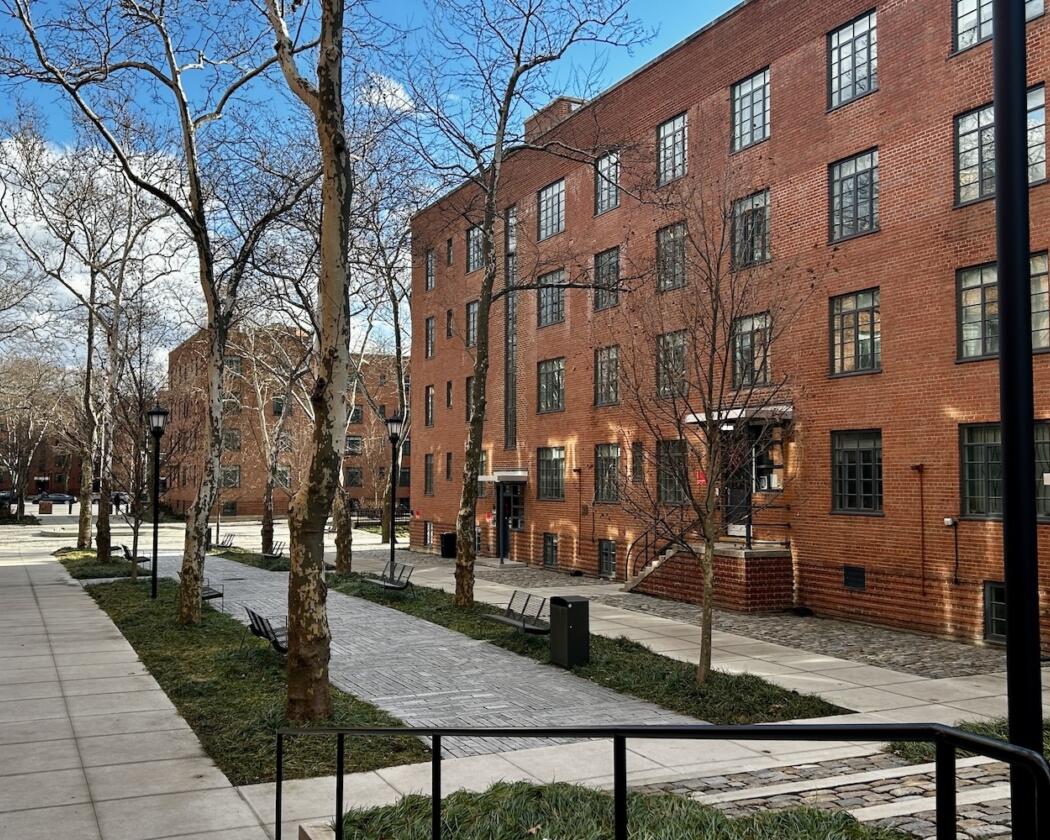
Harlem River Houses underwent many renovations, including new windows. But its historical designation meant that its façades were required to remain intact. Photo: Camille Squires
Harlem River Houses’ historical landmark designation as a shining example of New Deal progressivism is generally a point of pride for its residents, management, and developers. But when it came to planning — and paying for — a clean energy upgrade, that landmark status also posed a challenge.
“I would say the real challenging part was balancing the scope and different scope priorities with the available funding,” said Eliot Hetterley, a senior project manager at Settlement Housing Fund, the nonprofit developer that co-led rehabilitation on the HRH complex.
In order to retrofit the property in 2022, the owners figured out a way to turn the unique challenges of the Harlem River Houses into unique financing advantages.
They found a way to make financing the HRH renovation more affordable through the Permanent Affordability Coming Together (PACT) program. The city first created the initiative in 2016 as a way to bring private and non-profit dollars into public housing explicitly for renovations. Under the program, residences are converted from Section 9 housing, which is totally owned and operated by NYCHA, to project-based Section 8 housing, which opens up opportunities for private development and funding, while also protecting tenants’ rights to remain in rent-assisted housing. The program has not been without its controversies, but has still taken off. Today, it covers roughly a quarter of NYCHA’s portfolio, with roughly 30 PACT-paid projects underway across the city.
At HRH, a team of development partners were selected through the PACT program to lead the public housing property’s renovations, including modernizing the outdated steam heating systems, updating the property’s windows to be better insulated, and substituting LED lighting across multiple buildings. The HRH complex’s physical upgrades took several years to complete and cost $275 million in total.
Doing these retrofit projects under the PACT program allowed developers to use a mix of public and private funding to complete the public housing site’s upgrades. “We pulled together a lot of different sources with the help of a lot of very critical partners, especially NYCHA and HDC [the city’s Housing Development Corporation],” said Hetterly. Both NYCHA and HDC provided subsidy loans for the project’s completion.
Additionally, one of the most significant financing sources for the project was a historic tax credit equity that development partners secured from JP Morgan Chase as a private bank investor. The older 1930s portion of the HRH complex, made up of a seven-building enclave that now has the landmark site designation, gave it access to this historic tax credit, which covered roughly $63 million — or about 23 percent of the project’s total cost.
New York’s historic rehabilitation tax credit program has been leveraged by developers and landlords to revitalize hundreds of properties across the state, including public housing sites. Since 2022, an estimated 106 affordable housing projects have used New York’s historic tax credit program to create 1,757 new units and rehabilitate 2,412 existing units. Although a rigorous review process by federal and state authorities is involved as part of the process to secure the historic tax credit, many NYCHA-owned housing properties rehabilitated through the PACT program have been able to successfully secure the preservation-based tax credits, according to Hetterley.
Yet securing financing was only half of the battle. Once the diversified pool of resources was secured, the next challenge was to stretch those funds to cover the rehabilitation project’s ambitious goals.
Reporting contributed by John Surico.