
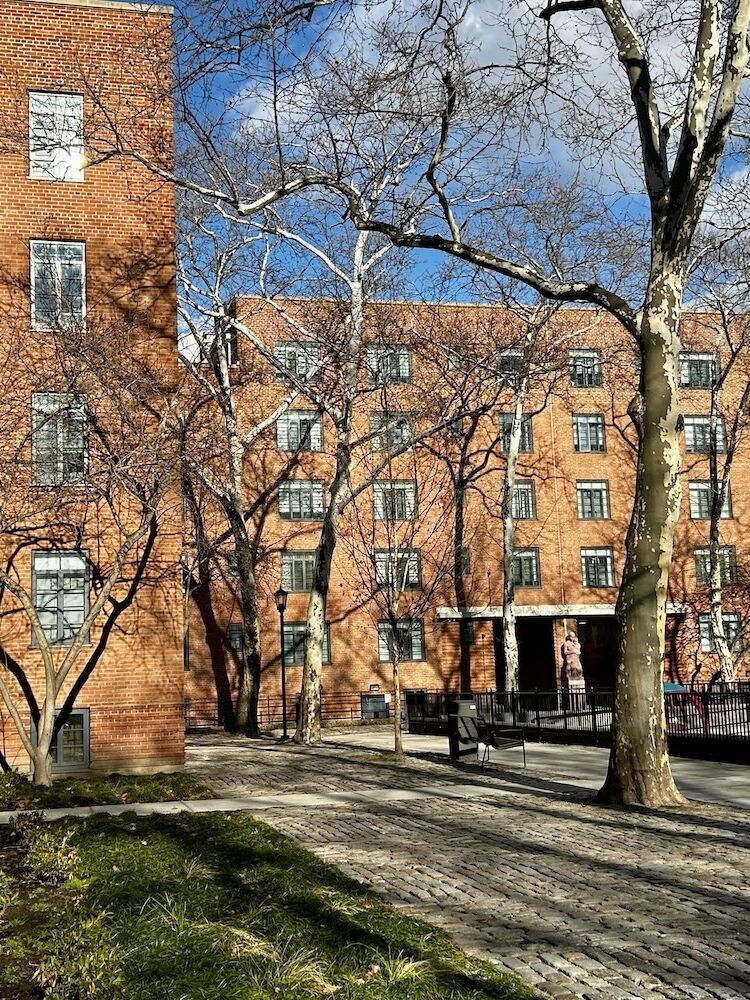
A courtyard at the center of the original Harlem River Houses complex. Photo: Camille Squires
A historic NYCHA development leaves behind steam heat for clean energy as part of a suite of new upgrades
Two bright murals line the walls in the porticos leading into the Harlem River Houses, located in Manhattan between East 151st and 153rd Street. The eastern hallway features historic figures from Harlem’s past, like Malcolm X and Afeni Shakur, while the western hallway has some other familiar faces — of neighbors who walked these spaces throughout their lives, transposed on tinier bodies. Walter, a decades-long maintenance worker and resident, is also shown: “He’s next to the famous folks, because he’s famous here,” Jacqueline Ortiz, an assistant general manager, pointed out on a recent walk there.

The “Planet Harlem River” mural, created by artist Paul Deo in collaboration with residents of Harlem River Houses, depicts residents of the neighborhood past and present. Photo: Natasha Ishak
The artworks were part of a larger renovation project that wrapped this fall, which also saw major energy efficiency improvements thanks to modernized windows, energy-saving LED lighting, new HVAC systems, and more. Like most NYCHA buildings, Harlem River Houses, or HRH, as it’s sometimes shortened to, has its own compliance standards to meet for Local Law 97 (LL97), which requires buildings of this size to meet new greenhouse gas emissions goals or face fines. The complex presented a particularly unique case for updating infrastructure to get there: As New York City’s oldest federally-funded public housing project, it was the first major retrofit in decades.
The challenge: Future-proofing history
The original Houses, which opened in 1937, are made up of 574 apartments spread across nine acres. (An addition with 116 additional units was built in the 1960s, named Harlem River II.) Built at a time when public housing was racially segregated, HRH was an experiment in “separate but equal” public housing standards. The complex was built for Black residents at the same time as the majority-white Williamsburg Houses were built in Brooklyn, both funded by federal dollars through the Works Progress Administration. HRH has gone on to become a bastion for the city’s uptown Black communities — a reputation the staff there proudly touts today.
Modernizing the NYCHA complex’s clusters wasn’t without challenges. The largest, perhaps, was due to that history: In 1975, the entire campus was granted landmark status, an honorific that has since heightened as HRH has been cited as an acclaimed example of large-scale development. But the city’s landmark laws also set strict rules around what alterations may be made. So any fixes put in had to be both precise and practical — and in a city whose housing stock is, on average, 90 years old, their proven success could provide a stress-test for overcoming one of the greatest hurdles in decarbonizing New York City: Age.
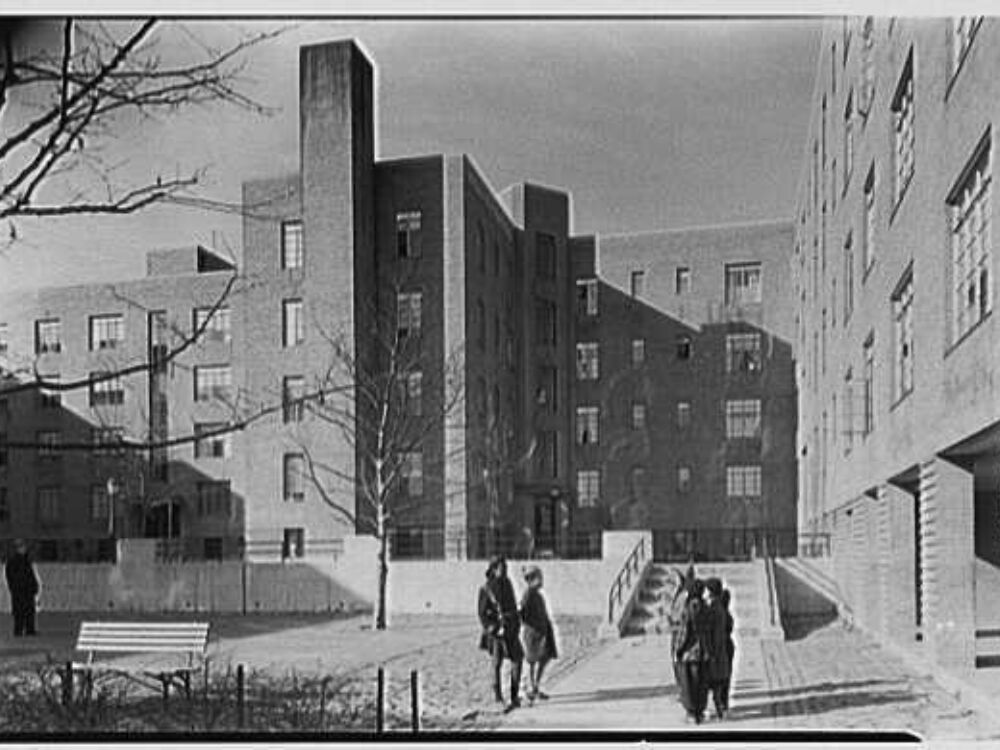
Harlem River houses in December 1940. Photo: Library of Congress
Undertaking an energy upgrade
Skylight got a tour of HRH, including a peek into a newly refurbished unit. The whole suite of upgrades, both infrastructural and cosmetic, have led to a higher quality of living for residents; but for Manuel Ortiz (no relation to Jacqueline), a superintendent who has lived here for years, the most significant aspect of the renovation is hidden to most.
Until recently, the heating at HRH was powered by a dual fuel boiler that produced steam heat and domestic hot water for the entire campus. The older buildings originally had coal-burning boilers, but the whole development was converted to a steam piping system in the 1960s. The boiler was then powered by fuel oil and, eventually, natural gas. But the infrastructure, now over sixty years old, had reduced energy efficiency, and contributed to greenhouse gas emissions that degraded air quality. These factors led the campus to emit more than 7,000 metric tons of carbon annually, and earn a D energy efficiency letter grade, according to an energy audit report conducted by Bright Power.
“Back in the day, when you got past the first three steps on that staircase, you could feel heat,” said Manuel Ortiz, as we stepped into the basement, whose tunnels run underneath, connecting the separate buildings. “It looked like a boiler room from a horror movie down here. There were old chains and lifts everywhere.”
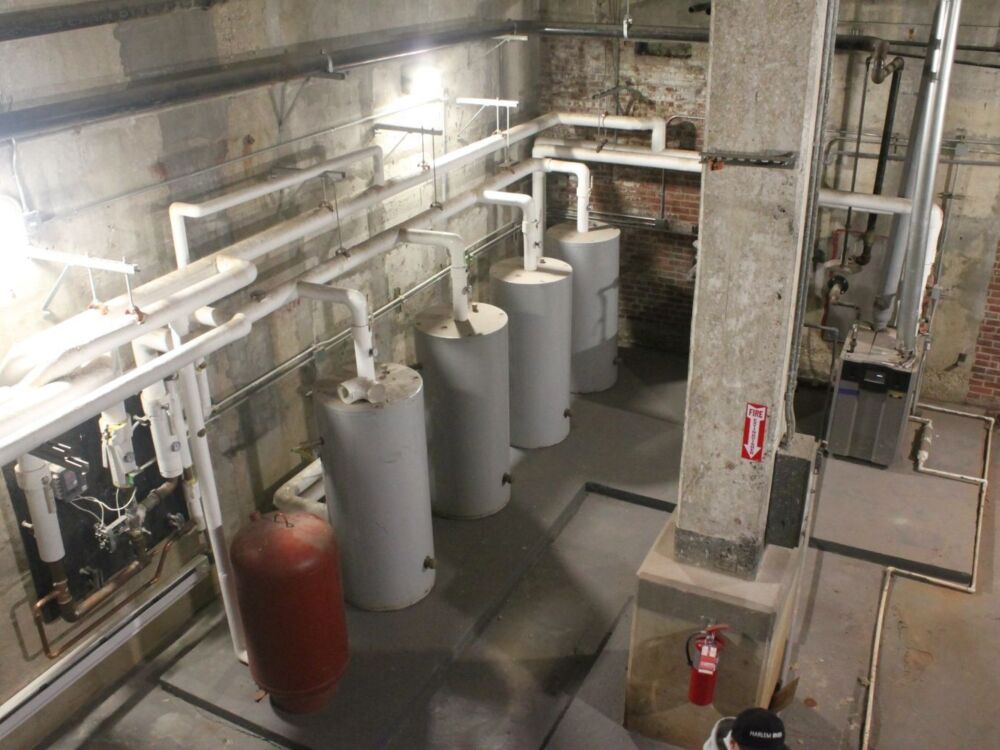
Localized hot water tanks were installed after the old steam boilers were taken out of service. Photo: Natasha Ishak
Under the new system, heating and cooling is localized and electrified, with a variable refrigerant flow (VRF) system; heat pumps on the roof pull in air from outside, then use refrigerant to warm or cool the air, depending on the season, and blow it into ducted units in each apartment.
The new system is not fully decentralized but, rather, dispersed — so if, say, one condenser blows, it’ll minimize the impact, limiting fallout to a single building instead of an entire system. The rain and cold outside during Skylight’s visit was a good reminder of why every degree of warmth matters. “From here, it tells me what the water temperature is, and what the apartment thermostat is showing,” said Ortiz, showing off the subterranean devices. “So while heat is flowing out of here, it lets me know how much heat is in the actual apartment upstairs.”
Plus, it saves space: Today, the basement is brighter than before, with room for the staff to have meetings and workout equipment — a far cry from what once was.
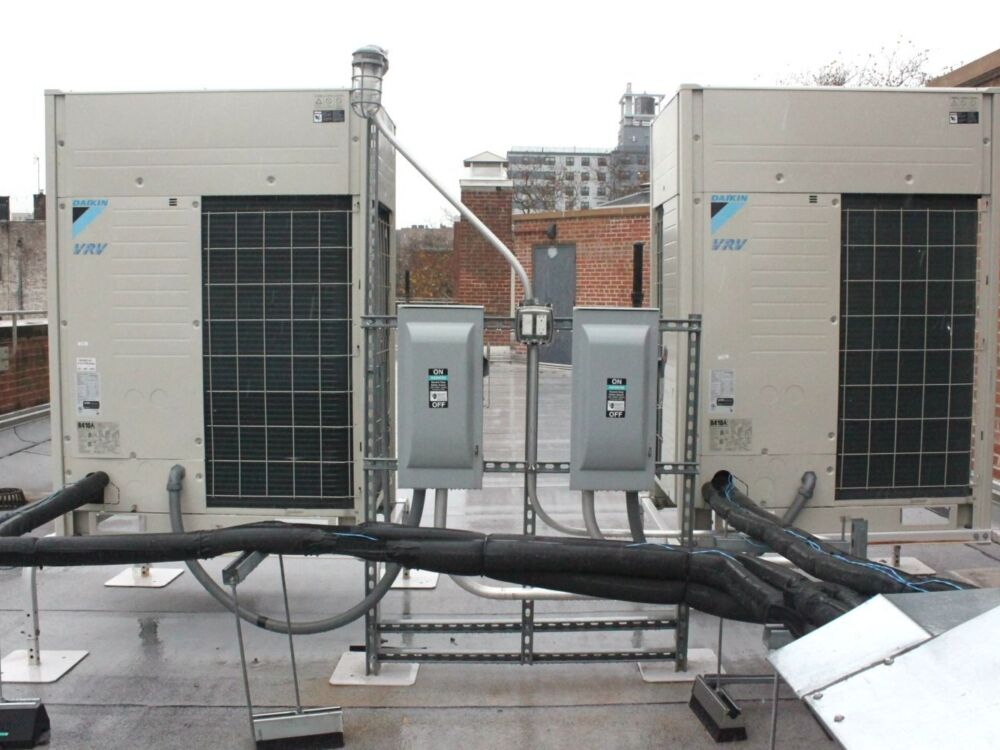
Rooftop heat pump units are the cornerstone of the new VRF system that now heats and cools units at Harlem River Houses. Photo: Natasha Ishak
Over at Harlem River II, package terminal heat pumps, otherwise known as PTHP units, were installed in every apartment to replace its steam heat system. This development is not under landmark status, and thus carried fewer work restrictions. The project at HRII also included a refurbished roof and an Exterior Insulation and Finish System (EIFS) on the façade, which added insulation to retain heat.
The electrical wiring, if anything, is more confined now but still extensive, as the PTHP units require more electrical load than the apartments were originally designed for, said Ryan Esparza, an associate at Curtis + Ginsberg Architects. “So if there’s a two bedroom apartment, then there are three of these PHTP units in that apartment — one for each bedroom, and one for the living room,” he said. The architects coordinated with Con Edison to add more electrical capacity to the building, and additional electrical risers, or shafts to carry electrical cables vertically across floors, were added to meet this additional load, but even those were done as a clever repurpose — the electrical risers were installed in corners where steam risers had previously been. And another silver lining: All of this was done without having to rip up the street outside, like it must be for so many retrofits.
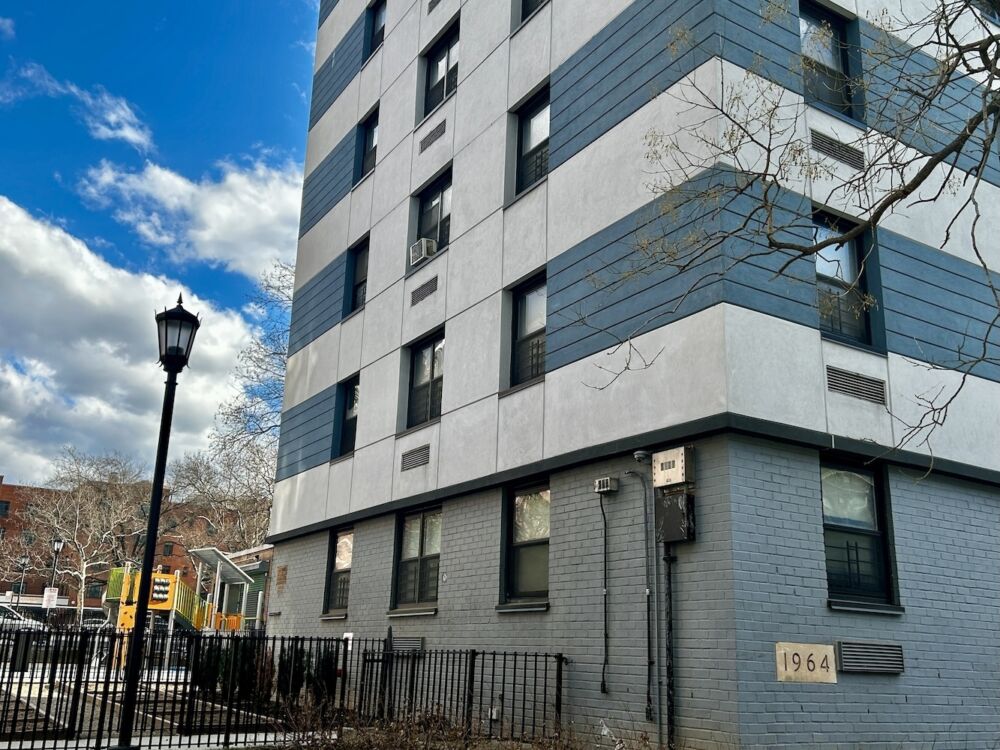
Heat pumps at HRII sit beneath the overcladding and peek out through vents. Photo: Camille Squires
The heat pumps are limited to HRII since they impact the look of the façade, which a landmark designation bars. But Esparza is hopeful that its success will convince policymakers to soon consider it. “That’s not to say that they won’t at some point,” he said. “But hopefully in the near future, you can use this in the building, and have some alternate technology for those [buildings with historic façades].”
But the heat pumps’ track record thus far has convinced the architects to go beyond HRH.
“We’re now trying to push PTHP installation at most of our projects, because it’s really a big step in the right direction,” Esparza added. “We’re reducing how much refrigerant exists within each building, so you don’t have long runs of piping from the rooftop to each unit. The potential for leaks and the greenhouse gas emissions are just much less. And it’s a far easier system to install.”
All of these efficiency improvements are expected to lead to a 55 percent improvement in HRH’s carbon emissions, and bring both sites in compliance with LL97 through at least 2034, according to Bright Power’s projections.
Paving a new path for HRH
All of these upgrades carried a steep shared price tag of $275 million. Specifically, upgrading to VRF at the original site cost about $16.5 million, and the PTHPs and overcladding at HRH II cost about $4.68 million.
The projects were made more affordable through the Permanent Affordability Coming Together (PACT) program, which the city first created in 2016 as a way to bring in private and non-profit dollars into public housing explicitly for renovations. When a public housing complex enters into a PACT agreement, the infusion of cash can mean a complete departure from NYCHA’s norm. That is on display the minute one enters HRH. The red bricks have been restored. Statues have been buffed. And the management office is of a quality befitting a market-rate condo or co-op.
All of this is evident in the ground floor apartment, which the management team keeps empty in case tenants need to be temporarily relocated: The windows are newly weatherized; the rattling steam radiators, staples of NYCHA units, have been swapped out for thermostats; most appliances, including the stove, are now electric; and the flooring has a sleek aesthetic.
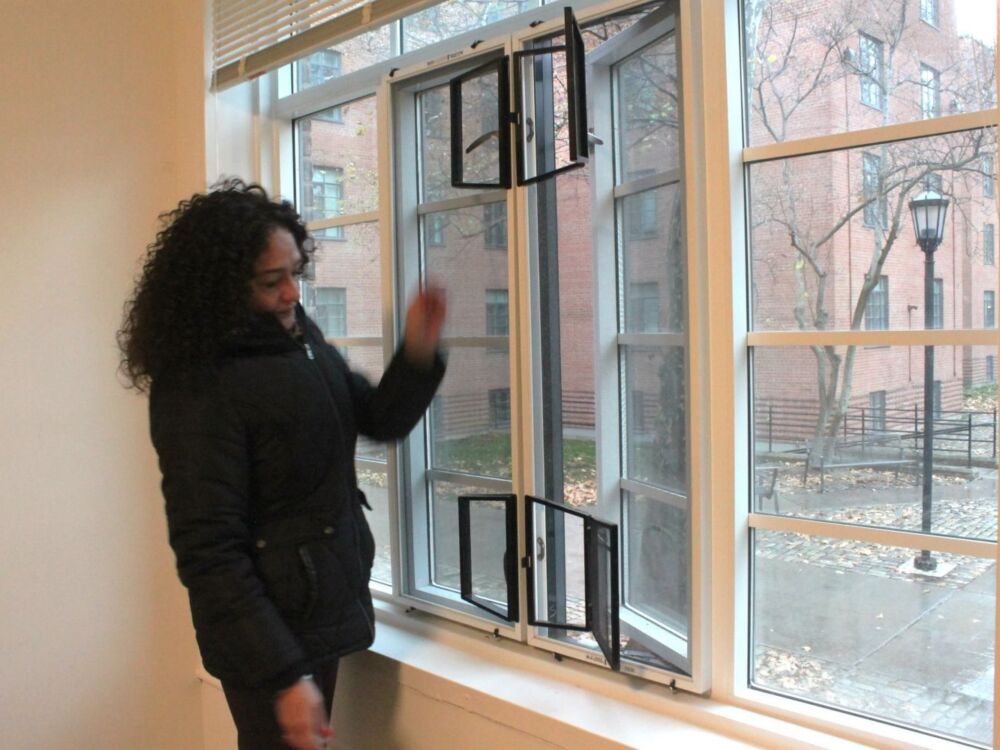
Assistant general manager Jaqueline Ortiz shows off the new windows installed at Harlem River Houses. Photo: Natasha Ishak
A new Harlem River Houses, but still home
All of these changes offer an encouraging new perspective on what public housing can and should look like. In fact, the renovations have earned HRH recognition among many of its peers in the world of architecture and design — the renovation was awarded a 2025 Residential Design Award of Excellence by Docomomo US, a non-profit organization that highlights conservation of buildings, sites and neighborhoods of the modern movement.
Yet the most salient impact of the new-and-improved HRH is for the people who call it home. Those changes begin with its new organizational structure.
HRH is now overseen by the Settlement Housing Fund, a nonprofit that holds a 99-year lease on the land from NYCHA, which still owns the property; West Harlem Group Assistance, a community-based organization, was brought on to lead social services; and a separate subsidiary, C+C, handles management.
Assistant general manager Jacqueline Ortiz works for that last entity, and while it may appear a bit balkanized, she said the new setup allows for a faster and easier approach to tenant concerns than before. “We’re constantly working with the developer’s engineering teams, who’s on the construction side,” she explained. “So if a specific unit is affected by something, we can quickly move neighbors.”
That came in handy when residents were relocated elsewhere within HRH for six weeks as the energy efficiency repairs were underway. Complaints weren’t completely avoided then, and they still exist as neighbors acclimate. “We’ve heard from people who miss the old radiators, but once they learn the thermostat, they love it,” Ortiz added.
But what matters most is the actual listening. At the end of Skylight’s tour, Tyrone Thomas, the general manager of HRH, stepped out of a morning meeting with his team to talk. For anyone considering a similar retrofit, he stressed the importance of having on-site social services. Transitions can be difficult, and so offering a helping hand was crucial to ensuring that nobody was left behind in moving forward.
“We had town halls every month, and that really made a difference,” said Thomas, as the day’s work — rent payments, work requests, etc. — got going. “By hearing from them, we got hands-on because there are things that we may not be aware of.”
“We’re still NYCHA, that’s the thing,” Jackie Ortiz commented. “But better living.”
Reporting contributed by Natasha Ishak.
Corrections (Jan. 14, 2026): A previous version of this article misstated the total cost of the renovation project, and erroneously attributed it to another project as well. $275 million was spent on the project at Harlem River Houses only. This article also previously misstated how the electrical wiring for the PTHP units at HRII was installed. We regret the errors.