
Finding the funds for community ownership
Clean energy developer Working Power helped UPROSE build a community solar project truly owned by the community, not investors.
With community solar, “We were trying to raise climate consciousness. We were trying to put money back in people’s pockets,” said Elizabeth Yeampierre, executive director of UPROSE. Photo: Courtesy of UPROSE
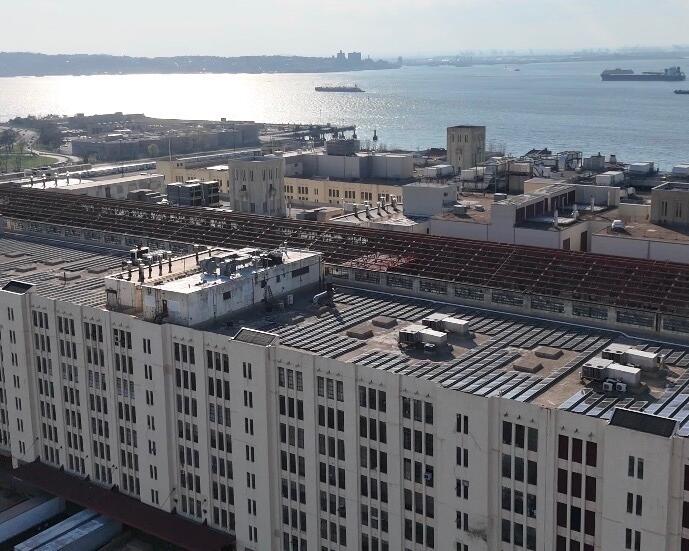
For UPROSE, a Sunset Park-based environmental justice group, winning community support and negotiating a lease for a solar panel installation on the Brooklyn Army Terminal’s roof was only half the work. The other half was figuring out how a neighborhood organization could own a solar project.
UPROSE and Working Power, a developer that partners with community groups to build and co-own clean energy projects in underinvested neighborhoods, each turned to their own networks to finance the project. Supporters included The Solutions Project, Climate Justice Alliance, Nathan Cummings Foundation and several other foundations, said Elizabeth Yeampierre, executive director of UPROSE.
“These are foundations that are committed to a just transition, and they have special funds for infrastructure,” Yeampierre said. “They were very excited about this project.”
Ian Fischer, co-founder and co-executive director of Working Power, explained that most solar developers and investors don’t directly address bringing in community organizations. As a result, many companies and investors keep their commitment to the community at surface level. “They will buy a project, they will fund a project 100 percent, and then they’ll give you some energy savings. You can get 10 percent off your bill. There may be some community engagement, some training for job training, but there isn’t that ownership element,” he said.
With that in mind, Fischer and his business partner Bracken Hendricks launched their organization in 2022 in Washington. Their goal was to respond to community-based organizations nationwide that need greater technical expertise, legal support, and financial resources to develop solar projects, without giving up control to outside investors.
They quickly expanded into other energy markets in the Northeast, including New York, where they partnered with UPROSE to help the group an ownership stake in the Brooklyn Army Terminal project. This way, residents not only benefit from shared renewable energy, but also have a stake in the infrastructure that produces it. Co-ownership means they get to help determine how the proceeds from that investment are reinvested.
According to Fischer, a key component of their projects is the federal Investment Tax Credit (ITC), which lets the owner of a qualifying renewable energy project deduct a share of its construction costs from its taxes. The owner can also sell the credit to companies looking to lower their own tax bills, raising money that would otherwise have to come from private investors or loans. That’s what made shared ownership possible in Sunset Park.
The New York City Economic Development Corporation and Working Power estimate the project will save roughly 150 households about $1.24 million on their energy bills over its lifetime. Counting UPROSE’s returns as an owner, the project should generate about $2.2 million in total community benefits over its first 25 years, Fischer said.
Subscribers will also have a say in how the project’s benefits are used. According to Yeampierre, they will decide how UPROSE’s share of the proceeds is distributed and help choose which climate solutions the money goes to.
“The truth is that working-class families are paying an enormous amount of money for energy, and they’re paying money for energy that is causing them health problems, everything from asthma to upper respiratory disease,” said Yeampierre. “Their money is being poured into their poor health.”
“We were trying to raise climate consciousness. We were trying to let people know about environmental health,” she said. “We were trying to put money back in people’s pockets.”