
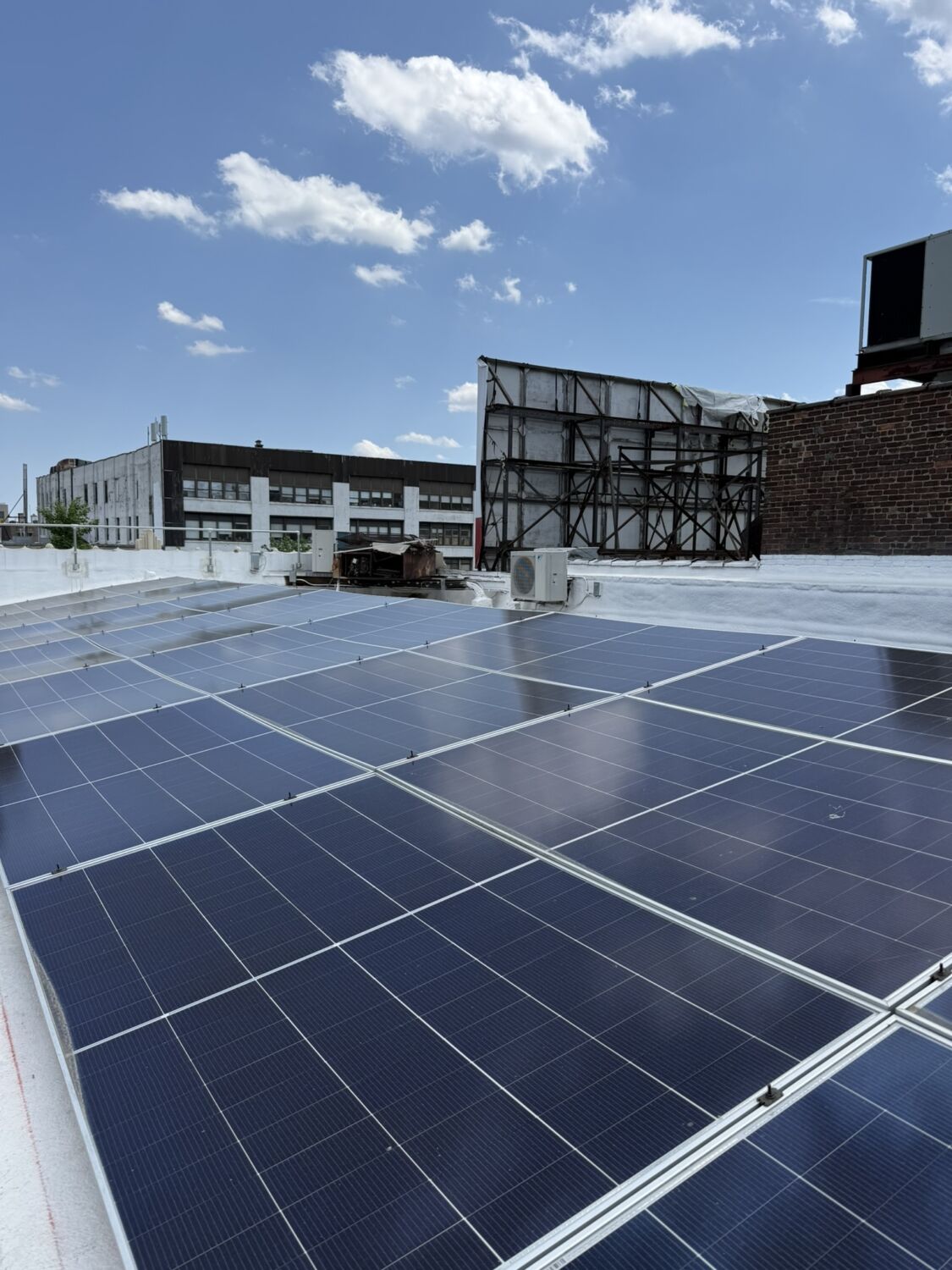
Completed solar panels on a Bronx rooftop generate electricity for the grid through Fieldston Power’s community solar project. Photo: Courtesy of Fieldston Power
A new renewable energy developer offers a model for solar-generated electricity that shares the benefits beyond a single building.
The roof of Bronx native Emily Weisberg’s family-owned commercial building on the Grand Concourse kept leaking. Her family couldn’t find a definitive solution — even after spending about $8,000 trying to fix it.
Then came an unexpected solution: installing solar panels.
Fieldston Power, a renewable energy company that develops rooftop solar projects founded by her husband Alex Weisberg and his partner Adam Zucker, replaced the roof at no cost to the building and installed solar panels that feed electricity into New York City’s grid.
The building now hosts a community solar project, a model where residents and businesses subscribe to a share of a solar array’s output and receive credits on their electric bills. For the Weisbergs, participating in New York’s growing community solar market also addressed a recurring maintenance headache.
“More than anything, my tenants are just happy that they don’t have a leak in the roof anymore,” said Emily Weisberg, who also owns the community staple Moss Café in Riverdale, about a 20-minute drive away.
Subscribers to this community model can receive credits on their electricity bill from a shared solar installation without having to live in the building where the panels are installed: Moss Café subscribes to electricity generated by panels on the Weisberg-owned building, connecting the neighborhood business to the property.
The project brings together two things she cares about: maintaining her family’s property and making sustainable energy more accessible.
Cleaner buildings
Fieldston’s approach offers benefits for all parties involved; in exchange for hosting solar panels, owners get a new roof and discounted electricity rates. On top of this, the city gets more solar on its rooftops as it intensifies its efforts to cut emissions from buildings, which account for roughly two-thirds of New York City’s greenhouse gas emissions. Local Law 97 (LL97), passed in 2019, requires most buildings larger than 25,000 square feet to reduce their emissions, with stricter limits starting in 2030.
In general, the city is on track to meet the ambitious goal set out by LL97. On Sept. 25, Mayor Zohran Mamdani’s administration announced that about 95 percent of the roughly 20,000 privately owned properties covered by the law had filed compliance reports, and that about 95 percent of those demonstrating compliance had met their emissions targets. These buildings improved efficiency through methods such as improving insulation, electrifying HVAC systems, and embracing solar energy.
Weisberg’s building is smaller than 25,000 square feet, so it isn’t covered by Local Law 97. For her, the main draw was the roof.
“We saw the opportunity back to Local Law 97 as a way to not only meet the city’s admirable intention and goals of decarbonizing the built environment, but as a way to recapitalize and reinvest in these buildings as well,” Adam Zucker, Fieldston Power’s co-founder, said. “Our model is to not only lease these roofs, but to provide these owners a fully financed and hassle-free solution towards our Local Law 97 requirements.”
Still, rooftop solar does not automatically bring a building into compliance with Local Law 97. Whether a particular installation helps an owner meet its carbon emissions limits depends on the property’s energy use, the amount of electricity it generates, and the rules applicable to said building. Solar can contribute to a broader energy efficiency strategy, but it alone doesn’t necessarily offset other emissions sources.
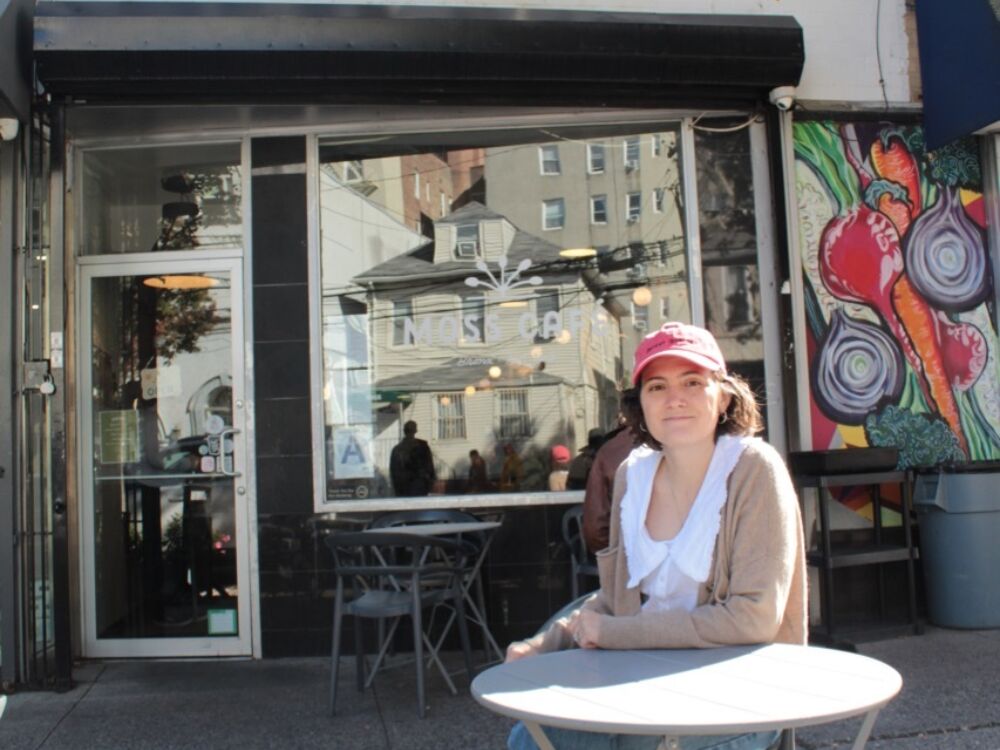
Emily Weisberg, owner of Moss Cafe in the Bronx, discussed her family’s experience with Fieldston Power’s solar project. Photo: Mohamed Farghaly
How it works
Fieldston, founded in 2024, leases the rooftops from building owners and finances the entire development, installation, and operation of the solar systems, including feasibility studies, equipment procurement, proper permits, and design.
Once the solar panels are installed, the electricity they generate feeds into the broader Con Edison grid, powering New York City. Fieldston makes money by selling those credits: subscribers pay the company less than the credits are worth, and the difference is the amount subscribers save each month. The company also relies on state incentives and federal tax credits to cover its costs.
The company targets older multifamily properties, many built in the 1930s and 1940s, where roof repairs can often be an expensive and recurring concern, but the ideal rooftop isn’t severely damaged either. “We do very extensive analyses of all of our projects before moving into permitting it,” Zucker said. “So we’ll assess the roof’s condition from a moisture standpoint, from a structural feasibility standpoint, from a condition standpoint.”
After the initial repairs, they install a lightweight, fluid-applied elastomeric membrane, which comes with a 20-year warranty. The final step is attaching the panels.
For new projects, they generally look for landlords with portfolios of multiple buildings large enough to support an economically viable group of solar installations. The ideal candidate has at least 100,000 square feet of rooftop space across a portfolio, with individual roofs around 7,500 square feet. Building dimensions, sunlight exposure, structural conditions, roof moisture and obstructions such as telecommunications and cables can also affect whether a project would work.
Fieldston also screens prospective property owners for their history of maintaining their buildings, Zucker said, because the company expects to have long-term growing relationships with the landlords whose rooftops they lease.
According to Zucker, the company has completed 73 solar system installations, 71 of which are operational as of the date of this publication, most of them in the Bronx. The rest are in final commissioning, and several hundred more are in early development phases.
The company has already bought equipment for about 40 megawatts in a purchase made ahead of a federal tax-credit eligibility deadline, as a way to preserve the ability to develop its future projects under the applicable rules. Building those projects will cost an estimated $200 million.
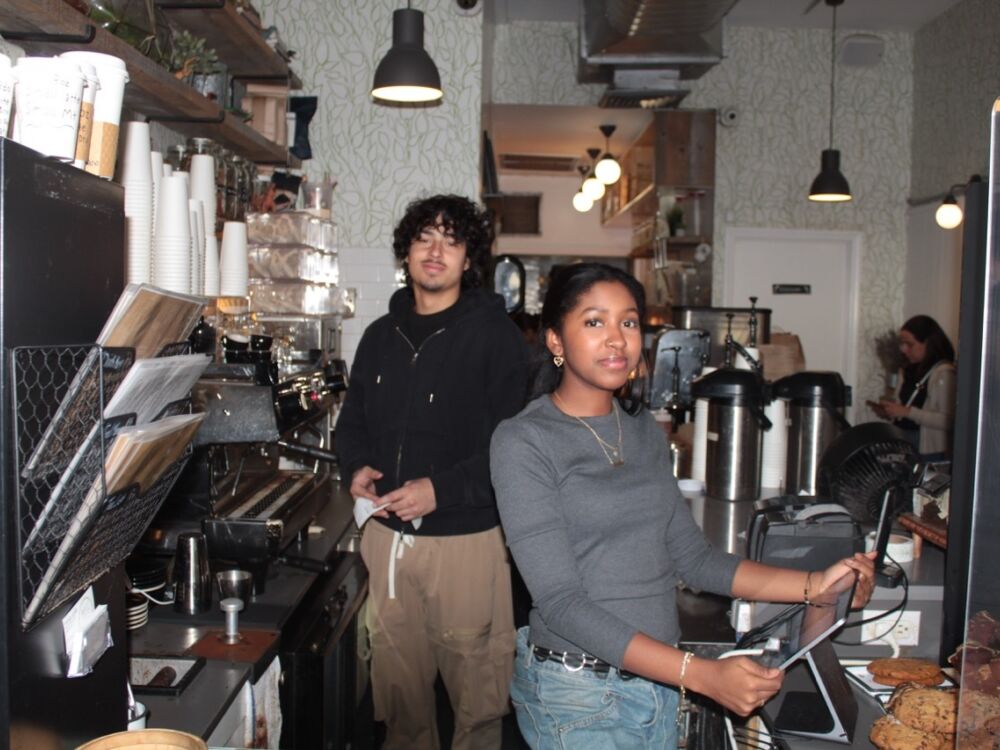
Employees at Moss Cafe, which gets part of its electricity from subscribing to solar panels installed on another building 20 minutes away. Photo: Mohamed Farghaly
The roadmap
In densely-populated New York City, where the majority of residents and small businesses are renters, community solar offers a way for more people to participate in carbon-free energy generation without buying the infrastructure. As of August 2026, New York City had 607 community solar projects, according to data from the New York State Energy Research and Development Authority (NYSERDA): less than 1 percent of all solar installations in the city, but roughly a tenth of its solar capacity.
The model works like this: Subscribers to a community solar project buy into a solar company’s array and receive credits on their electric bills for the power generated by their share of the project, usually at a discount of 5 to 20 percent. But that discount applies to the credits, not to the ratepayer’s entire monthly bill.
Each month, the electricity produced by a subscriber’s share of the project is converted into a dollar credit that appears on their Con Edison bill and lowers the amount they owe for their energy supply. The subscriber then pays the solar company for those credits at a discount.
A subscriber with a $100 monthly bill, for example, might receive $60 in solar credits, meaning they owe Con Edison only $40 and $60 to the solar company. But with a 20 percent discount, they would actually pay the solar company $48 for the $60 in credits. Their total cost would be $88, a savings of $12, or 12 percent of the bill. The discount applies only to the portion of the bill covered by the credits, not to the entire bill. Depending on the program, a subscriber either pays one consolidated bill to the utility that includes their community solar subscription, or receives two bills — one from the utility with the credits applied, and another from the solar company for the discounted credits.
How much someone saves depends on how much of their bill the credits cover.
New York State also pays solar developers extra to steer savings toward low- and moderate-income households. Through NYSERDA’s Inclusive Community Solar Adder, projects receive additional funding if they reserve at least 40 percent of their capacity for those households and guarantee them a discount of at least 10 percent. Projects that offer 15 or 20 percent discounts and meet other community-benefit requirements, such as local hiring or community partnerships, qualify for a larger incentive.
Zucker explained that Fieldston participates in NYSERDA’s NY-Sun Program and that its projects are eligible for the Adder initiative: Approximately 60 percent of the power generated by their systems is allocated to low-income subscribers, who receive a 20 percent discount through the program.
The challenges
For owners of older buildings, major projects compete for limited capital. Installing solar panels can create another source of clean electricity, but the economics depend on each building, the particular installation, and the terms of arrangement.
Although Weisberg’s building is almost 100 years old, she described the process as surprisingly straightforward, taking about a year and a half from start to completion. The leaks stopped, and both she and her tenants have seen a reduction in energy costs — but not everyone is optimistic about community solar’s financial benefits.
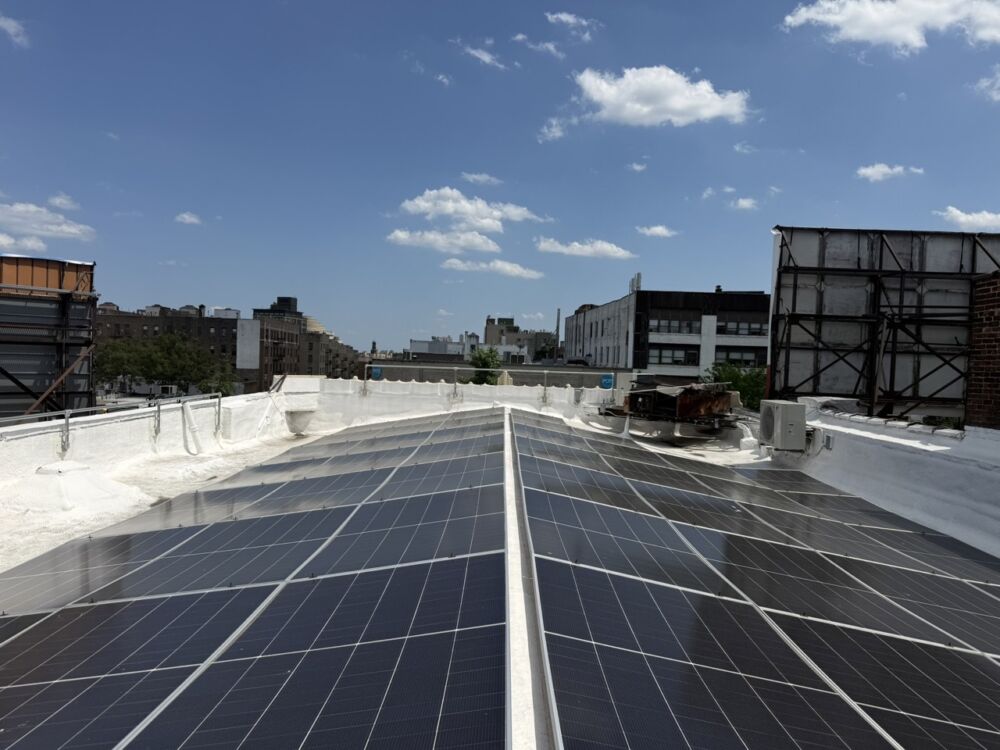
Another view of the completed solar installation atop the Weisberg's commercial building in the Bronx. Photo: Mohamed Farghaly
McGowan Southworth, co-founder of Daisy Chain Energy, an AI-enabled software platform that works on energy systems, argues that most of the value from solar energy goes to whoever owns the project and favors models in which ownership — and the profits that come with it — stay in the communities that host the panels.
“I would argue that community solar doesn’t really save residents a meaningful amount of money,” Southworth said, unless the community itself owns the projects.
“I’m much more interested in co-op living and co-op ownership,” McGowan said. “I think that when you’re selling those to a third party, ultimately most of that money goes upstream to a large head fund, large investors, high net worth, you know, people who don’t necessarily need a great deal.”
He also sees solar as only part of the solution. Shifting when buildings use electricity away from the hours when the grid is most strained could matter more, he said.
The model has its own set of challenges: developers must find suitable rooftops, navigate permitting and grid connection requirements, finance installations, and recruit customers to subscribe. Even when a project is financially viable, delays or costly electrical upgrades can affect how quickly it proceeds, and grid-interconnection work can create substantial expenses.
Southworth described projects that required costly upgrades to existing electrical infrastructure, illustrating how expenses beyond the panels themselves can complicate development.
Fieldston faces another constraint: the availability of experienced workers. Zucker said the company has had lots of interest from landlords and that financing has not been an obstacle. But the limited pool of qualified crew members on the installation and engineering side and construction contractors able to handle the complexity and volume of rooftop projects in the city complicates things. Because the company awards contractors several projects at a time, reliable crews are essential to its expansion plans.
The future
Zucker expects Fieldston to continue to expand its solar portfolio significantly in the coming years, whilst the company is currently exploring battery storage to complement its generation projects.
Rooftop projects like Fieldston’s could offer one option for property owners exploring cleaner energy, but the model’s value depends on more than the panels. Their long-term promise will hinge on whether developers can scale installations, overcome labor and grid constraints, and demonstrate that the savings reaching subscribers are meaningful and transparent.
For Weisberg, the project solved a problem she and her family had struggled with for years and allowed her café to participate in community solar, but she sees a broader challenge for New York’s aging building stock: ensuring environmental improvements do not leave smaller property owners behind.
“We have to keep property in the hands of many,” she said. “That’s important and essential.”