
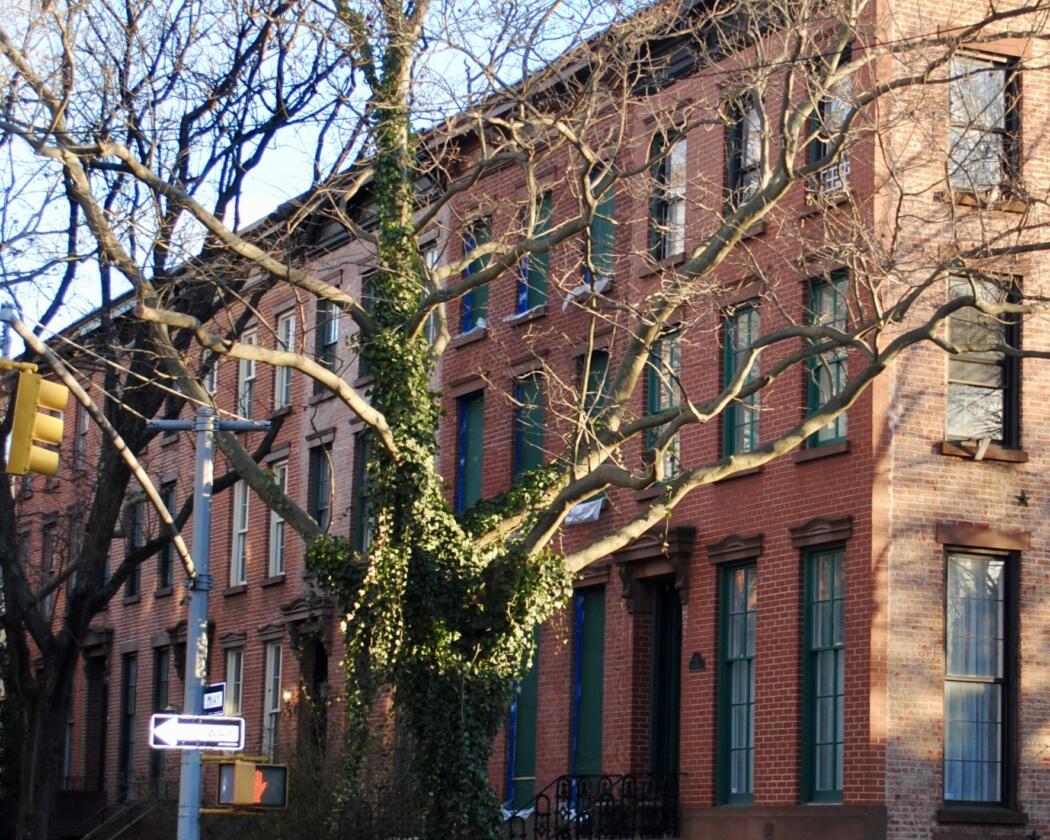
“Wow, there’s one more brownstone powered by solar.”
Skylight sits down with Brooklyn SolarWorks’ Shane Preece to understand a day in the life of a solar installer.
Photo: Hannah Berman
Shane Preece, now operations and maintenance manager of Brooklyn SolarWorks, knew very little of how solar power worked when he moved from Salt Lake City, Utah, to New York City in 2018. Eight years later, he is not only totally convinced of its benefits as a source of renewable, carbon-free energy, but has installed solar panels in more buildings than he can count across the city — and is always happier when he gets the skyline views from Park Slope or gets to see Central Park from above.
Some of his experience is working on community solar projects, including one very close to him: the very own Brooklyn SolarWorks warehouse in Gowanus. The energy produced there gets distributed through the employees, so he sees the benefits reflected on his Con Edison bill at his home a couple of neighborhoods over in Bed-Stuy.
We spoke to Preece to learn more about his experience installing solar panels on New York City rooftops.
This interview has been edited for length and clarity.
How did you get into solar?
Preece: My friend was working in solar when we moved here, and it sounded like a cool thing to do, so he was actually able to get me a job. And that’s when I started my solar journey.
Why do you think it was an interesting thing to work on?
I really liked being outside and seeing different parts of the city, going to all these different cool locations. A bunch of my friends also worked for the company, so that didn’t hurt. That’s kind of what appealed to me mainly, and then all the interest in what it does for the environment and how beneficial it is to everyone came kind of later, once I got a foot in the door.
Can you walk me through a regular workday?
For a regular install, there are two teams: roof and electrical. They show up, introduce themselves to the customer and walk them through where we’re going to run our electrical conduit and what areas we’ll be working in. That happens at the start of the day, and from there, everything moves really quickly and efficiently.
The roof team gets all the equipment up to the roof by pulling it up the front of the building. We have a pulley system for that. At the same time, the electrical team starts running the conduit and making sure the electrical panel is safe for us to interconnect.
At a certain point, both teams meet in the middle, when it’s time to connect all the panels and equipment on the roof to the downstairs. Then the solar is turned on, everyone’s happy, we clean up, get out of there and do it again the next day.
Do you feel like you experience New York City in a different way than most people do?
I absolutely do feel that way.
Going to all the different locations and really seeing all these different neighborhoods that… a lot of them I would probably never have a reason to go to. That’s my favorite part. I always look for a place with good food around. I know a lot of installers share this feeling too; we look for the good food and the special little pockets and the rare gems, and we share them with each other. Working around the city definitely helps me experience New York in a way I wouldn’t have otherwise.
Have you worked on any community solar projects?
Yes, I’ve worked on a couple of bigger jobs, like on co-op buildings. These co-ops have big roofs with a lot of room to produce power, so we install a special meter from Con Ed that tracks the system’s total production. The tricky part is splitting that power between the units so everyone gets a fair share and it makes sense for each owner. That’s where community solar comes in: it allows the credits to be shared.
What are the biggest differences between a community solar project and a regular one?
I’d say the biggest difference is how Con Edison handles it. With regular solar, the power a home doesn’t use gets sent out to the grid, and Con Ed tracks how much is exported. That’s called net metering here in New York. Those credits go directly to that customer’s bill for future use. With community solar, all the credits get counted on one account and then distributed to the different units.
From the installation point of view, the difference is the meter. With a residential install, we use the regular meter the home already has for its electricity. With community solar, we have to put in a new meter with Con Ed, because the system isn’t attached to any individual account in the building.
You mentioned that concerns about environmental benefits of solar came later for you. Can you tell me more about that?
Growing up in Utah, I was always conscious of my impact on the climate, because I saw how beautiful nature is there. But it didn’t really click for me at first [with regards to solar]. I got this as a job.
Then I saw that this company’s approach was environmentally forward, and I saw the passion some of the owners of Brooklyn SolarWorks have. I thought it was really cool, and I was inspired. The longer you’re in the industry, the more you learn about it and about what it takes to make electricity.
It’s really satisfying to go up and put solar on a roof in one day and walk away knowing that, in a lot of cases, that entire house now runs on solar. It compounds that feeling: Wow, there’s one more brownstone powered by solar.
The other thing I find really nice is how easy it is to deploy. You can produce a lot of energy with solar pretty quickly, especially compared with other ways of making energy. In one day, we have a system up on a roof and it starts producing energy.