

“You have to consider other shareholders’ needs, and you all pitch in to achieve something together”
An expert on NYC co-ops speaks about what clean energy goals and regulation mean for this unique homeownership model.
Rebecca Poole is the Director of Membership at the Council of New York Cooperatives and Condominiums (CNYC). Photo courtesy of the subject
Many thousands of New Yorkers live in co-operatives and condominiums, which make up roughly 22 percent of the housing stock in New York City. While co-ops get a reputation for being exclusive; the domain of the well-to-do or the lucky few who pass the interview, the truth is that hundreds of thousands of New Yorkers live in co-ops that were built or converted for the working and middle classes, including tens of thousands of co-op apartments that were built by unions. It’s an important socioeconomic position to consider as New York City buildings take on the clean energy transition — a significant capital investment responsibility that doesn’t fall on all shoulders equally.
Skylight founder Eric Lee recently sat down with Rebecca Poole, a champion for residents of co-ops and condos in New York City. In her role as the Director of Membership at the Council of New York Cooperatives and Condominiums (CNYC), she advocates for the interests of these groups in front of legislators who set state and local policy. In this wide ranging interview, Poole discusses the role of co-ops in preserving affordable housing, what is working as co-ops push to lower carbon emissions and the increase the efficiency of the operations of their buildings, and her recommendations for improving the laws that govern the transition to net zero emissions in New York City.
This interview has been edited and condensed for clarity
Eric Lee: Hi Rebecca. Thanks for making time to talk this morning. You work at CNYC, can tell us about what CNYC does?
Rebecca Poole: CNYC is a member-funded not-for-profit organization that provides education, information, advocacy for co-op and condo buildings, and by extension, their homeowners, which we have been doing for over 50 years. CNYC started initially as a group of newly converted co-ops on the Upper West Side and the idea was to develop best practices that could be shared, so that these newly founded boards were not continually reinventing the wheel. Over time, advocacy has become a much more important component of what we do, equal to the educational and informational component.
EL: One of the things I have enjoyed about getting to know you is that you have a passion and great intellectual interest in the story in co-ops and condos. How did you get involved in the co-op world?
RP: I grew up in a co-op. The apartment building where I lived went co-op in 1982 when I was in middle school. My parents were involved in the conversion as part of the tenants’ association at the time, as were many of my friends’ parents, who also lived in the building. I was aware of their discussions about what being in a co-op meant, why people were considering purchasing their units or not purchasing their units, and the thought behind the transition from a rental building to a co-op building. After the building converted, I observed the community that developed as the homeowners came to understand how they could improve their quality of life and the financials of the building, looking toward the long term.
There was a very strong community feeling, and I’ve always identified with what that can bring to everyone’s life. Having a co-op where you have to consider other shareholders’ needs, and you all pitch in to achieve something together, I think, can be very positive.
One thing that is never recognized about co-ops is that there is a tremendous diversity in homeowners. I think today a lot of people view a co-op, or a condo, as a whole. They don’t see the individuals that basically make up a tiny town that have lived together over years, and how that has changed. I think that’s the major battle that we have when trying to explain the importance of the financial component.
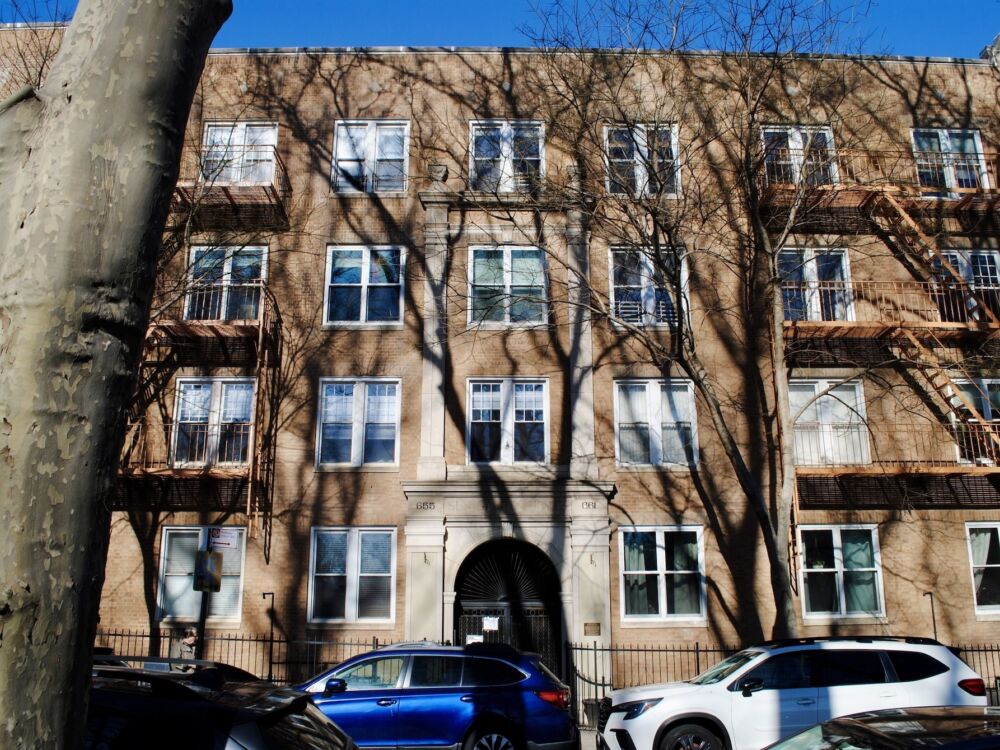
Sun Garden Homes, a co-op in Sunset Park, began their retrofit project with an energy audit. Photo: Hannah Berman
EL: You grew up in a co-op at a time in the city’s history when co-op conversion was an important story in the city. Why did you stay in the world of co-ops as an adult?
RP: I graduated from Rensselaer Polytechnic, RPI, with a degree in management systems and a background in physics. After college, I worked with somebody who was just managing a few buildings and she was trying to put financial information right at the fingertips at boards and, at that time, that wasn’t being done. I helped her build a system to do that. Then I ended up managing one of her properties, and, like with most people, I sort of fell into the field and my role, and I loved being a property manager. I felt I could have a real lasting impact on people’s lives, because your apartment — for 90-plus percent of shareholders or unit owners — is your most valuable asset. So, the management of that is really essential to most people’s well-being, financially and otherwise.
EL: Let’s talk about one of the things I know is an important part of your work at CNYC, which is watching what’s happening with the transition to clean energy. What’s distinctive about co-ops and condominums in the context of this larger story of dramatically reducing carbon emissions in New York?
RP: I think the fact that co-ops and condos are not organized based on a profit motive is one important distinction. So improvements that may enable a landlord [of a market-rate rental building] to increase their rent because of the attractiveness of clean energy and no gas in the building, being able to control your own heat, all those things, don’t come into play the same way for a co-op or condo.
Obviously there’s a potential addition to how much you can get for your apartment if it’s been fully converted and somebody else doesn’t have to then pay for the work, but that only comes into play for the individuals that might want to sell. But if I have just purchased my apartment with the idea that I’m going to be here for the next 30 years of my life, and my children are going to go to the local public school and I’m going to develop a community here, then the idea that electrifying today could improve my property value when I sell in 30 years, it doesn’t have the same impact. Instead, I have to consider what the expense will do to me now, and I also have to look at the benefits of waiting because prices [for new clean energy systems] are probably going to come down eventually.
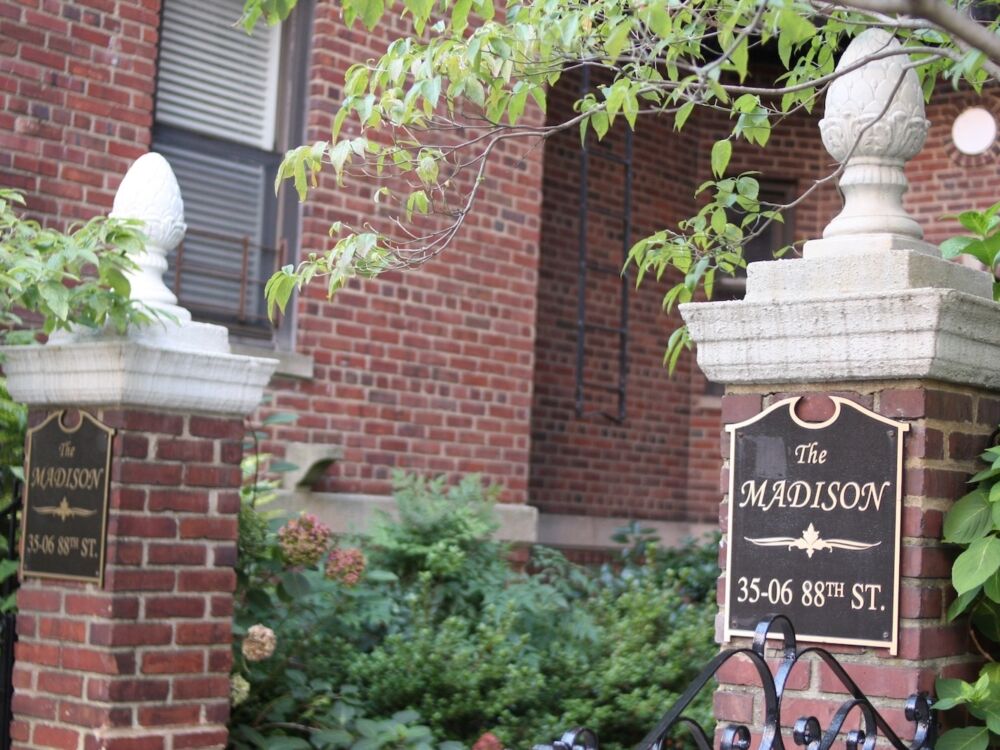
The Madison has ten years before it needs to take action for decarbonization; for now, the board is considering a project upgrading its windows. Photo: Sunny Nagpaul
EL: I think this tension is underappreciated that if your view spans over decades, then everything changes — prices are going down, the tools are getting better, and it’s happening fast — and your point is, that in some contexts, this leads to an instinct to defer for a minute.
RP: Yes, I think there are just too many unknowns right now. There are so many variables that determine what a building decides to do in terms of their decarbonization path, but for the majority of co-ops and condos, there are tremendous benefits to staying nimble, to being able to pivot, and to being able to see how technology changes, to be able to observe how systems have actually worked in real life in similar buildings over time, and that is not available yet.
The picture is much broader than decarbonization. Co-ops and condos have to consider not just the cost of decarbonizing and trying to help with climate change, but also the impact of climate change on our buildings, like flooding, for example, and making sure that in 20 or 30 years, our building will, in fact, still be here. So, the energy efficiency improvements that help us adapt to changing temperature while keeping our costs as low as possible, that is as important to us as decarbonizing. I think that the problem with the way incentives and Local Law 97(LL97) are structured is that they don’t sufficiently take that into account.
EL: CNYC has been instrumental in getting through the changes to the J‑51 tax abatement, and they’re really monumental: They change the process so that it’s more reliable, and they dramatically change the time frame so that a larger number of buildings are eligible. Does that effectively remove your concern about incentives versus penalties? For buildings that don’t have the wherewithal to deal with the next 20 years through investment, they can do so with incentives?
RP: We’re very grateful to [New York] Senator [Brian] Kavanagh and many other legislators and to [New York] Governor [Kathy] Hochul for getting the changes to the J‑51 program done; extending it to ten years, putting in a [cost] escalator, and giving buildings an opportunity to plan properly, improve their buildings, and deal with climate change. [It’s] an important bill, and it will be very helpful to buildings that qualify. But the belief that just a building’s location should determine whether or not the individual shareholders can afford the cost of LL97, It’s overlooking the needs of [some] homeowners. The majority of co-ops and condos that have to comply with LL97 are not covered by this bill and I would argue that most of them do not have the wherewithal financially to comply with the electrification.
These laws do not take into account the economic diversity in a co-op or condo. For that, you have to look at every single individual homeowner. For three years, four years now, we have been striving to get senior citizens, disabled homeowners, as well as any shareholder or unit owner that would fall within the 80 percent to 165 percent of AMI or that receives benefits to be eligible for a benefit to cover their portion of the assessment as related to LL97. We thought that would help those who need it most to not be financially impacted by the work in their building.
Huge incentives are given to single family homeowners all the time who meet these income tests. There are huge amounts of money set aside for single-family homeowners not set aside for co-op and condo owners in the same financial and life circumstances.
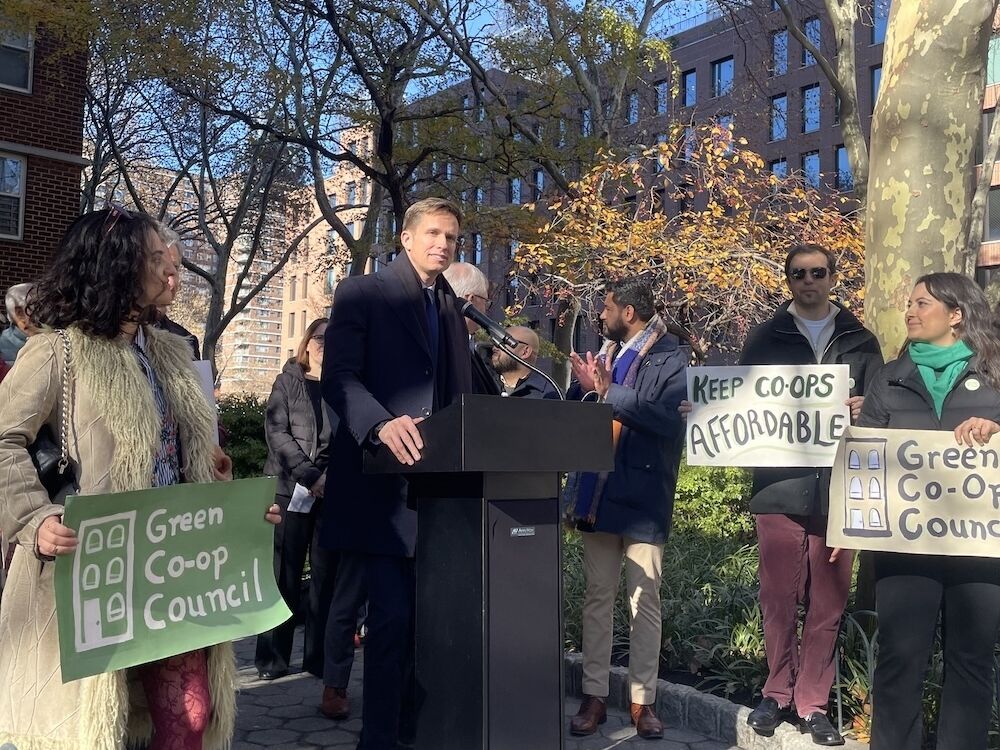
New York City Councilmember Erik Bottcher speaks in support of the J-51 tax abatement at a Green Co-op Council campaign launch. Photo: Hannah Berman
EL: Looking at the work that is underway — and I know you read Skylight — there are loads of buildings that are doing meaningful work now. What do you hear from your members and from the technical experts that you work with that gives you confidence about how we’re moving forward?
RP: The boiler control systems and the other energy efficiency work, the results are looking extremely positive. Buildings have cut their usage tremendously, and those systems have a payback period of eight to 12 years, which seem realistic for most buildings.
There have been some buildings with problems, but for most buildings that have instituted new boiler control systems and changed out chillers and other equipment like that, the feedback has been very positive. Same thing with improving ventilation systems. The buildings have seen not just a drop in carbon emissions, but also a drop in fuel usage, so that’s very important. I think it’s best practice for co-ops and condos to pursue that work, and to pursue it now. And potentially, when or if buildings go to electrification, the energy efficiency projects that have been done in the past will be helpful.
EL: You’ve talked before about ideas that you have about how we might change LL97 to make it sort of more attainable, more fair and more in line with the circumstances of people who live in co-ops and condominiums. Can you tell us about these ideas?
RP: It’s our position that co-ops and condos can help the city achieve its long-term decarbonization goals by pursuing energy efficiency measures like the ones that we’ve just discussed, but that the penalty structure and late filing fees need to be adjusted. The city also needs to consider where it doesn’t make sense to require compliance with the law. Many, many buildings are allowed to just take on prescriptive measures. [Housing developments] with co-generation plans that are already operating efficiently would be one example.
We also would like to see garden apartment co-ops that have multiple heating plants and large distribution systems exempted from the cost of requiring them to dig up their entire property to comply with the local law. It’s just not realistic from a financial standpoint at the current time. That’s going to change, I’m sure, in time, but right now we believe they should be also exempted through 2050. There aren’t that many of them, and they face the largest penalties per household of almost all co-ops and condos, so until there’s a solution that’s specific to them that makes financial sense, we feel that they should also be exempted from the penalties.
EL: Everybody in New York is correctly concerned about affordability and housing. How do co-ops and condominiums contribute to the affordability story?
RP: Co-ops and condos, by their very nature, being not for profit, have preserved affordable homeownership, because the goal of any co-op or condo is to provide the best quality of life at the lowest possible cost. You know what your expenses will be over time, and it’s not like your lease expires and you are hit with a new rent increase. So in this way we maintain affordable housing.
We also self-fund the preservation of New York City’s housing stock, because we’re concerned about the long-term viability of our buildings, which is critical to the city’s goals. The cost to the city in subsidies that is required for new construction is astronomical, and maintaining existing housing doesn’t have to cost the city really anything, as long as the city starts to look at the expense [to individuals] of the local laws that it’s passing and how they all interact to raise the cost of preserving the housing stock. The city has limited funds, we have limited funds, there’s only so much that we can cover.
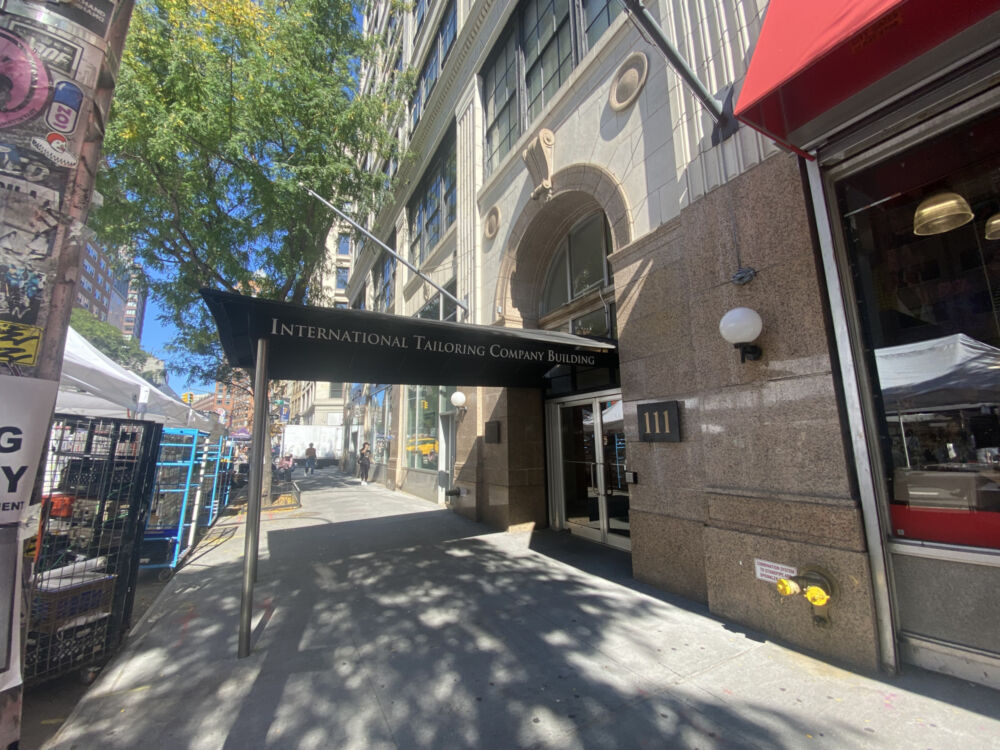
Exterior entrance to the International Tailoring Building. Photo: Mary Cunningham
EL: So in a word, what are the things that co-ops and condominiums need to focus on in the next ten, 20 years ahead?
RP: Co-ops and condos need to focus on ensuring that their building systems and exterior envelopes are maintained and preserved and improved in such a way that they can meet the challenges ahead of us over the next ten to 20 years. If buildings have issues because of extreme precipitation events and flooding and water backup, they need to make sure that they proactively address that because these issues are going to become more prevalent.
The same thing with the cost of electricity, gas, and oil: buildings need to make sure that they are operating at peak performance proactively because, as fuel costs rise, that’s one way that we have of maintaining affordability, by putting systems in place that will ensure that we’re operating optimally.
EL: And what do co-ops and condos need from the city in order to be able to deliver?
RP: Co-ops and condos need the city to consider the cost of implementing new rules and regulations operationally and financially. So, any new legislation that is introduced that is going to impact the operation of a building needs to be viewed in terms of what it will do to a building’s bottom line, and especially how it could divert funds that could be used for preservation and decarbonization.
For example the sidewalk shed regulations, where now we have to get permits every 90 days. That is going to add $15,000 to the cost of a project, for every façade job. The tenant protection plan requirements that were put in place probably add $20,000 a year. That is money a building could be spending on other work, if the regulations and legislation were drafted in such a way to minimize the financial impact on co-ops.
EL: That’s a substantial additional cost, repeated over the years through the lifecycle of the projects a building takes on.
RP: Right! There are tons of examples like that, and the amount seems small when you look at them piecemeal, but when you put them together, it is a lot.
It’s important that the city does [what it can] to ensure that we can afford to continue to self-fund the preservation of our buildings and keep this housing stock affordable for future generations. Homeownership stabilizes communities, it generally improves communities and it enables social mobility. The homeownership rate in New York City is among the lowest in the U.S., and the housing cost burden is amongst the highest, so it’s definitely in the city’s interest to support affordable home ownership.