
It’s hard — and it’s happening
One year in, Skylight has documented real progress towards a clean energy transition in New York City’s apartment buildings
We launched Skylight in January 2025 to tell the stories behind the clean energy transition happening in New York City’s residential buildings — one building, one decision, one resident at a time. Our reporters have gone deep into the work of building decarbonization, documenting both the successes and the failures in order to catalogue the transition as it currently stands.
In that time, much has shifted, both locally and nationally. We’ve seen the beginning of the first compliance period for Local Law 97 (LL97), which imposes limits on large buildings’ carbon emissions; we’ve seen the federal government cancel millions in funding for offshore wind projects, including one in Staten Island which would have helped clean up the city’s power grid; here at home, we’re also welcoming a new mayor who has loudly stated his commitment to upholding our city’s climate goals. All of these factors are bound to alter the course of our energy transition.
Amidst these changes, we’ve noticed a clear theme: Even if the work is hard, it’s happening. Here’s a summary of what we’ve learned from our first year of reporting at Skylight.
The energy transition demands a lot
Moving New York City away from fossil fuels and toward clean energy is far more complex than the flip of a switch. It involves not just the revamp of multifamily building systems, but also the infrastructure that supports them — electrical grids, gas lines, etc. — along with broader economic trends, like technologies and products coming to market to run buildings more efficiently.
Existing building infrastructure built for oil- and gas-powered systems is difficult and costly to rewire for a clean energy future. Deciding what to replace and when is a juggling act: The old tech is inefficient, but it’s also the devil we know. Building owners and operators fundamentally understand how a boiler works, and are hesitant to decommission theirs to opt for newer tech that has just come onto the market in the last few years — especially before existing systems reach the end of their life cycle. In the context of already-rising operating costs, many buildings might not want to consider adding another financial burden to already-thin margins.
To make matters more complex, all of this work often falls on the shoulders of people who aren’t experts in decarbonization. A big portion of the clean energy transition of New York City is being led by the folks sitting on co-op and condo boards, many of whom have little idea where to start, but take the leap anyway. “We’ll never delegate our way to an excellent building,” one co-op shareholder who took the lead on his building’s projects told Skylight. “You have to be actively engaged.”
New Yorkers are finding solutions
Despite myriad challenges, retrofitting is indeed happening all over the city, in apartments and homes across all five boroughs. Here are the methods that New Yorkers have employed to move the needle.
- Financial planning: We’ve learned it’s important to start putting away cash for large upgrades early; many co-op shareholders and condo boards who choose to plan carefully, with a long time horizon of several years, have seen success. This strategy worked at the Charlton House, where Chris McGinnis and his fellow cooperators were able to bundle several incentives over the course of several years to essentially get solar as a free perk; similarly, planning was a key part of the International Tailoring Building’s strategy for saving money on costs. “If you’re spending money reactively, you’re just going to be throwing money down the drain,” their project manager told us.
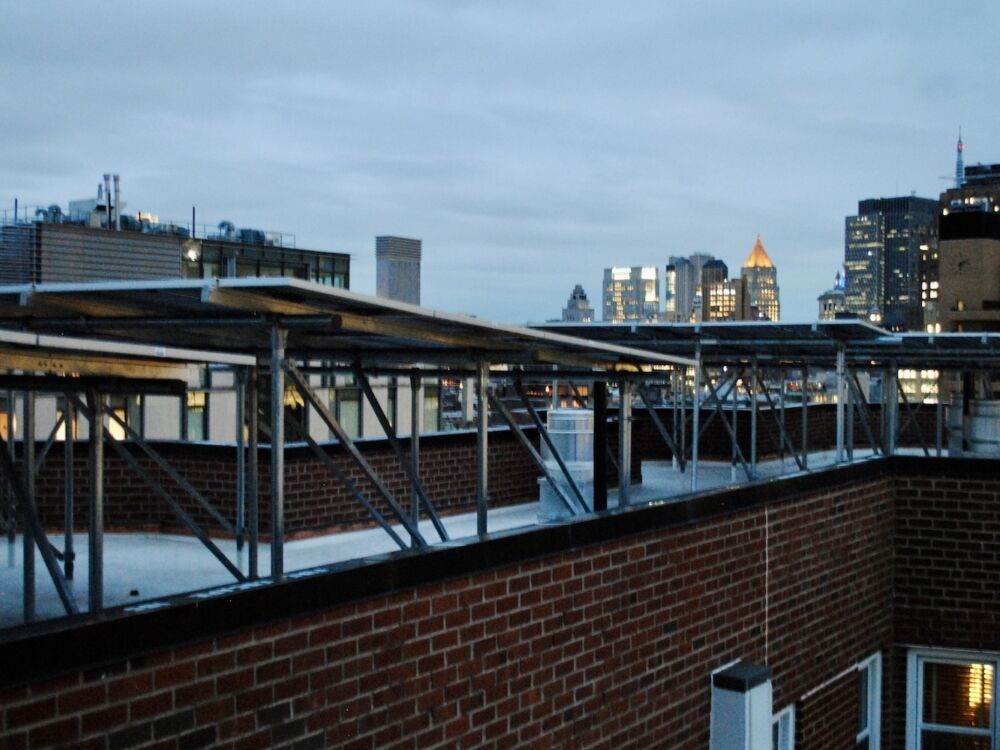
Charlton House’s new solar panels feed electricity back to the grid, turning unused roof space into revenue generation. Photo: Jaime Stock
- Taking advantage of free money: The expenses of decarbonization can be steep, but there are also plenty of ways to mitigate them, as Skylight has documented. One method is to pursue quickly-drying-up tax credits. As one Brooklyn condo owner who used credits to facilitate the installation of rooftop solar put it, “It’s kind of like a no-brainer.” Other building owners hope to take advantage of the J‑51 tax abatement, if it is extended.
- Embracing efficiency fixes: In many building projects Skylight has covered, planning major upgrades comes hand-in-hand with smaller-scale efficiency improvements. Enough cannot be said about the wins that come from focusing on making existing systems work more efficiently — getting the maximum amount of heating and cooling results, with the least amount of energy input. In five out of 11 of our case studies, Skylight reported on projects anchored in an efficiency first move that cut both emissions and costs. These include LED lighting, which lasts longer and lightens the electrical load; smart sensors installed on a building’s boiler, which give more insight and control over its usage; and radiator covers, which work to trap existing heat, making the boiler run more efficiently.
- Focusing on the façade: Gaps in the building envelope can allow conditioned air to escape and force existing heating and cooling systems to work harder, wasting oil and gas. Closing up holes in the building façade, or air sealing, is a step that building efficiency expert Tom Sahagian says all buildings should take, regardless of whether they plan larger improvements to go along with it. Larger-scale façade change is also possible through recladding, which entails stripping a building of its exterior skin and replacing it entirely. Though ambitious and costly, recladding can see huge benefits, as it did in a former white-brick building at 201 E. 79th St., where falling bricks have been replaced by porcelain tiles that better insulate the building and have cut the amount of energy needed for façade-related heating and cooling by about 37 percent.
- Taking the leap to electrify: For many cases, the final step is making the switch — turning off that oil- or gas-fueled boiler, and relying instead on electricity. In buildings all over the city — from public housing in Woodside, to co-op housing in Brooklyn Heights — this has meant switching to heat pumps, which run on electricity and provide both heating and cooling. Installing traditional heat pumps throughout a building requires unit access, which is sometimes disruptive, though not always. New innovations address this problem: One legacy New York boiler company has created a brand-new heat pump that uses existing infrastructure to deliver heat from the basement; and NYCHA led an innovation competition that resulted in the invention of heat pumps that plug into a regular electrical socket and slot over one’s windowsill.
People drive change
Moving the energy transition forward in our homes requires both grit and time — the willingness to engage with highly-technical topics, work with unlikely collaborators, and think in twenty-year timeframes. How does a movement like this maintain momentum?
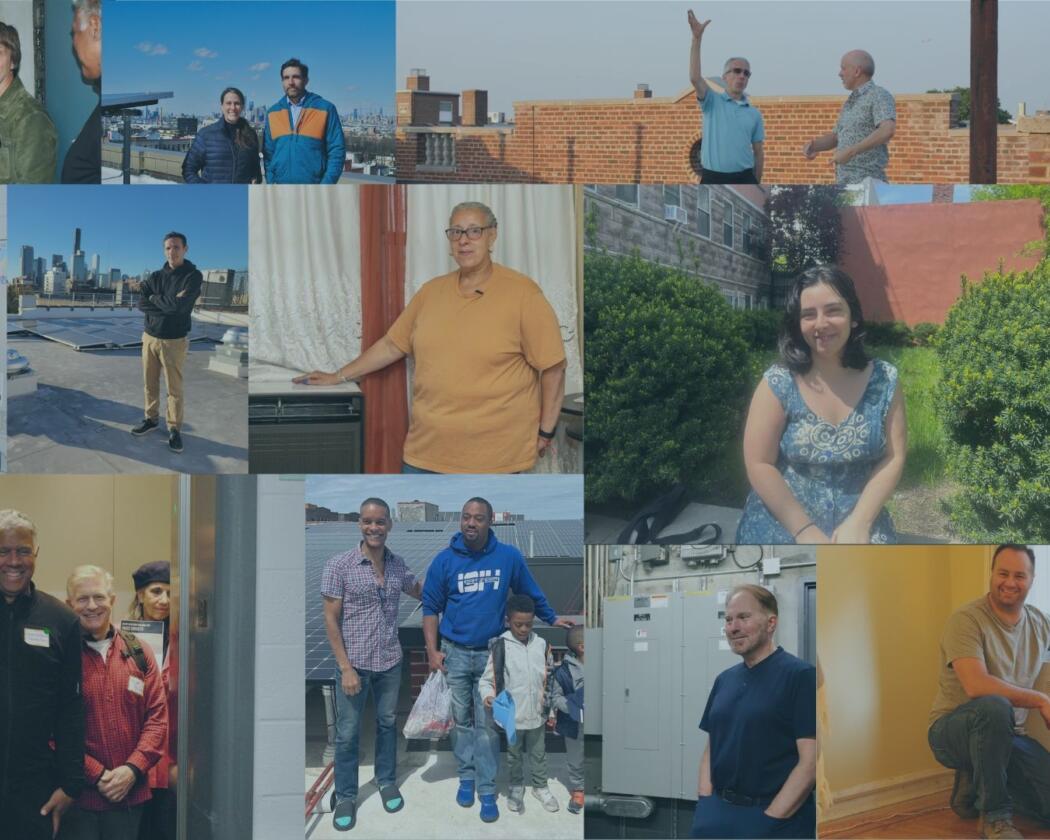
Early adapters — passionate, self-taught New Yorkers — are rising to the challenge to find the answer to this question. Both homeowners and tenants are pushing this transition forward; as a group, these homegrown experts have taken it upon themselves to uphold New York City’s climate commitments in their own homes, for benefits that often feel abstract. Motivations can differ: For some homeowners, like those in a Jackson Heights co-op that painstakingly built a culture of energy efficiency, avoiding costs and fines is always front of mind; for others, like those at one of the first buildings in Manhattan to fully electrify heating and cooling, it’s an investment in a clean energy future.
“Don’t be afraid of starting somewhere and asking questions,” reminds Eric Einstein, of the International Tailoring Building. “Even if you run into a bunch of walls at first, eventually, hopefully, you come to something that will work.”
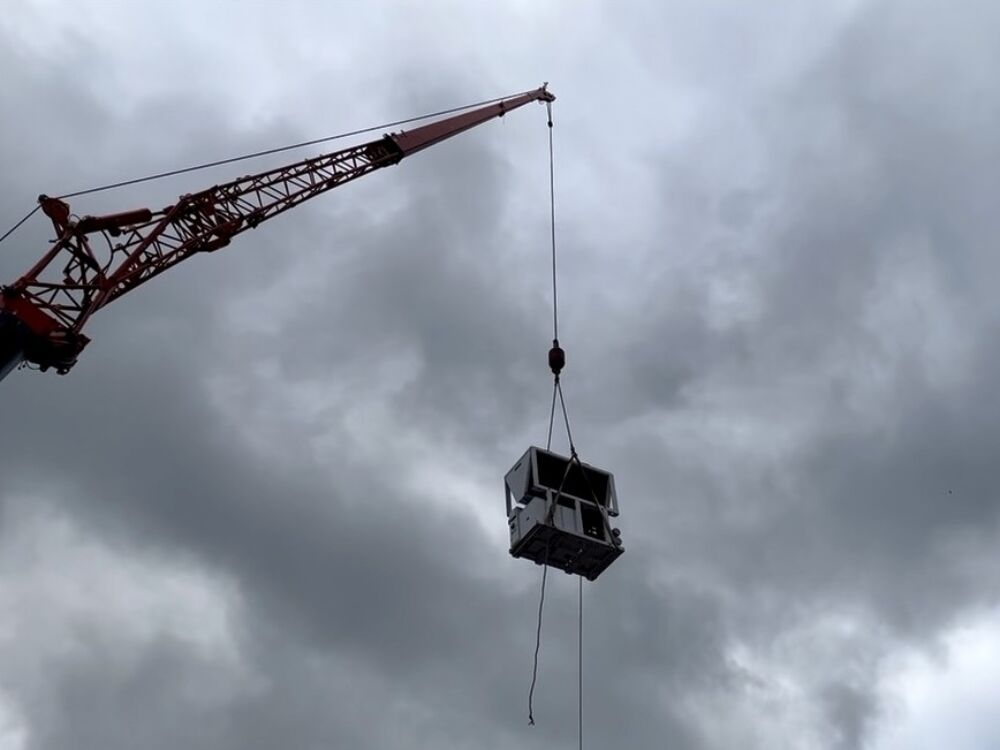
Cranes installing the new heat pumps on the roof of 420 Beekman Hill. Photo: Courtesy Randy Gerner
We’re all looking for role models
What’s stopping other homeowners from moving forward? We decided to get in touch to find out. Over a series of interviews conducted in partnership with Public Policy Lab, what we heard over and over is the desire for examples of work that is relevant and specific, essentially “role models” — buildings of a similar profile to their own that have already taken on energy projects.
That’s true for cooperators, building boards, and tenants in rental buildings. According to one homeowner we interviewed, “You need to find people that look like you. You need to find similar-shaped buildings, people, and [financial] profiles that these stories resonate with.”
Owners of rental buildings, too, need relevant examples that help them understand a path forward in the buildings they own. Said Eric Bluestone, of the Bluestone Group: “Being able to have somebody say, ‘I own a building that’s a similar size. Why can’t I do that?’… A‑ha moment.”
What’s next?
A lack of relevant information is a huge barrier to participation for would-be retrofitters. Skylight approaches this challenge through our rigorously researched, reported and fact-checked journalism, based in the belief that seeing is believing, and that deep understanding requires clearly-written, accessible resources. In the new year, Skylight plans to keep delivering stories that inspire and motivate. We’ll also be hosting more events like our first clean energy building tour, and continuing to collect data documenting the status of New York’s clean energy transition.
Our nonprofit newsroom is made up of an editorial team of four, along with a robust roster of freelance reporters who specialize in the clean energy housing beat. To date, we’ve engaged over twenty writers and fact-checkers, covered stories in over twenty buildings, and published over sixty articles documenting the clean energy transition in New York City apartments — and we’re just getting started.
The clean energy transition may not be assured in our city, but it is well underway. As this work continues, Skylight will be tracking it doggedly, reporting out what readers like you care most about. We hope you will see yourself reflected. Until then, keep reading, sharing, and tracking the transition along with us.