
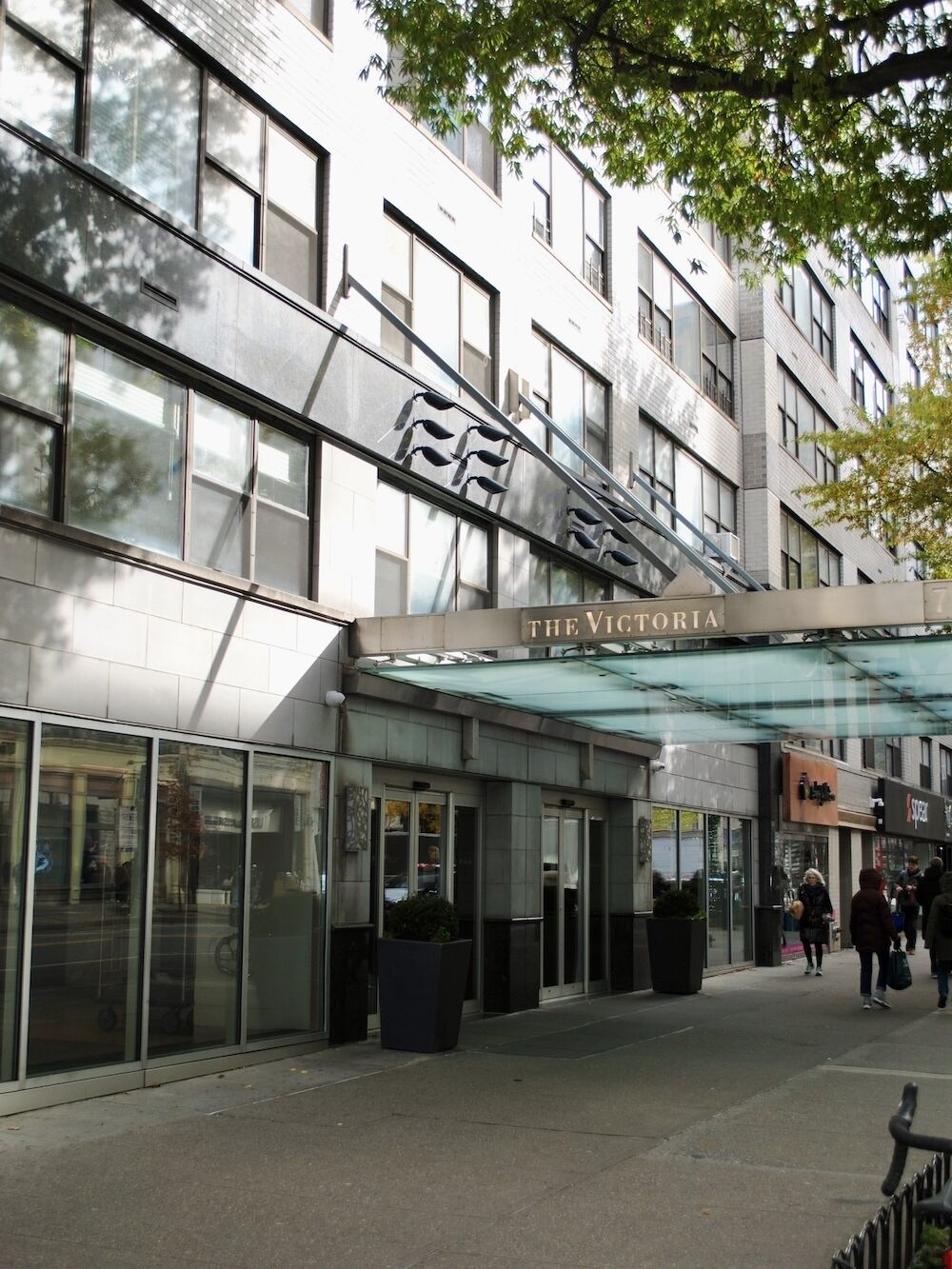
The entrance to the Victoria, a Manhattan co-op built in 1965, but with newly-updated heating and cooling systems. Photo: Hannah Berman
The Victoria, a large residential building in Union Square, has kept perfect time with LL97 requirements thanks to the forward thinking of its board.
Over the past three years, Amalia Cuadra, the senior director of engineering at EN-POWER GROUP, has been putting together an orchestra of sorts. Rather than violins and cellos and flutes, her instruments are heat pumps, efficient boilers and HVAC equipment. She’s used them all to build a harmony of energy efficiency at the Victoria, a 1960s white brick co-op building with about 500 units in the heart of Union Square in lower Manhattan.
“I’ve seen the chillers operate, I’ve seen the boilers operate, and now everything is going to be working together as an orchestra,” she said.
Cuadra’s symphony is now almost performance-ready. Largely hidden from view in the building’s mechanical room on the first floor are new modular water-source heat pumps. They stand stacked and ready to function as chillers, providing cooling for the building as temperatures start to rise in the coming summer months. They’re also connected to another system across the room — hot water tanks store domestic hot water for resident use. They will be warmed using heat sucked out of hot apartments in the summer by the cooling system. The heat pumps will still see a bit of action during the fall shoulder season, when they switch to heating mode to warm the building. And then as winter takes hold, new, efficient gas-fired hot water boilers will take over to heat homes and domestic hot water.
With a mix of electricity and natural gas-powered components, the hybrid electrification solution was the Victoria’s answer to compliance with New York City’s Local Law 97 (LL97), which mandates cutting carbon emissions over time. When the board found out in 2019 that it was subject to regulation, it had already been planning ahead — plumbing infrastructure badly needed to be replaced along with a host of other capital improvements, so members were prepared to fund the upgrades when they refinanced the building’s mortgage in 2021.
“We intend to make smart decisions for our shareholders,” said Corinne Arnold, president of the Victoria’s board. “It’s not all about moving to electric, it’s about making a decision based on a cost benefit analysis with all the local laws and planetary goals.”
Arnold, who became board president in 2019 and is currently running for the New York State Assembly, views these improvements as necessary to keep the building in both good financial and infrastructural health for decades to come. The board’s proactivity, along with a communicative management team and knowledgeable engineers, has contributed to the decarbonization efforts that reduce their annual energy costs. And more importantly, it will save on LL97 penalties to the tune of $300,000 per year after 2030 fines would have kicked in.
Hybrid harmony
With penalties on the horizon, common sense could point a blanket solution of fully electrifying a building’s HVAC systems. But, Cuadra points out, full electrification isn’t necessarily feasible for the Victoria, as with the majority of buildings EN-POWER works with. For such buildings with a central air system that delivers heating and cooling via fan coil units in each apartment, going fully electric doesn’t typically make economic sense. It can be wiser to decentralize these systems where possible, installing technology like package terminal heat pumps in apartments to both heat and cool the space.
After meeting with different engineering firms, The Victoria board decided EN-POWER GROUP would fit their needs best. Cuadra and the board ran through options and decided hybrid electrification would be the way to go. They decided as a group to remove the steam absorption chillers, which previously provided cooling, and replaced them with the modular heat pumps. The new pumps are neatly stacked in the mechanical room so the cooling system now runs completely on electricity. The heat pumps will also be able to provide heat in milder chilly temperatures, reducing the load on the natural gas-fired boilers.
Even though the building is still using gas, the new boilers are lightyears ahead of the previous iteration in terms of energy efficiency. The building previously used steam for heating and domestic hot water, as well as for cooling, making all the systems inefficient and expensive. Now, the boilers make hot water, which heats the coils in each fan coil unit; those in turn heat the air as the fan warms apartments in the winter — a delivery system more efficient than using steam.
The new boilers also make hot water to use for domestic hot water — but not all the time. It’s a process shared with the heat pumps during part of the year, thanks to a heat recovery system Cuadra implemented into the cooling system while the heat pumps operate in chilling mode. As chilled condenser water conditions the air in a fan coil unit and extracts the heat, that now-heated water is circulated to warm up the domestic hot water before being sent to the cooling tower — which won’t have to work as hard — to repeat the cycle. As long as systems work how they should, the Victoria shouldn’t have to use the boilers for hot water at all during the summer months when the chilling and heat recovery systems are active.
“We can turn off a piece of equipment and we’re making the cooling tower more efficient,” Cuadra said. “It’s really a win-win.”
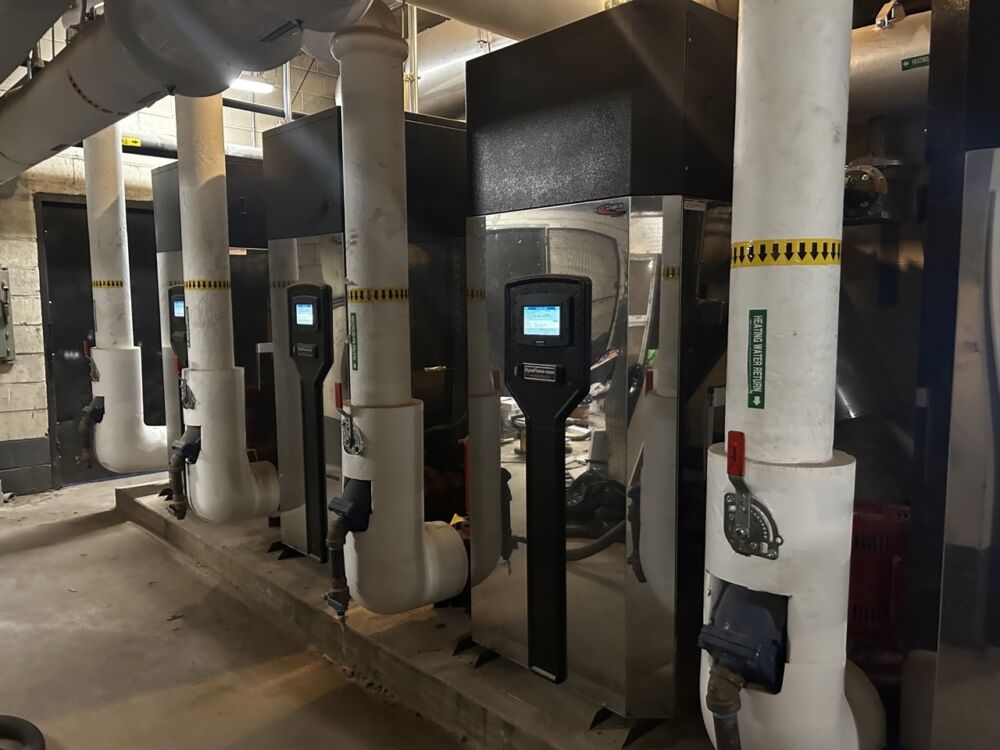
New hot water boilers at the Victoria run on natural gas, but they're much more efficient than the previous ones. Photo: Camille Squires
2026 will be the first year that all these new systems are operational at the same time. The final piece of the puzzle is the building management system (BMS), which is being installed presently, with a plan for it to be finalized in June. This computerized control system will keep tabs on the mechanicals throughout the building. It will allow both Cuadra and the management team to take a closer look at where and how much energy is being used across the HVAC system, producing a trove of data to see how well they’re working.
“That’s really the motherboard, it’s the brains behind everything,” Cuadra said.
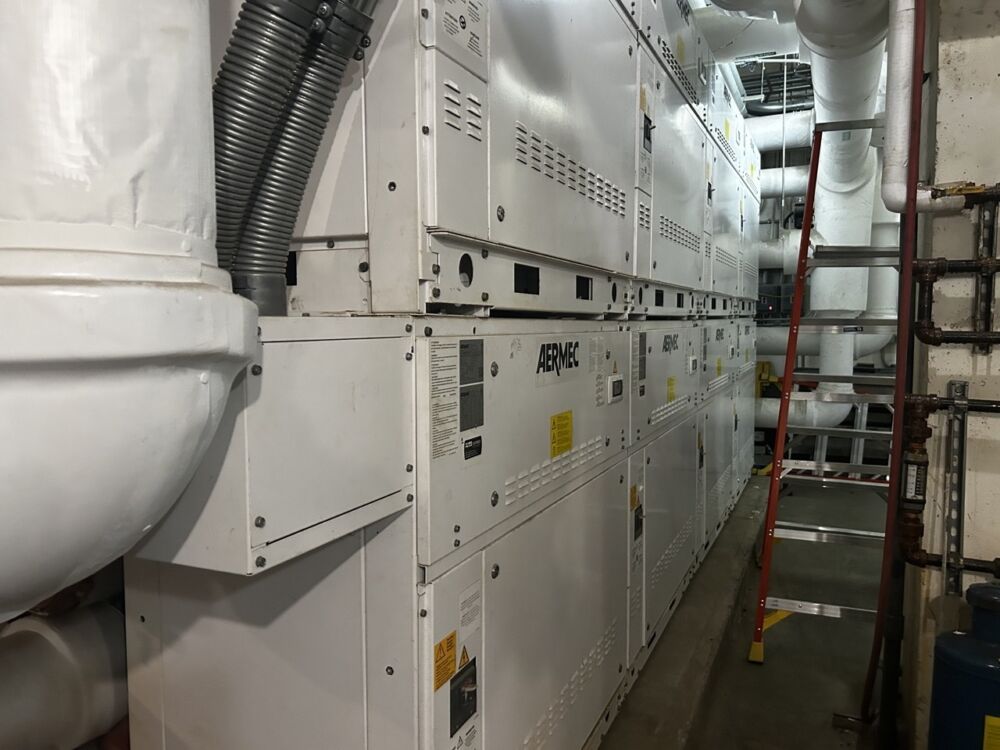
New modular heat pumps cool apartments during warm months, but also can provide heating during shoulder season. Photo: Camille Squires
Financial forte and human capital
The Victoria’s mortgage refinance in 2021 coincided with a historic drop in interest rates during the pandemic. It secured a $20 million interest-only loan at 2.38 percent with which it has been able to get good returns on investments. About $5 million has gone towards decarbonization work, with the remainder funding other projects including essential plumbing upgrades and even a new gym. But the board is also thinking ahead to when the mortgage payment will come due in a few years. To pay it off, the board plans to use the savings accrued from increased energy efficiency and only paying interest on their current loan.
“Now that all of these upgrades have reduced our energy and financial liability, we should see more cost savings, and we’re taking them and putting them towards mortgage repayment,” Arnold said. “We are just trying [to think] like five steps ahead.”
The work has qualified for a little over $1 million in incentives and rebates, mostly from Con Edison. The Multifamily Energy Efficiency and Building Electrification Program provides incentives of up to 70 percent of the cost of energy efficiency projects and up to 50 percent of the cost of building electrification projects, so a majority of the projects qualified. However, the amount can seem a bit like a drop in the bucket compared to what the building has spent to do the work. Arnold would like to see the city step up in more ways to help share some of these costs.
“It feels like the city should be participating more if they’re going to increase taxes and at the same time create all of these expenses,” she said. “Something has to meet in the middle.”
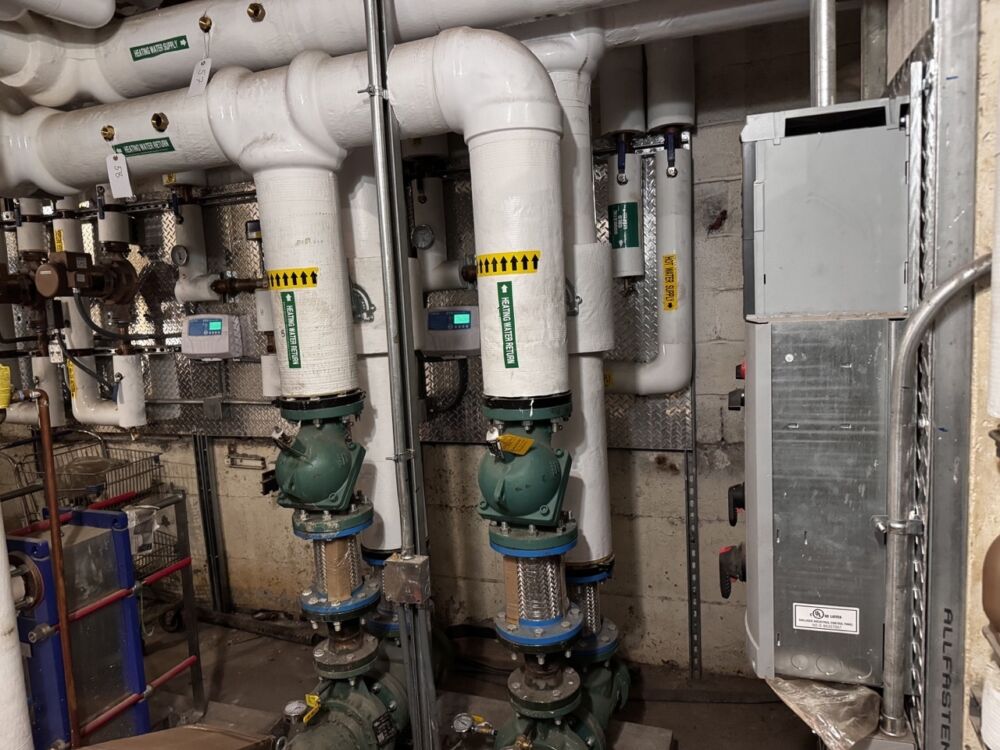
Return pipes bring hot water back to the mechanical room, where it's cycled back to the new heat pumps. Photo: Jaime Stock
The Victoria is now set up to pay nothing in LL97 fines through at least 2040, according to EN-POWER GROUP’s estimates. In addition to this, these measures will help decrease the building’s annual energy costs by about $288,000 annually.
While the financial capital made these projects possible, the human capital within the building has been instrumental in making them a reality. Arnold works closely with the management team, which includes a resident manager, building manager and on-site manager Angelina Curanovic, to communicate directly with shareholders about what’s going on, why it’s happening and what they can expect. The HVAC improvements haven’t drastically impacted residents’ day-to-day experiences of their apartments — they can still adjust temperatures to their comfort as before. But with multiple projects happening behind the curtain, straightforward and consistent communication has made it easier for the board and management to present a united front and avoiding different answers to the same questions from shareholders about all the changes happening in the building.
“The more information you give them, the better,” said Curanovic, the on-site manager at the Victoria. “In my opinion, the residents aren’t how they used to be — they have Google and ChatGPT available to them. They’re becoming more knowledgeable about what to ask, and it’s better to give them all the information up front rather than hold back.”
The depth of knowledge among the board and shareholders has also motivated people to be more involved throughout the process, according to Arnold. The board’s secretary, Robert Von Ancken, has a background in real estate as an expert appraiser, so he knows the value of getting this work done. He’s been part of efforts to educate shareholders about the impact of the upgrades with annual reports. Those reports will soon include hard data — once the BMS is in place — to illustrate for residents how all the individual pieces contribute to that symphony of efficiency that will continue to play for years to come.
“I want to upgrade the building to the point where it’s certainly going to enhance the overall value of the assets,” Von Ancken said. “You may not be able to see it because it’s all in the back room, but it makes a huge difference when you’re selling an apartment and you’re talking about the upgrades that you’ve put into the building; they’re not going to have these big expenses going forward.”