
“Does this place have good energy?”
What to ask about building emissions before you buy an apartment in New York City
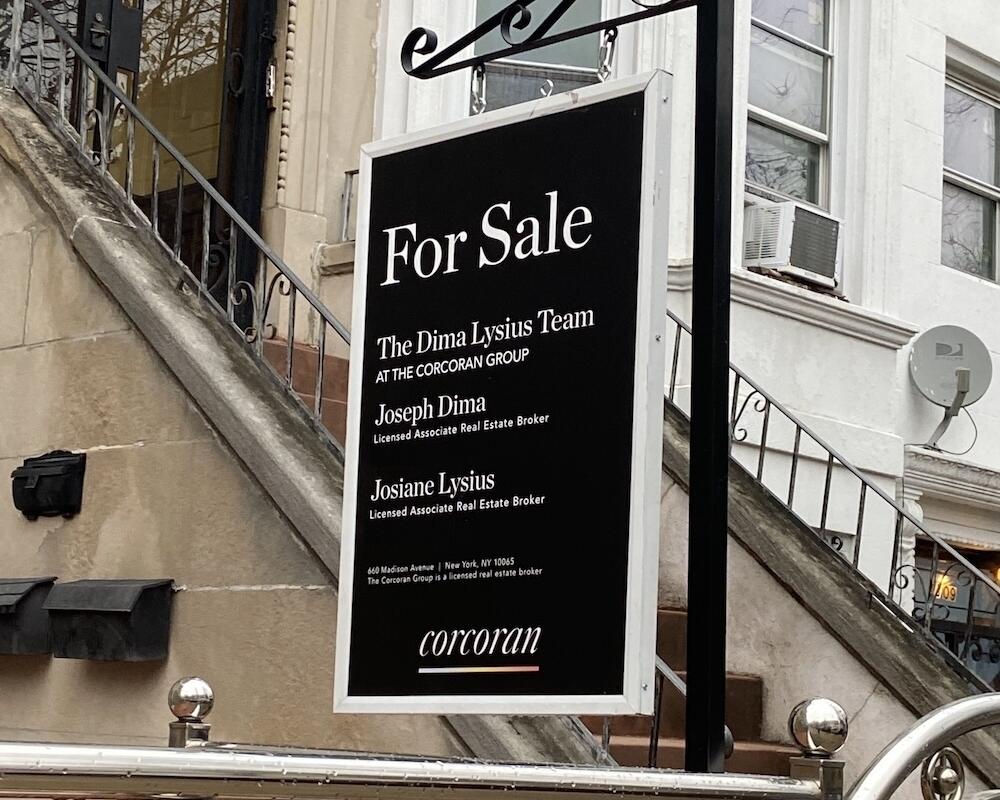
For Sale sign outside of a multifamily apartment building. Photo: Camille Squires
Buying an apartment in New York City is famously not a simple process — and in recent years, a suite of climate-focused city and state regulations have added additional considerations for potential homebuyers to keep top of mind, beyond things like south-facing windows and in-unit laundry. The New York City Climate Mobilization Act (CMA), a package of climate laws geared toward lowering emissions citywide, includes several components that directly impact apartment buildings. Key components of the law include requirements for energy audits (Local Law 87), green roofs or solar panels (Local Laws 92, 94), the phasing out of specific fuel types (Local Law 32), and more.
For most apartment buildings, the more significant aspect of the CMA is Local Law 97 (LL97), which mandates caps on building emissions for buildings over 25,000 gross square feet (you can read more about the law in our explainer here). These emissions caps tighten over time, with fines for non-compliance or late reports.
What does that mean for building and apartment owners? LL97 will certainly have broad, longer-term positive impacts on New Yorkers — public health improvements, more resilient housing, and a more sustainable future. But in the meantime, it will be the responsibility of individual buildings to make significant updates and upgrades to their infrastructure in order to comply with the emissions limitations set for the next milestone in 2030 — and beyond. These costly improvements can range from new heating and cooling systems to energy-efficient windows, new insulation, or even new exterior cladding.
Current and future homeowners in covered buildings will almost certainly be impacted by higher maintenance charges, capital assessments, and more. For those on the hunt for a new apartment, here are some key questions to ask during the search:
1. Is this building subject to Local Law 97?
The first, most important question is whether these regulations even apply, based on a building’s size. The answer here may be an obvious “no” if a buyer is looking at a smaller building, like a brownstone or a walk-up. But any building 25,000 square feet or larger is subject to the law. This designation roughly aligns with a mid-sized New York City apartment building: A six- or seven-story elevator building on a 50×100 foot lot would be just about 25,000 square feet. Before visiting a potential building, it may be worth doing research beforehand, especially because there are some caveats to the law’s applicability. You can look up whether any building is subject to LL97 on the city’s covered buildings list here.
2. What’s the building’s current status in terms of LL97 compliance?
Compliance with LL97 is not something that a buyer can confirm from public real estate listings alone, and there are no laws that state that a seller must disclose this information. In fact, the average owner may or may not be aware of the details of compliance, energy audits, or fines. Buyers will likely need to rely on their real estate agent or attorney to find out this information through board minutes, monthly fees history, the review of past annual emissions reports, and more, cautions Samantha Michel, a licensed real estate salesperson at KWNYC: “In estate sales, for example, the executors may have limited knowledge of building finances; they’ve simply inherited the unit, so I recommend not relying solely on what’s disclosed upfront.”
It is possible to confirm a building’s current or projected penalties for LL97 using different online tools, such as reviewing the “Penalties Owed” button after searching for a building’s address in the Department of Buildings’ portal, DOB Now. Active penalties or violations (but not past ones) are noted by filtering through various local laws. NYC Accelerator also provides specific information about your building’s energy use and LL97 compliance status, but since the information is “projected,” rather than actual, it’s still best to directly request information such as LL97 emissions reports, energy audits for LL87 (more on that below), and board meeting minutes.
3. Is this building subject to Local Law 87? Has an energy audit been done?
Local Law 87 (LL87) requires that large buildings (over 50,000 square feet) complete an Energy Efficiency Report every ten years, starting in 2009. If a buyer is looking at an apartment in a large building, the completion of these reports contextualizes the building’s existing systems performance through an energy audit and retro-commissioning, which ensures that existing systems are properly calibrated and functioning as intended. Compliance with LL87 means filing the reports with an energy professional every ten years and performing the retro-commissioning of building systems, so it typically does not have the same financial impacts as the implications of LL97 (although there are fines for late reports or non-compliance). However, it is helpful to review these reports because of what they note about the state of existing systems.
4. Are there any plans in place to address Local Law 97 requirements?
A building might currently be in compliance and have no need for any present improvements or upgrades. However, as John Walkup, co-founder of New York-based real estate analytics company UrbanDigs explained, “The 2024 caps were meant to be lenient, but in 2030, the caps shrink, so a building that’s okay today could face stiff penalties down the road.” Potential buyers will want to know if the board or building management is forward-looking with a plan in place to address any future required upgrades.
5. What kind of approvals or agreements from the board are needed in order to set assessments, enact capital projects, or levy maintenance increases? What is their approval process like?
Both infrastructure planning and cost increases are typically decided upon by the co-op or condo board, and it can be helpful to understand what their decision-making process is like. Buyers should look at how many people comprise the board, how frequently they meet, whether decisions need to be unanimous in order to be approved, and how these decisions get communicated to residents. Buyers may even want to review the background of board members — do any have experience or expertise in engineering, capital projects, or related sectors? Or does the board rely entirely on outside consultants or others to assist in decision-making?
6. What are the current heating and cooling systems?
Understanding the basics of how a building is heated or cooled is a helpful way to understand a building’s potential vulnerability to LL97 caps, because heating systems are the biggest factor in a building’s carbon footprint.
Most prewar and mid-century buildings in New York City have a central oil- or gas-powered boiler with steam or hot water radiators providing heat to apartments; domestic hot water is usually gas-fired. The worst culprits are typically oil-fired systems, particularly ones that run on #4 oil (which is being phased out under LL32), because their high combustion emissions count towards the LL97 calculation. If a building has equipment that runs on #4 oil, buyers should anticipate upcoming replacement costs and possibly also conversion to an all-electric heating system, which would replace the on-site combustion of fossil fuels with electric-powered equipment.
Many buildings are looking to convert to all-electric systems for several reasons. These systems remove or reduce reliance on oil- or gas-powered equipment, and are also extremely efficient: They transfer heat rather than generate it through combustion, and often cooling can be provided by the same equipment. However, electrification is not a simple swap: Installing heat pumps and other equipment typically requires an upgraded electrical service, new electrical distribution panels, increased electrical riser capacity, and sometimes also exterior envelope improvements that enable heating systems to operate efficiently during cold weather. If this type of conversion is in the works or is forthcoming, residents can expect initial fees to offset the work, but a more cost- and energy-efficient system in the long run.
7. Are there any LL97-related projects going on right now?
Ongoing LL97 projects can be a good indication that the building is trying to get ahead of future fines. However, buyers should understand what is happening upon move-in. Some upgrades may have minimal impact on a resident’s day-to-day life, like LED fixture replacements in mechanical spaces. Others would be something to plan around — a window replacement project starting just as a new resident is about to hang their curtains, or the installation of heat pumps in every unit just as someone is preparing to move in could prove much more disruptive.
8. Is there a resident superintendent or regular maintenance contracts with companies that can ensure equipment is functioning efficiently?
Maintenance is one of the most important factors when it comes to the longevity and efficiency of heating and cooling equipment; this is what LL87 is trying to target. It’s important to know who is responsible for making sure equipment is running the way it’s supposed to: Outside consultants? A building engineer? No one? A buyer may also consider viewing places like the basement or a rooftop mechanical bulkhead; while engineering expertise and hands-on testing are required to determine equipment efficiency, a clean and well-kept mechanical room is a sign that the equipment is well cared for and maintained.
9. When was the last time the windows and HVAC systems were updated or replaced?
Gilbert Michaud, PhD., a professor at Loyola University Chicago whose work focuses on renewable energy policy and energy efficiency, recommends asking this question because of the implications of older infrastructure. Older equipment tends to be less efficient, making a building more susceptible to higher emissions — and potential replacement costs through assessments or increased monthly maintenance in the future.
10. How does the building or board plan on paying for any required upgrades? What would be the timeline for any associated cost increases?
Many buildings do not have funds in their reserves to immediately and directly address the large-scale upgrades that might be required in order to comply with upcoming LL97 emissions caps. New, energy-efficient mechanical equipment can easily cost several hundred thousand dollars, and building-scale retrofits can easily cost in the millions. Homebuyers should be aware that coops and condos will likely handle upgrades through different financial vehicles. “Will it be a one-time assessment, a monthly one with an end date, or an increase in maintenance?” asks Veronique Perrin, a real estate agent at Coldwell Banker Warburg. A buyer might find a short-term charge acceptable if it means new heating and cooling sensors or new windows, while a long-term maintenance increase that will only continue to grow in the future may be less appealing. A lack of clarity about costs and timing should be a red flag that the building has not done enough planning.