
Skylight takes New Yorkers behind the scenes of the Victoria’s energy-efficient renovation
A recap of Skylight’s latest clean energy building tour, hosted in partnership with EN-POWER GROUP.
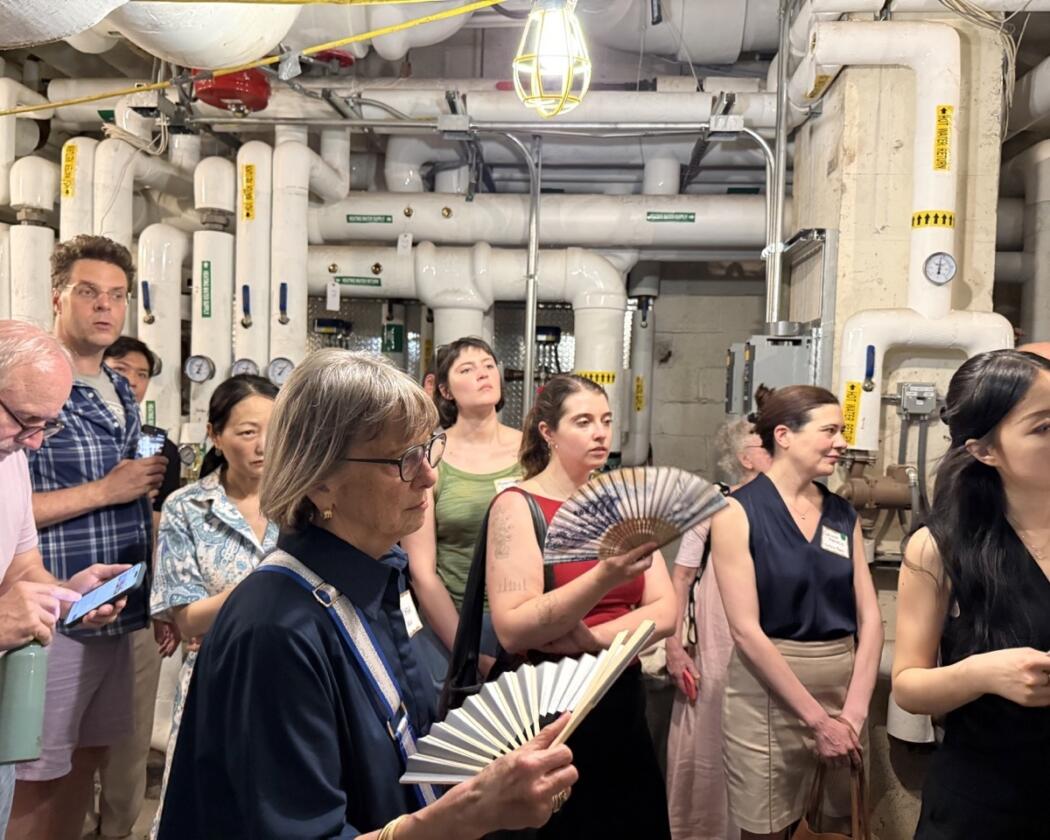
Attendees of Skylight's clean energy building tour at the Victoria listen attentively to experts detailing the building's upgrades. Photo: Eric Lee
On the evening of May 19, Skylight hosted their second clean energy building tour at the Victoria, a large co-op building down the block from Manhattan’s bustling Union Square. Building on the success of the first tour, hosted at the Charlton House in the fall, the event was an opportunity for attendees to see up close the mechanical upgrades the building made to improve energy efficiency, guided by expert engineers and residents who oversaw the work.
The sold-out event, co-hosted by EN-POWER GROUP, the engineering firm that led the work at the Victoria, was attended by over 30 New Yorkers; a mix of co-operators and clean energy enthusiasts, all eager to learn about how the building had been responding to Local Law 97 (LL97) requirements.
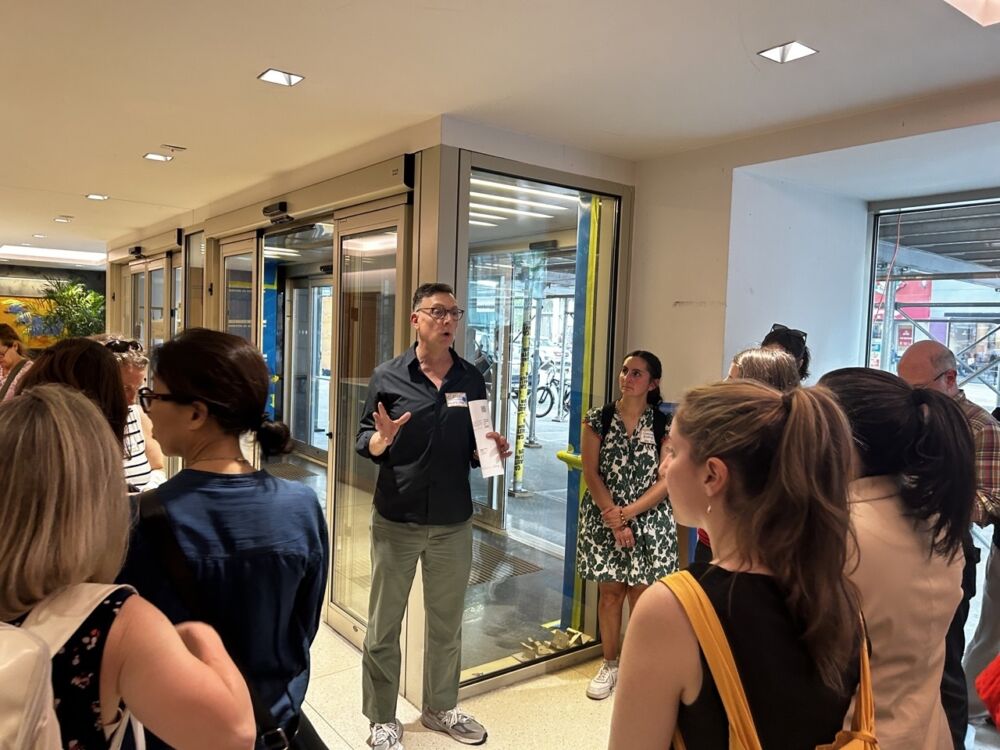
Skylight founder Eric Lee offers an introductory message to building tour attendees. Photo: Camille Squires
Skylight founder Eric Lee opened the evening by grounding the crowd in Skylight’s mission. The problem, he noted, isn’t that people don’t believe it is important to decarbonize their buildings — most New Yorkers align with the principles undergirding the city’s Climate Mobilization Act. But as the actual work comes before us, Eric explained, “New Yorkers are finding that it’s a daunting task, the work is expensive and it’s technically complicated.” And as this work falls on the shoulders of regular New Yorkers responsible for the management and operation of their buildings, he continued, “suddenly we are having to learn a whole lot about new technology and building systems.”
Skylight’s hope is that “we can learn from one another, see the work that people are doing right now, and all get going faster with the actual reduction of carbon emissions [in apartment buildings].”
Next up was a prime example of a “doer,” Corinne Arnold, the board president of the Victoria. Arnold told the story of how the building got to where it is today. When LL97 first passed, the building initially wanted to be a pioneering “first mover” and go fully electric. But after consulting with several engineering firms, the board held back — not because they didn’t believe in the work, but because the numbers didn’t add up. The engineers they spoke to understood the technical side, but not the financial. For a co-op, Arnold stressed, every decision is a financial one, and the costs of full electrification were just too much. The building’s money belongs to its shareholders, and any project has to make sense as a long-term investment, not just as an energy play. It wasn’t until they met EN-POWER GROUP that they found a firm that understood both sides of the equation.
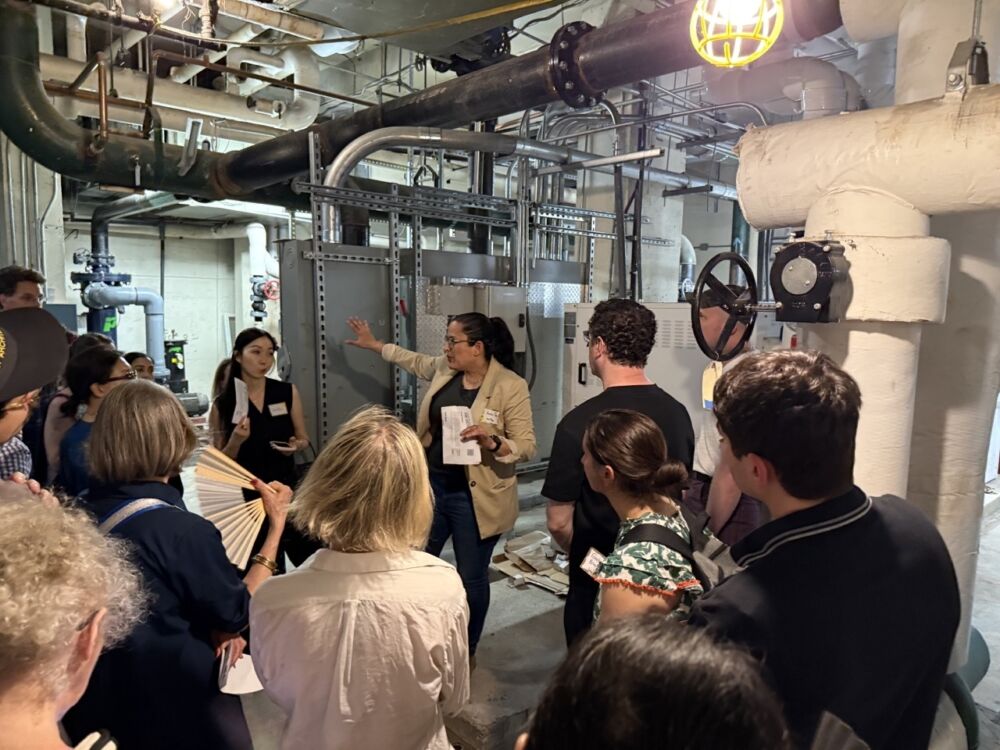
EN-POWER GROUP senior director of engineering Amalia Cuadra explains to the group how the building's new modular heat pumps function. Photo: Eric Lee
Arnold then handed off to Amalia Cuadra, senior director of engineering at EN-POWER GROUP who oversaw the project from start to finish. Cuadra opened with a description of what the building looked like before any of the work began: two large steam boilers handling many systems at once — boiling water to make steam for heating, domestic hot water and also using the steam to power the cooling system. “It doesn’t take a genius to know that’s really inefficient,” she said. She then walked the group through the scope of the work EN-POWER had undertaken: a full electrification of its cooling plant, new high-efficiency boilers, and significant plumbing upgrades, coordinated across seven contractors over several years. With that overview in place, the group headed downstairs to see it for themselves.
The first stop was the boiler room, where the scale of the transformation was immediately visible. Where the two aging steam boilers once sat, four compact, high-efficiency condensing boilers now stood. Three boilers are enough to heat the entire building, Cuadra explained, with the fourth kept in reserve. The building has just come through its first full winter with the new setup. “We did not get complaints,” Arnold noted — notable, someone pointed out, given how cold this past winter actually was. Now, with summer approaching, the team was gearing up to test the cooling system for the very first time.
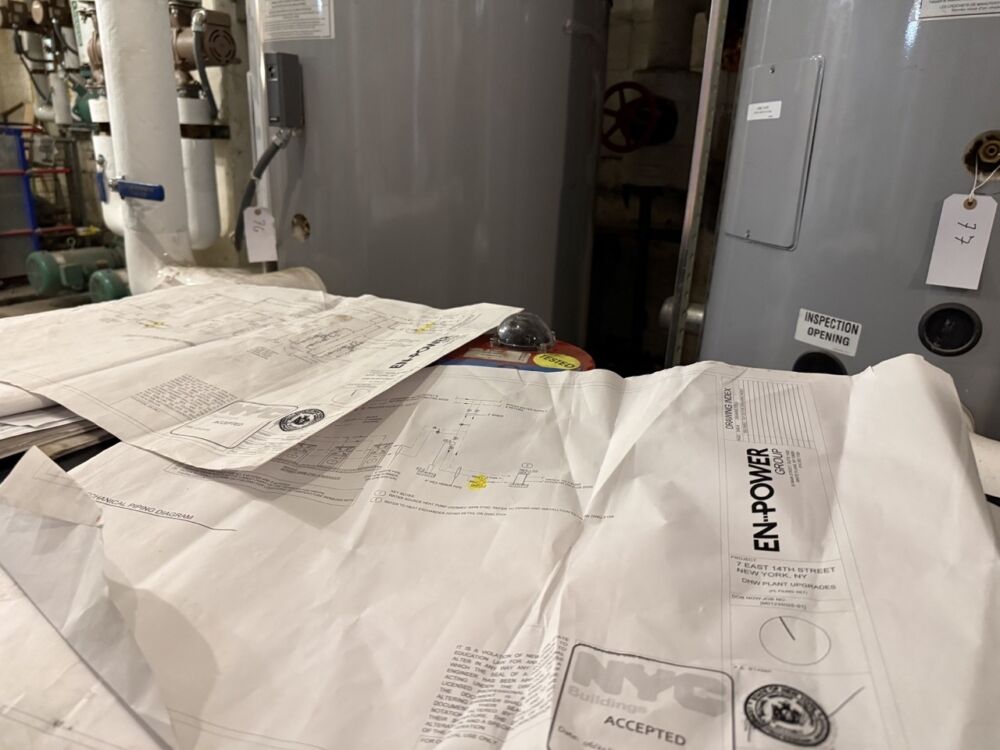
Engineers from EN-POWER GROUP managed the project at the Victoria across three years and several contractors, requiring lots of planning. Photo: Jaime Stock
The tour split in two, and Cuadra led half the group to the chiller room, where the new cooling system was installed. The building’s old steam absorption chillers have been replaced by sixteen modular electric units — more than ten times more efficient than what they replaced, and capable of providing heat during shoulder seasons as well as cooling in summer.
Meanwhile, EN-POWER mechanical engineer Savan Patel led the other group to the electrical room, which has been almost completely rebuilt as part of the broader overhaul — a behind-the-scenes upgrade that made many of the building’s other projects possible.
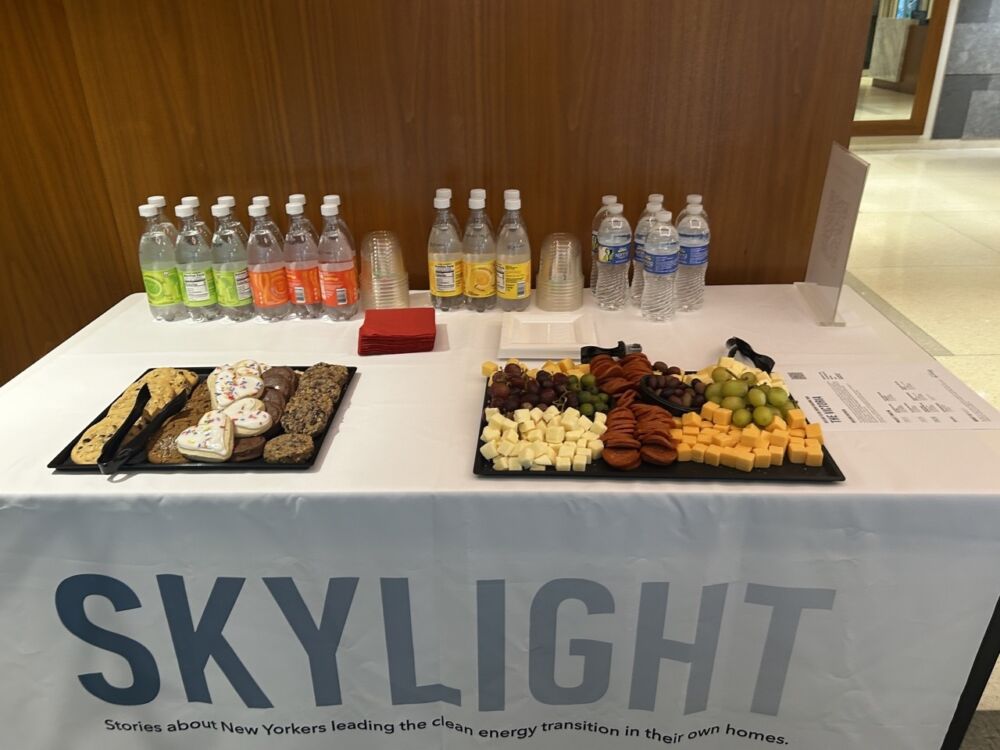
The event concluded with refreshments and fruitful conversation among the attendees. Photo: Camille Squires
The tour concluded with drinks and snacks in the lobby. It was, by all accounts, a warm ending to a warm evening — the crowd lingered after the formal program had wrapped, still exchanging cards, tales of trials and wins, and comparing notes on their own buildings. One attendee commented that Skylight was “doing God’s work” in showing what successful solutions look like in a building much like her own.
The tone of the evening was dictated by the spirit of the work at the Victoria, which proves that pragmatism need not come at the expense of meaningful improvement. Corinne Arnold and her board didn’t set out to be heroes of the clean energy transition — they set out to make a good investment for their shareholders. That they ended up doing both is the point. For the thirty-odd New Yorkers who came out on a Tuesday night to walk through a boiler room and talk about efficiency ratings, that was more than enough inspiration to take home.